
Mark Kirk
last updated: April 12, 2018
Please note: The Militarist Monitor neither represents nor endorses any of the individuals or groups profiled on this site.
Government
- Senate: R-IL, 2011-2016
- House of Representatives: R-IL, 2001-2010
- U.S. Naval Reserves: Intelligence Officer, 1989-
- U.S. State Department: Special Asisstant to the Assistant Secretary of State, 1991-1993
- House International Relations Committee: Counsel, 1995-1999
Education
- Cornell University: B.A., History
- London School of Economics: M.A.
- Georgetown University Law Center: J.D.
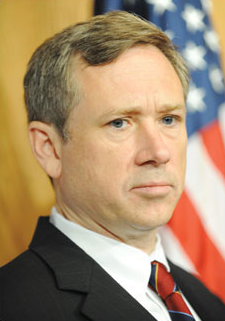
Sen. Mark Kirk (R-IL) was a leading Senate hawk on the Middle East as well as one of the Republican Party’s more moderate voices on social policies. A vocal advocate of stiffening sanctions on Iran, Kirk also championed hardline policies on Iran and the Israeli-Palestinian conflict during his tenure.[1] He was defeated in the November 2016 elections by Democratic challenger Rep. Tammy Duckworth.
After his electoral defeat, Kirk was out of the spotlight for several months, until announcing, in June 2017, that he would be joining the advisory board of United Against Nuclear Iran (UANI), a neoconservative advocacy organization that pushes for confrontation with Iran.[2] At a dinner in his honor, Kirk made it clear that at UANI he would pursue an aggressive stance not only on Iran, but on North Korea. Speaking at the event just outside of Chicago, Kirk said, “A point that cannot be said often enough by our current administration … is that the missile program of North Korea and the nuclear program of Iran are the same program. When you send money to Iran, you’re basically sending money to North Korea’s biggest partner in the nuke and missile business. You cannot do that.”[3]
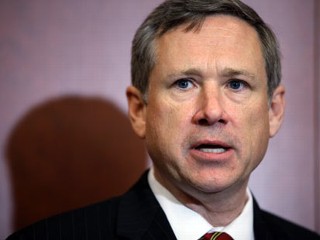
An officer in the U.S. Naval Reserves and a former five-term House member, Kirk was one of Congress’ top recipients of donations from “pro-Israel” advocacy groups, leading one critic to call him “AIPAC’s Million Dollar Baby.”[4] A writer for Salon described Kirk as “about as neoconservative as they come.”[5]
A vociferous opponent of Donald Trump, Kirk once argued that the real estate magnate was “too bigoted and too racist” to be president.[6] Yet, in the wake of Trump’s 2016 election victory, Kirk expressed optimism about the prospects of the new president’s foreign policy, saying that he was “very happy” with Trump’s decision to select retired Marine Gen. James Mattis to be Secretary of Defense and retired Lt. Gen. Michael Flynn as his national security adviser.[7]
Since leaving the Senate, Kirk has continued his advocacy of hardline U.S. foreign policies. During a joint United Against Nuclear Iran and Jewish Institute for National Security Affairs briefing in early 2017, Kirk pressed the Trump administration to turn up the heat on Iran. He focused attention on ways to attack the Iran nuclear agreement, including “declassifying” the entire deal: “The best thing the Trump administration can do is declassify the entire agreement and publish it so the Congress and the American people can look at it and see the negotiating record and understand all of the terms as they were put forward before the parties.”[8]
Iran
Kirk was a leading proponent in the Senate of increasing pressure on Iran over its nuclear program, once arguing that “it’s okay to take the food out of the mouths” of Iranian citizens because of their government’s actions.[9]
Since leaving the Senate, he has continued to rail against the Iran nuclear deal and pushed for an aggressive stance against Iran. In March 2018, Kirk wrote, “It’s in our mutual self-interest for America and Israel to join together against Iran, which seeks regional dominance and is an avowed enemy of both our nations. Our first step should be to effectively eliminate the Iranian threat from war-ravaged Syria.”[10]
Kirk has also linked the issues of Iran and North Korea in an apparent attempt to increase the pressure on the Trump administration to take a more aggressive, even militant, stance on both countries. “To show both North Korea and Iran that their actions are untenable, the Trump administration must follow through on its promise to impose further sanctions on those found to have helped Iran and North Korea share military technology,” Kirk wrote in December 2017. “The administration should also consider a policy to intercept and destroy ICBMs headed toward the U.S. or our allies in the Western Hemisphere. Further, with the Iran deal in limbo, multiple shortcomings must also be addressed. The U.S. needs to make clear that extraterritorial actions by Iran to share its military and nuclear technology is forbidden and subject to the agreement’s sanctions “snap-back” mechanism. In relation, the deal’s restrictions on Iran need to apply to more than just its domestic nuclear program.”[11]
In July 2015, after the successful negotiations between Iran and leading world powers (the P5+1) on a comprehensive nuclear deal, Kirk proclaimed that “tens of thousands of people in the Middle East are gonna (sic) lose their lives because of this decision by Barack Hussein Obama.” He wildly added that what President Obama really wanted was “to get nukes to Iran.”[12] In a July 2015 interview with a Boston-based radio station, Kirk characterized the nuclear deal as the “greatest appeasement since Chamberlain gave Czechoslovakia to Hitler.”[13]
In the lead-up to a November 2014 negotiations deadline on the nuclear deal, Kirk and fellow Iran hawk Sen. Robert Menendez (D-NJ) argued that “a good deal will dismantle, not just stall, Iran’s illicit nuclear program.” Kirk and Menendez also threatened “to work” with their “colleagues in Congress to act decisively” if a deal emerges that does not meet their standards, including imposing “stringent limits” on Iran’s nuclear program that will last “for decades.”[14]
In 2015, after Menendez was indicted on federal corruption charges related to his relationship with a Florida businessman, Kirk suggested that Menendez was targeted by the Justice Department because of his views on Iran.[15]
Although he opposed negotiations with Iran, Kirk repeatedly urged President Obama to link talks to the release of Americans held in Iran.[16] However, in late 2016, amidst accusations that U.S. payments to Iran as part of the nuclear deal were really “ransoms” to get Americans released, Kirk appeared to abandon his former position, saying in a September 2016 radio interview: “We didn’t have to get our guys back. We shouldn’t have paid the ransom.”[17]
In November 2013, shortly before Iran and the P5+1 reached an interim agreement that saw Iran cap its enrichment at low levels only allowing for the production of nuclear power and submit to intrusive inspections in exchange for partial sanctions relief, Kirk told reporters that he was working closely with the American Israel Public Affairs Committee to push new sanctions through the Senate. Kirk also launched unusually personal attacks against the Obama administration diplomats charged with shepherding the deal, deriding them as political appointees who “desperately want[ed] a New York Times article saying how great they are.” Comparing himself to the famous Copernican scientist who was persecuted by the medieval Catholic Church for his beliefs, Kirk concluded, “Now I know exactly what Galileo felt like when he was dragged before the papal court.”[18]
Kirk argued that more sanctions were necessary to get Iran to agree to a deal, even as talks were already underway between U.S. and Iranian negotiators—an approach that critics warned would have sunk any prospects for a deal.[19] Invoking a common neoconservative analogy likening the U.S. standoff with Iran to the run-up to World War II, Kirk at one point complained to reporters that “This administration, like Neville Chamberlain, is yielding a large and bloody conflict in the Middle East involving Iranian nuclear weapons that will now be part of our children’s future. And the best way to prevent that from happening is to continue sanctions.”[20]
Kirk’s remarks followed a supposedly confidential hearing in which Secretary of State John Kerry urged the Senate Banking Committee to let the negotiations proceed before considering new rounds of sanctions. Kirk claimed that Kerry had told him to dismiss an Israeli assertion that a proposed interim agreement between Iran and its international negotiating partners would only delay Iran’s enrichment activities by 24 days. “The pitch was very unconvincing,” Kirk said. “It was fairly anti-Israeli. I was supposed to disbelieve everything the Israelis had just told me, and I think the Israelis probably have a pretty good intelligence service.”[21]
“So,” observed former CIA analyst Paul Pillar in response to Kirk’s claim, “a United States senator was calling the U.S. secretary of state and the vice president liars because of what a foreign government had told him.” Pillar called Kirk’s advocacy for the Israeli government’s position “the most extreme form of any member of Congress, to the point of being a caricature,” and accused Kirk of “doing everything he can to overturn a diplomatic process designed to prevent both a war and an Iranian nuclear weapon.”[22]
Kirk also directed a barb at Iranians. “How do you define an Iranian moderate?” he asked reporters. “It’s an Iranian who is out of bullets or out of money.”[23] The quip drew a swift condemnation from the National Iranian Affairs Committee (NIAC). “The 18 million Iranians who defied the odds and voted for change in this year’s presidential elections might take issue with Senator Kirk’s insulting characterization,” said NIAC policy director Jamal Abdi, referring to the election of Iranian President Hassan Rouhani, who campaigned in 2013 on reaching a diplomatic accord with the West. “Kirk has been more effective than any regime hardliner in convincing the Iranian people that, no matter what they do, the U.S. government will stand against them.”[24]
“Making ignorant and belligerent comments about Iran has now become a form of Republican electioneering,” quipped a writer for the American Conservative. “If this is what passes for foreign policy thinking among top Republicans, the party is in a very bad way.”[25]
Previously, Kirk co-authored, along with Sen. Joseph Lieberman (I-CT) and Sen. Robert Menendez (D-NJ), Iran sanctions legislation that passed the Senate in late November 2012. According to the Wall Street Journal, the sanctions, which were attached to the National Defense Authorization Act, “target Iran’s energy, shipping and shipbuilding sectors, already in the sights of U.S. sanctions. But the legislation goes further, restricting trade with Iran in precious metals, graphite, aluminum and steel, metallurgical coal and software for integrating industrial processes.”[26]
In 2011, Kirk spearheaded a campaign aimed at pressuring President Obama to adopt Iran sanctions that observers argued Tehran could interpret as an act of war. The proposed sanctions, targeting Iran’s central bank, were supported by most Senate members and applauded by key elements of the “pro-Israel” lobby, including the American Israel Public Affairs Committee (AIPAC). In a press release, the organization stated: “AIPAC applauds today’s bipartisan letter—signed by 92 U.S. Senators—to the administration urging it to sanction the Central Bank of Iran (CBI), or Bank Markazi. The letter, spearheaded by Senators Charles Schumer (D-NY) and Mark Kirk (R-IL), notes that the CBI lies at the center of Iran’s strategy to circumvent international sanctions against its illicit nuclear program.”[27]
Kirk was also a leading supporter of the 2009 Iran Refined Petroleum Sanctions Act, which according the Congressional Research Service would prevent the United States “from providing credit, insurance, or guarantees to any project controlled by any energy producers or refiners that contribute significantly to Iran’s refined petroleum resources.”[28] Although loudly promoted by Kirk and other hardline “pro-Israel” figures,[29] the bill was sharply criticized by many observers, who claimed it would “hurt the Iranian people while having little effect on the leadership sanctions are supposed to put pressure on; undermine the Obama administration’s attempts at engagement with Iran under a multilateral negotiating framework; and isolate the U.S. by antagonizing crucial allies in the UN Security Council.”[30] A version of the bill was eventually passed and signed by President Obama in July 2010.[31]
On Israel
Kirk’s hardline stance on Middle East issues, which included supporting the 2003 invasion of Iraq, earned him considerable support from “pro-Israel” donors.[32] According to data collected by OpenSecrets.org, Kirk was a top recipient in the House of campaign contributions from political action committees (PACs) that support Israel.[33] Kirk has said that ensuring “the survival of the state of Israel in the 21st century” was “the reason why I ran for the Senate” in the first place.[34]
Kirk has maintained the stances he held while in Congress that so endeared him to supporters of the Israeli right wing. Former Israeli Defense Minister Moshe Ya’alon spoke at a 2017 event near Chicago honoring Kirk: “I can think of no one more deserving of such an occasion than Mark. I’m lucky enough to call him a colleague—a personal friend whose advice and wisdom I continue to cherish. The bond that we have is one of brothers in arms. We are both military men who have fought in some of the world’s darkest corners. Mark understands what it is to risk everything for the sake of your country and for the sake of freedom.” Speaking about Kirk’s level of understanding of the Israel-Palestine conflict from the Israeli right’s point of view, Ya’alon remarked, “He gets it.”[35]
Despite acknowledging that Israel received, at the end of 2016, a ten-year, $38 billion commitment from the United States in military aid, Kirk said much more was needed. “With growing conflict in the Middle East, Israel will be looking to the U.S. for more aid than ever before. And as a reliable ally, the U.S. should readily back Israel in its efforts to dispel the increasing tensions.”[36]
In 2009, M.J. Rosenberg, a writer who formerly worked as an editor for AIPAC, said of Kirk, “Why do the PACs love him? It is because Kirk is a pure Israel-firster. For Kirk, Israel can do no wrong. Add to that that he sits on the House Appropriations Subcommittee on Foreign Operations where he brings home the bacon for Israel big time … I would not categorize him as pro-Israel because that would require supporting an end to the deadly status quo. Mark Kirk is just pro-AIPAC and shaking the trees for all the campaign money he can get by his hate rhetoric about Arabs. Playing like he’s ‘pro-Israel’—and not just pro lobby—has paid off very very well for him.”[37]
Kirk has drawn other criticism for his strident views on the Israeli-Palestinian conflict. At a Washington rally for Israel held during the invasion of Gaza in early 2009, Kirk said, “To misquote Shakespeare, something is rotten in Gaza and now it’s time to take out the trash.” A U.S. military veteran commented on Daily Kos, “People who throw around such cavalier remarks have never watched a civilian bleed to death on a battlefield after being cut down in the crossfire. To people like Congressman Kirk, combat doesn’t involve real people in real situations. Just numbers, ideologies, terrorists, and ‘trash.’ It’s the same reckless attitude that birthed George W. Bush’s ‘bring ’em on’ statement and many others like it.”[38]
Kirk’s hardline views on the Middle East were also in evidence in his opposition to the nomination of Chas Freeman to a key intelligence post in the Obama administration. Freeman, a highly regarded diplomat and scholar of Middle East issues who has spoken out against one-sided U.S. support for Israel, eventually withdrew his nomination in early 2009 because of the uproar over his views, which was led by a number of high-profile neoconservatives, including former AIPAC official Steven Rosen.[39] Kirk contributed to the opposition by co-authoring a letter with Rep. Steve Israel (D-NY) that pointed to Freeman’s business dealings as raising potential conflicts of interest, which was one of several attempts by opponents to call into question Freeman’s patriotism.[40]
Other Issues
Kirk is a moderate on many social and domestic issues, generally supporting abortion rights, gay rights, and some efforts to combat climate change.[41]
But Kirk has also supported a number of controversial domestic policies, especially on immigration. In a statement released shortly after Kirk announced his Senate candidacy in July 2009, the Chicago office of the Council on Islamic-American Relations (CAIR) stated, “In 2005, Kirk stated that he was ‘Okay’ with racial profiling directed at Arab males from ‘terrorist-producing states.’ Kirk notably voted in favor of many anti-immigrant bills proposed in Congress, including the infamous Sensenbrenner bill (HR-4437), which would have made criminal felons of priests, nuns, doctors, teachers, and even family members who helped undocumented immigrants. He has also come under fire from immigrant rights groups after indicating that he supports family planning as a way to curb Mexican immigration to the United States.”[42]
In something of a departure from his image as a moderate Republican when it comes to domestic social issues, Kirk stirred up a minor controversy just after he left the Senate in 2017 when he accused former President Barack Obama of refusing to invite him on to Air Force One because “white Republicans don’t get invited to go on those kind of trips.”[43] A few days later, however, it was reported that Kirk’s own spokesperson, in 2016, had said that Kirk had been “asked to accompany Obama on Air Force One, but he declined because of Senate votes.”[44]
According to his congressional website, Kirk, an intelligence officer in the Naval Reserves, “became the first House member to deploy to an imminent danger area since 1942 when he served as special advisor for counternarcotics in Kandahar, Afghanistan” in 2008-2009. The bio adds that Kirk “also served in Iraq, Haiti, and Bosnia and in 1999, was awarded the Navy and Marine Corps Commendation Medal for his service in Kosovo.”[45]
Before running for office, Kirk “worked on the staff of his predecessor in the House, Congressman John Porter, a former Representative of Illinois’ 10th District, and also spent two years at the State Department as Special Assistant to the Assistant Secretary of State. Mark then went into private law practice and eventually became counsel to the House International Relations Committee, a post he held until 1999.”[46]
SOURCES
[1] Ed Tibbetts, “Kirk: U.S. should launch missile strike at Syria,” Quad City Times, August 26, 2013, http://qctimes.com/news/local/government-and-politics/kirk-u-s-should-launch-missile-strike-at-syria/article_2cfbfd46-f799-5f35-8bdc-971cb084f71e.html
[2] Press Release, “Former U.S. Senator Mark Kirk Joins UANI Board of Advisors,” United Against Nuclear Iran, June 20, 2017, https://www.unitedagainstnucleariran.com/press-releases/former-us-senator-mark-kirk-joins-uani-board-of-advisors
[3] Paul Miller, “Honoring Former Senator Mark Kirk as a True Friend of Israel,” The Algemeiner, August 31, 2017, https://www.algemeiner.com/2017/08/31/honoring-former-senator-mark-kirk-as-a-true-friend-of-israel/
[4] M.J. Rosenberg, “Mark Kirk Is AIPAC’s Million Dollar Baby,” Huffington Post, February 3, 2009, http://www.huffingtonpost.com/mj-rosenberg/mark-kirk-is-aipacs-milli_b_448192.html
[5] Luke Brinker, “GOP Sen. Mark Kirk comes unhinged over Iran agreement, name-checks Hitler,” Salon, April 2, 2015, http://www.salon.com/2015/04/02/gop_sen_mark_kirk_comes_unhinged_over_iran_agreement_name_checks_hitler/.
[6] Nolan D. McCaskill, “Mark Kirk: Trump ‘too bigoted and racist’ to be president,” Politico, June 6, 2016, https://www.politico.com/story/2016/06/mark-kirk-trump-racist-224427
[7] Lynn Sweet, “Mark Kirk on his career, Trump’s national security picks,” Chicago Sun-Times, December 19, 2016, https://chicago.suntimes.com/news/sweet-mark-kirk-on-his-career-trumps-national-security-picks/
[8] Nicholas Ballasy, “Former Sen. Kirk: Trump Should ‘Declassify’ Entire Iran Deal,” PJ Media, February 13, 2017, https://pjmedia.com/news-and-politics/2017/02/13/former-sen-kirk-trump-should-declassify-entire-iran-deal/
[9] Eli Clifton and Ali Gharib, “Pro-sanctions Group Targets Legal Humanitarian Trade with Iran,” The Nation, November 13, 2014, http://www.thenation.com/blog/190601/pro-sanctions-group-targets-legal-humanitarian-trade-iran.
[10] Mark Kirk, “America and Israel must stand together against a dangerous Iran,” Fox News, March 7, 2018, http://www.foxnews.com/opinion/2018/03/07/america-and-israel-must-stand-together-against-dangerous-iran.html
[11] Mark Kirk, “Remember Iran when dealing with North Korea,” Chicago Tribune, December 8, 2017, http://www.chicagotribune.com/news/opinion/commentary/ct-perspec-kirk-north-korea-iran-1210-20171206-story.html
[12] Andrew Kaczynski, “Sen. Mark Kirk on Iran Deal: Obama ‘Wants to Get Nuke To Iran,’ Predicts Nuclear War in the Middle East,” Buzzfeed News, July 14, 2015, http://www.buzzfeed.com/andrewkaczynski/sen-mark-kirk-on-iran-deal-obama-wants-to-get-nukes-to-iran#.ltwZZj53Kb.
[13] Mark Hensch, “Kirk: Iran deal ‘greatest appeasement since Chamberlain,’” The Hill, July 15, 2015, http://thehill.com/blogs/blog-briefing-room/248027-kirk-iran-deal-greatest-appeasement-since-chamberlain.
[14] Howard LaFranchi, “Will Congress kill an Iran nuclear deal? Two key senators warn Obama,” Alaska Dispatch News, November 13, 2014, http://www.adn.com/article/20141113/will-congress-kill-iran-nuclear-deal-two-key-senators-warn-obama.
[15] Andrew Kaczynski, “Sen. Mark Kirk on Iran Deal: Obama ‘Wants to Get Nuke To Iran,’ Predicts Nuclear War in the Middle East,” Buzzfeed News, July 14, 2015, http://www.buzzfeed.com/andrewkaczynski/sen-mark-kirk-on-iran-deal-obama-wants-to-get-nukes-to-iran#.ltwZZj53Kb.
[16] Marco Rubio and Mark Kirk, “Rubio, Kirk Comment On Iran’s Charges Against Washington Post Reporter,” Press Release, April 20, 2015, https://www.rubio.senate.gov/public/index.cfm/press-releases?ID=1bf0cea9-4d09-40ce-a4fb-296324afa327
[17] Andrew Kaczynski and Nathaniel Meyersohn, “Mark Kirk On “Ransom” For Iran Hostages: ‘We Didn’t Have To Get Our Guys Back,’” Buzzfeed, September 8, 2016, https://www.buzzfeed.com/andrewkaczynski/mark-kirk-on-ransom-for-iran-hostages-we-didnt-have-to-get-o?utm_term=.bc6Ddb91b#.iqxMv3w23
[18] Eli Clifton and Ali Gharib, “GOP senator unloads in private call,” Salon, November 21, 2013, http://www.salon.com/2013/11/21/exclusive_gop_senator_unloads_in_private_call/.
[19] John Bresnahan and Burgess Everett, ” Senate Republicans reject White House plea on Iran,” Politico, November 13, 2013, http://www.politico.com/story/2013/11/senate-republicans-white-house-iran-99818.html#ixzz2l1NlB6KG.
[20] TheTower.org, “After Kerry Briefing, Senators Slam White House Over ‘Chamberlain’-Style Iran Deal & ‘Anti-Israel’ Statements,” November 13, 2013, http://www.thetower.org/kerry-briefing-senators-slam-white-house-chamerlain-style-iran-deal-anti-israel-statements/.
[21] TheTower.org, “After Kerry Briefing, Senators Slam White House Over ‘Chamberlain’-Style Iran Deal & ‘Anti-Israel’ Statements,” November 13, 2013, http://www.thetower.org/kerry-briefing-senators-slam-white-house-chamerlain-style-iran-deal-anti-israel-statements/.
[22] Paul Pillar, “How Not to Show Decent Respect to the Opinions of Mankind,” National Interest, November 14, 2013, http://nationalinterest.org/print/blog/paul-pillar/how-not-show-decent-respect-the-opinions-mankind-9402.
[23] TheTower.org, “After Kerry Briefing, Senators Slam White House Over ‘Chamberlain’-Style Iran Deal & ‘Anti-Israel’ Statements,” November 13, 2013, http://www.thetower.org/kerry-briefing-senators-slam-white-house-chamerlain-style-iran-deal-anti-israel-statements/.
[24] NIAC press release, “NIAC Condemns Senator Kirk’s Insulting Comments Against Iranians,” November 13, 2013, http://www.niacouncil.org/site/News2?page=NewsArticle&id=10047.
[25] Scott McConnell, “Mark Kirk, Foreign Policy Voice of the GOP,” American Conservative, November 14, 2013, http://www.theamericanconservative.com/mark-kirk-foreign-policy-voice-of-the-gop/.
[26] Samuel Rubenfeld, “Senate Passes Tough New Iran Sanctions,” Wall Street Journal blog, December 3, 2012, http://blogs.wsj.com/corruption-currents/2012/12/03/senate-passes-tough-new-iran-sanctions/.
[27] Jay Solomon, “Senators Press Obama on Iran’s Central Bank,” The Wall Street Journal, August 8, 2011, https://www.wsj.com/articles/SB10001424053111904480904576494463569720404
[28] Eli Clifton, “U.S.: One Step Closer to Unilateral Sanctions against Iran” Inter Press Service, December 9, 2009.
[29] Rep. Mark Kirk, “”House Passes Iran Refined Petroleum Sanctions Act,” Press Release, 15 December 2009.
[30] Eli Clifton, “U.S.: One Step Closer to Unilateral Sanctions against Iran,” Inter Press Service, December 9, 2009.
[31] Congress.gov, “H.R.2194 – Comprehensive Iran Sanctions, Accountability, and Divestment Act of 2010,” https://www.congress.gov/bill/111th-congress/house-bill/2194
[32] M.J. Rosenberg, “Mark Kirk Is AIPAC’s Million Dollar Baby,” Huffington Post, February 3, 2009, http://www.huffingtonpost.com/mj-rosenberg/mark-kirk-is-aipacs-milli_b_448192.html
[33] Opensecrets.org, “Pro-Israel: Top Recipients,” http://www.opensecrets.org/industries/recips.php?cycle=2010&ind=Q05
[34] Eli Clifton and Ali Gharib, “GOP senator unloads in private call,” Salon, November 21, 2013, http://www.salon.com/2013/11/21/exclusive_gop_senator_unloads_in_private_call/.
[35] Paul Miller, “Honoring Former Senator Mark Kirk as a True Friend of Israel,” The Algemeiner, August 31, 2017, https://www.algemeiner.com/2017/08/31/honoring-former-senator-mark-kirk-as-a-true-friend-of-israel/
[36] Mark Kirk, “America and Israel must stand together against a dangerous Iran,” Fox News, March 7, 2018, http://www.foxnews.com/opinion/2018/03/07/america-and-israel-must-stand-together-against-dangerous-iran.html
[37] M.J. Rosenberg, “Mark Kirk Is AIPAC’s Million Dollar Baby,” Huffington Post, February 3, 2009, http://www.huffingtonpost.com/mj-rosenberg/mark-kirk-is-aipacs-milli_b_448192.html
[38] Brandon Friedman, “Mark Kirk (R-IL) on “Taking Out the Trash” in Gaza,” Daily Kos, http://www.dailykos.com/story/2009/1/9/1515/14133/257/682144
[39] Daniel Luban and Jim Lobe, “Freeman Withdrawal Marks Victory for Conservative ‘Israel Lobby,’” Right Web, March 11, 2009, http://www.rightweb.irc-online.org/beta/articles/display/Freeman_Withdrawal_Marks_Victory_for_Conservative_Israel_Lobby/
[40] Steve Israel and Mark Steven Kirk, Letter to Mr Edward Maguire, Office of the Director of National Intelligence, March 5, 2009, http://theplumline.whorunsgov.com/letter-calling-for-deepened-probe-of-chas-freeman/
[41] On The Issues, Mark Kirk profile, http://www.ontheissues.org/il/mark_kirk.htm.
[42] Suada Kolovic and Julianna Parlock, “Immigration Groups Protest Rep. Kirk’s Bid for Senate Seat,” CAIR-Chicago, July 20, 2009.
[43] Kim Janssen, “Ex-Sen. Mark Kirk complains ‘white Republicans’ were not invited on Air Force One,” Chicago Sun-Times, January 20, 2017, http://www.chicagotribune.com/news/chicagoinc/ct-mark-kirk-to-open-lobbying-firm-0120-chicago-inc-20170119-story.html
[44] Kim Jansssen, “Despite ‘white Republican’ gripes, Kirk invited on Air Force One: official,” Chicago Sun-Times, January 23, 2017, http://www.chicagotribune.com/news/chicagoinc/ct-mark-kirk-air-force-one-0124-chicago-inc-20170123-story.html
[45] Mark Kirk, http://kirk.senate.gov/?p=about_senator.
[46] Mark Kirk, http://kirk.senate.gov/?p=about_senator.