
Elliott Abrams
last updated: February 5, 2019
Please note: The Militarist Monitor neither represents nor endorses any of the individuals or groups profiled on this site.
Affiliations
- Council on Foreign Relations: Former Senior Fellow for Middle Eastern Studies
- Project for the New American Century: Founding Member
- Beliefnet: Former Columnist
- American Committee for Peace in Chechnya: Former Member
- Ethics and Public Policy Center: President, 1996-2002
- Middle East Forum: Signatory (2000)
- American Jewish Committee: Former Member, National Advisory Council
- Hudson Institute: Senior Fellow, 1990-1996
- Center for Security Policy: Former Member, National Security Advisory Council
- Committee for U.S. Interests in the Middle East: Former Member
- Committee for Peace and Security in the Gulf: Former Member (1998)
- Francisco Marroquin Foundation: Former Chairman
- Nicaraguan Resistance Foundation: Former Chairman
- Social Democrats, USA: Former Member
- Committee for the Free World: Member of 1985 Conference on Reagan-Gorbachev Summit in Geneva
- Heritage Foundation: Alumnus of Heritage Foundation Resource Bank
- National Review: Former Contributing Editor
Government
- National Security Council:Special Assistant to the President and Senior Director for Near East and North African Affairs, 2002-2009; Senior Director for Democracy, Human Rights, and International Operations, 2001-2002
- U.S. Commission on International Religious Freedom: Chairman, 2000-2001; Commissioner, 1999-2001
- State Department: Special Envoy for Venezuela, 2019- ; Assistant Secretary of State for Inter-American Affairs, 1985-1989; Assistant Secretary of State for Human Rights and Humanitarian Affairs, 1981-1985; Assistant Secretary of State for International Organization Affairs, 1981
- U.S. Senate: Chief of Staff/Special Counsel for Sen. Daniel P. Moynihan, 1977-1979; Office of Sen. Henry M. Jackson, Staffer/Special Counsel, 1975-1976
- Senate Permanent Subcommittee on Investigations: Assistant Counsel, 1975
Business
- Verner, Lipfert, Bernhard, & McPherson: Associate, 1979-1981
- Breed, Abbott, & Morgan: Attorney, 1973-1975
Education
- Harvard University: B.A., 1969
- London School of Economics: M.Sc., 1970
- Harvard Law School: J.D., 1973
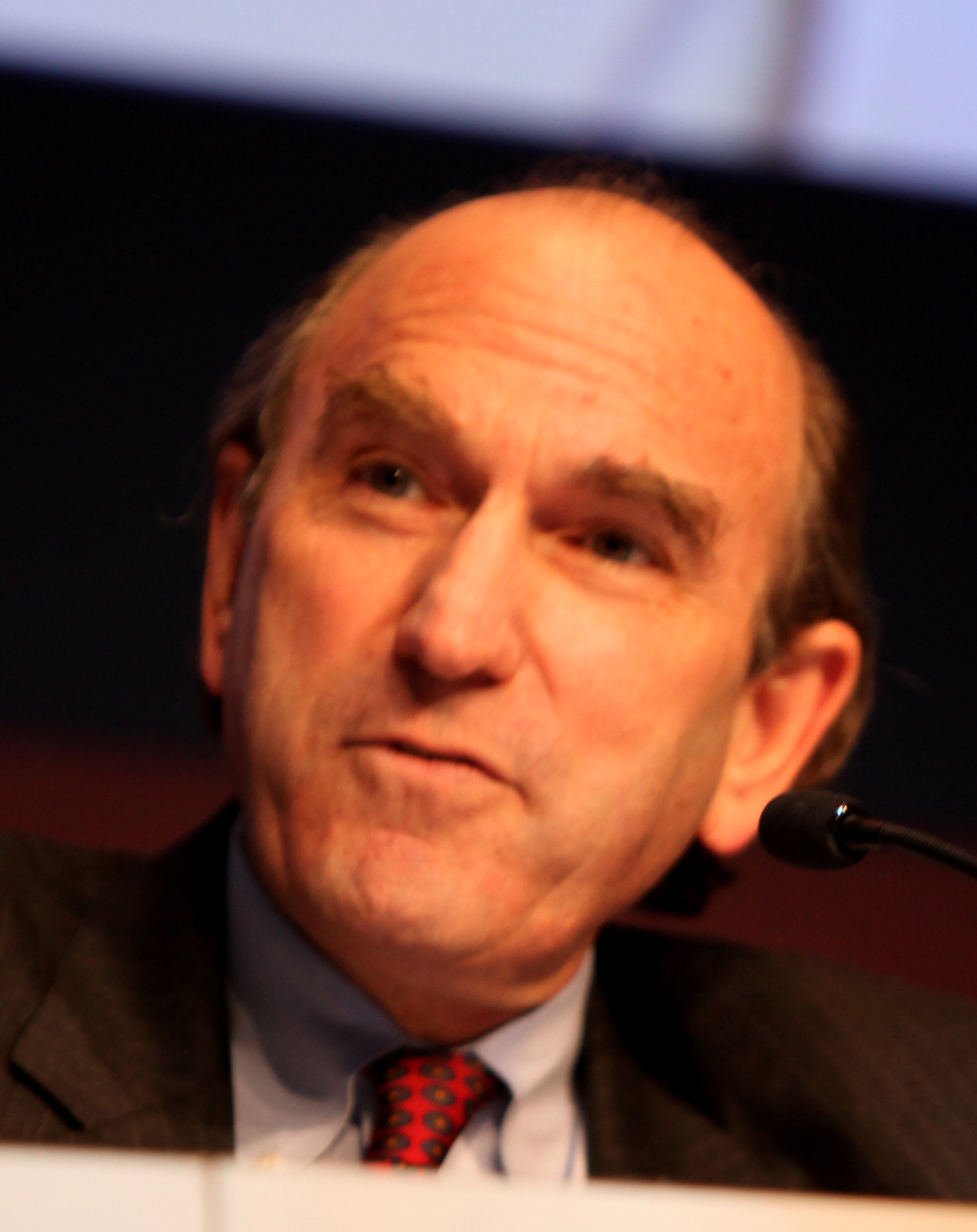
Elliott Abrams is the U.S. special envoy to Venezuela, having been named to the post amid efforts by the Donald Trump administration to back the ouster of Venezuelan President Nicolas Maduro. Abrams had been a senior fellow for Middle East studies at the Council on Foreign Relations and is closely associated with neoconservative foreign policyadvocacy.[1] He was a key figure in the campaign to push war in Iraq even before the 9/11 terrorist attacks.[2] Although sometimes cited in the press as a “respected” foreignpolicy analyst,[3] Abrams is arguably best known for pleading guilty to charges of withholding information from Congress concerning the Reagan administration’s role in the Iran-contra scandal—for which he was eventually pardoned by President George H.W. Bush—and for defending perpetrators of mass human rights violations during the CentralAmerican conflicts of the 1980s.[4]
Abrams also served as an adviser on Mideast policy at the National Security Council (NSC) during the George W. Bush presidency, where he was a key advocate for anaggressive “war on terror” after 9/11.
After his Trump administration appointment, William LeoGrande—a specialist in Latin American politics and US foreign policy—said, “Elliott Abrams, like his neo-conservative colleague John Bolton, believes in using U.S. power to overthrow regimes Washington doesn’t like, not negotiate with them. He is the wrong person for the job of Venezuelan envoy, because as long as the military remains loyal to Maduro, the only way out of the Venezuelan crisis is some sort of negotiated settlement.”[5]
Journalist Eric Alterman said of Abrams, “Like Trump himself, Abrams has behaved so badly in so many different arenas, it actually works in his favor: No one can keep up.”[6]
From his perch at the Council on Foreign Relations (CFR), which included his CFR blog “Pressure Points,” Abrams frequently commented on critical U.S. foreign policy issues anddiscussed political problems in the Middle East, often with a view to encouraging U.S. intervention, promoting a right-wing Israel-centric agenda, and launching rhetoricalbroadsides against regimes he does not favor.[7]
A long-standing neoconservative ideologue, Abrams is the son-in-law of former Commentary editor Norman Podhoretz and writer Midge Decter, the trailblazing couple who helpedshape neoconservatism in the 1970s.[8] His spouse, Rachel Abrams, who passed away in 2013, was an activist based at the Emergency Committee for Israel. Abrams hassupported or worked for a large number of neoconservative groups and campaigns, including the Project for the New American Century, the Center for Security Policy, theHudson Institute, and the Ethics and Pubic Policy Center, where he served as president for several years.
Like other neoconservative figures, Abrams has unabashedly employed accusations of anti-Semitism to smear people he disagrees with over Middle East policy. He stirred controversy in 2013 when he leveled the charge against then-Defense Secretary Chuck Hagel.[9] Although Hagel was defended by leading figures from both parties, by very mainstream figures in the Jewish community, and even by the president of CFR, he stuck to the charge, damaging his own credibility much more than Hagel’s.[10]
Rejected, then redeemed, by Trump
In early February 2017, it was widely reported that Abrams would be tapped by Donald Trump to serve as deputy to Secretary of State Rex Tillerson, a move that surprised many observers, including conservative groups like the libertarian Cato Institute, which called it “baffling.” Wringing his hands about “hundreds” of neocons “scurrying” into theadministration if Abrams is admitted, Republican Sen. Rand Paul said that he voted to confirm Tillerson because he appeared to have a “realist approach” while Abrams didn’tespouse “any type of foreign policy realism.”[11]
During the 2016 presidential election contest, Abrams was less strident in his opposition to Trump than other neoconservative figures. Nevertheless, he initially backed othercandidates in the GOP primary and was selected by Sen. Ted Cruz to be a member of his campaign’s national security team. In a May 2016 article for the Weekly Standard titled”When You Can’t Stand Your Candidate,” Abrams urged readers not to “allow the Republican convention to be a coronation wherein Trump and Trumpism are unchallenged.”[12]
Because of this criticism, Trump ultimately rejected Abrams, even though Tillerson strongly supported his appointment. “The core point here is that this comes from Trump’s thin-skinnedness,” a top Republican strategist who supported the Abrams appointment told Politico. “He is the problem, this is all he cares about.” Added Eric Edelman, former undersecretary of defense in the George W. Bush administration: “It really speaks so poorly of Trump. … It robs him of somebody who could have helped him enormouslybecause they know the State Department extremely well and would have been respected enormously by the foreign service officers who work with him.”
But in January 2019, Abrams was tapped by Secretary of State Mike Pompeo to be the point person for U.S. efforts to oust Venezuelan president Nicolas Maduro. According to Pompeo, “Elliott will have responsibility for all things related to our efforts to restore democracy in Venezuela.”[13] Pompeo described Abrams’ role as helping “the Venezuelan people fully restore democracy and prosperity to their country.”[14]
Other expressed more concern about Abrams’ role. For example, two professors of history wrote, “The United States has participated in the overthrow of dozens of Latin American governments since the late 19th century. These interventions have taken the form of direct military attacks, covert operations (often involving the CIA) and aid to internal actors bidding for power. By appointing Elliott Abrams as its point man in Venezuela, the Trump administration embraces that history of interventions.”[15]
As if trying to pave a path back into government, Abrams had been writing much more positively of Trump in the months before his appointment. Back in December 2017, he had written approvingly of Trump’s decision to move the U.S. embassy to Jerusalem and recognize Jerusalem as the capital of Israel.[16] But so had many of his fellow neoconservatives, who otherwise remained disdainful of Trump’s foreign policies.
In July 2018, Trump was facing withering criticism from many corners for what was perceived as a response based on personal affront in revoking security clearances of former national security officials who had been directly and consistently critical of his behavior as president. Abrams came to his defense, stating that Trump was right to revoke their clearances. “Security clearances should not depend on party loyalty and should not be routinely and immediately revoked when a word (or many words) of criticism are spoken,” he wrote. “But it is reasonable to ask our highest former national security officials to consider the integrity of their former offices and agencies and ask that they decide carefully before entering the political and media fray.”[17]
By November 2018, Abrams’ tone regarding Trump had completely shifted to full-throated support. He applauded Trump’s policies, particularly in the Middle East, unreservedly. “What Trump has achieved already is a reassertion of the American presence, diplomatic in some cases and military in others,” he opined. “He has reasserted that the U.S. knows who its friends are and who they are not, a simple, old-fashioned yet absolutely indispensable stance for a world power.”[18]
On Iran
Iran has long been a focus of Abrams’ advocacy. A vocal opponent of the negotiations that led to the 2015 nuclear deal, he accused the Obama administration of being naïve in itsefforts at rapprochement with Tehran, even after moderate President Hassan Rouhani was elected in 2013. “We are fooling ourselves if we see in [President Hassan] Rouhani areformer who wishes to change the Iranian system, move toward democracy, and abandon the nuclear weapons program. That ‘Rouhani narrative’ was carefully constructed toensnare Western diplomats, officials, and journalists. We have no excuse if we fall for it,” Abrams wrote in his CFR blog in October 2013.[19]
Regarding negotiations over Iran’s nuclear program, Abrams wrote in mid-2014 that “the road to peace does not lie through weak agreements with brutal dictatorships” and that“any agreement that strengthens the Iranian regime–that enhances its reputation, that gives it greater leverage in the Middle East, or that strengthens its strangle-hold on theIranian people–serves neither the cause of freedom nor that of peace.”[20]
Remarked one commentator: “If the negotiations fail, the chances of military action increase exponentially. The consequences promise to be disastrous, both to the people of Iranand to the global economy. More death and misery. But, for Mr. Abrams, all that suffering can be winked at.”[21]
After a comprehensive nuclear agreement was reached between Iran and the P5+1 nations in July 2015, Abrams accused President Obama of “throwing in the towel” and saidthat the administration had “acted as Iran’s lawyer.” In a National Review article, he wrote: “Iran has won a great victory: A weak country has outmaneuvered and outnegotiatedthe United States and the EU. … The rise of Iran means great danger ahead.”[22]
Vox’s Matthew Yglesias wrote in response: “What John Kerry and his team think is that if they had held out even more than they did, the international coalition to maintain thesanctions would have unraveled as foreign leaders concluded that the US, rather than Iran, was being unreasonable. This is the key point on which the whole thing turns, and yetAbrams has literally nothing to say about it—he has no argument.”[23]
In August 2015, Abrams penned a controversial piece for the Weekly Standard that accused President Obama of resorting to anti-Semitism in his criticisms of the deal’sopponents. Pointing to Obama’s spirited defense of the Iran deal during an August 2015 speech at American University, Abrams misleadingly wrote that “The president. …mustknow that he is here feeding a deep line of anti-Semitism that accuses American Jews of getting America into wars.” He added: “The basic idea is simple: to oppose thepresident’s Iran deal means you want war with Iran, you’re an Israeli agent, you are in the pay of Jewish donors, and you are abandoning the best interests of the UnitedStates.”[24]
Abrams has on numerous occasions sought to lay the groundwork for direct U.S. confrontation with Iran. In August 2012, for instance, he argued in the Weekly Standard blog thatCongress should vote on a joint resolution to give the president the authority to go to war with Iran.[25] In a January 2011 post on his CFR blog, Abrams highlighted apparentsetbacks in Iran’s nuclear program to urge the United States to aggressively pursue regime-change strategies in that country, including strengthening sanctions. He wrote: “Thenew Republican leaders of the House Armed Services, Foreign Affairs, and Intelligence Committees—respectively Buck McKeon, Ileana Ros-Lehtinen, and Mike Rogers—oughtto make this their first order of business. They should be asking right now what more the United States and our allies can be doing to stop the Iranian nuclear weapons program, make our sanctions more effective, and support democratic dissidents in Iran.”[26]
On Syria
Abrams has also been a fervent supporter of launching strikes on Syria. In the wake of the takeover of swathes of territory in Iraq and Syria by ISIS, Abrams called for a “wider useof power in Syria than solely attacking ISIS.” Air strikes, he wrote in September 2014, should be “broad enough to greatly restrict Assad’s ability to use air power as an instrumentof terror.”[27]
When President Trump launched missile strikes against Syrian targets in April 2017, Abrams—along with many of his fellow neoconservatives—was jubilant. He lavished praise on Trump, stating, “The president has been chief executive since January 20, but this week he acted also as Commander in Chief. And more: he finally accepted the role of Leader of the Free World.”
Abrams contended that the strikes had restored deterrence against the use of chemical weapons not only by Syria, but by other countries, “And the strike will have far wider effects. … Vladimir Putin will think again about his relations with the United States, and will realize that the Obama years of passivity are truly over. Allies and friends will be cheered, while enemies will realize times have changed. When next the Iranians consider swarming around an American ship in the Gulf, they may think again.”[28]
After an Israeli attack on Iranian forces in Syria in September 2017, Abrams urged the United States to help Israel take broader action. “What would be useful at this point, it seems to me, is a statement by the United States that we approve of the action Israel took, and that in the event of a conflict Israel would have our support in defending itself—for example by allowing the Israelis to have access to the stocks of weapons that we store in Israel. … Such a statement might, like the Israeli bombing of the weapons factory in Syria, help persuade Iran and Syria to observe the limits Israel is imposing and might help avoid a wider conflict.”[29]
Abrams has implied that American ground forces should be deployed in Syria and Iraq, writing: “If not American [ground forces] then those of some capable force, will also beneeded. Combat forces may not be needed, but advisers certainly will be and in the thousands. It is not at all clear that any other forces–Jordanian, Emirati, or Saudi–can actuallyperform this function that Americans perform so well.”[30]
In June 2015, Abrams argued in a piece for the National Journal that the “United States needs to recommit itself to the downfall of Bashar al-Assad in Syria.” He further posited: “ISIS in Iraq cannot be defeated so long as it has Syria as a sanctuary. This means more support for rebels in Syria than we are now giving; the current train-and-equip program istoo small and weak to have much impact. It means grounding Assad’s air force. It means safe havens in Syria, formed with the cooperation of Turkey, Jordan, and other allies—who, with other Sunni nations, are willing to do more if they are led by the United States.”[31]
Abrams has sought to tie U.S. intervention in Syria and Iraq to the Iranian nuclear issue, saying that a “display of American power and leadership in Iraq and Syria” should “remindIran that in the end it is a third world nation of 75 million confronting a superpower.”[32]
On Egypt
On Egypt, Abrams broke with many of his neoconservative allies—and seemingly steered away from his thinking during the Reagan administration, when he vouched for thehuman rights records of right-wing regimes receiving U.S. military assistance in Latin America—when he argued in August 2013 that the U.S. should halt its assistance to Egypt’smilitary following its overthrow of elected Muslim Brotherhood president Mohamed Morsi and its subsequent violent crackdown on his supporters. “Like most Americans, I wouldlike to see the Muslim Brotherhood out of power forever but killing demonstrators sympathetic to ousted President Mohammed Morsi is not going to bring long-term stability toEgypt or defeat the Brotherhood,” Abrams wrote. “Cutting off aid is the only serious way to tell the Egyptian military that its current conduct is beyond the pale.”[33]
On Obama Policy in the Middle East
In a June 2014 article for Politico titled, “The Man Who Broke the Middle East,” Abrams sought to portray President Obama as responsible for much of the instability in the region.Abrams wrote: “The Middle East that Obama inherited in 2009 was largely at peace, for the surge in Iraq had beaten down the al Qaeda-linked groups. U.S. relations withtraditional allies in the Gulf, Jordan, Israel and Egypt were very good. Iran was contained, its Revolutionary Guard forces at home. Today, terrorism has metastasized in Syria andIraq, Jordan is at risk, the humanitarian toll is staggering, terrorist groups are growing fast and relations with U.S. allies are strained.”[34]
In response, a commentator for the New Republic opined: “Abrams’s piece is a rant about President Barack Obama. If it appears odd that someone would claim that Obama, whocame to office in 2009, ‘broke’ the world’s most infamously broken region, well, it is. The article is almost criminally confusing and ill-argued, which means that it must count, forAbrams, as recidivism.”[35]
In a February 2015 piece for Mosaic, Abrams called President Obama a radical: “Given all we know, I would argue that Obama’s mission is to guide America not only out ofBushland (as [Hudson Institute fellow Michael] Doran puts it) but out of Rooseveltland, Kennedyland, and Clintonland—and indeed to reverse most of the foreign-policy legacy ofhis own party. … The ideas espoused by Obama ‘incubated’ decades ago and were most likely adopted back at Columbia University or in the Chicago kitchen of his friends ofWeathermen fame, Bill Ayers and Bernadine Dohrn.”[36]
In early 2013, Abrams was a leading neoconservative critic of President Obama’s nomination of former Sen. Chuck Hagel to serve as defense secretary during Obama’s secondterm. Instead of focusing on policy disagreements, however, Abrams publicly and repeatedly accused Hagel of holding anti-Semitic views, writing in the Weekly Standard that“Hagel seems to have a thing about ‘the Jews.’”[37] He repeated the charge in an NPR interview, leading the network’s ombudsman to admit that he was “troubled” that Abramswas “allowed to use NPR to make an inflammatory allegation for which he offered precious little proof.”[38]
Abrams’ accusations became the subject of fervent criticism, leading CFR president Richard Haas to distance his organization from Abrams’ insinuations, calling them “over theline.”[39]
“As Ali Gharib of the Daily Beast and others have documented, these charges are baseless,” wrote Foreign Policy’s Steven Walt. “Not only have prominent Israelis leapt to Hagel’sdefense against these smears, but so have important American Jewish leaders and some of Hagel’s longtime Jewish friends from Nebraska. Abrams knows all this, of course, butthat has not led him to retract his earlier calumnies against a distinguished public servant and decorated soldier.” Calling the anti-Semitism charge “an odious tactic that runscontrary to how one should behave in a great democracy like the United States,” Walt called on Haas to “make a stand for reasoned, rational discourse” and demand that Abramspublicly apologize to Hagel.[40]
Abrams, however, stuck by his accusations, claiming that Hagel believes “lobbying by American Jews to be illegitimate and offensive.”[41]
Abrams also wielded the anti-Semitism charge against President Obama when the president criticized those opposing the Iran nuclear deal saying that their views could lead tomore war in the Middle East. Abrams misleadingly wrote that Obama “must know that he is here feeding a deep line of anti-Semitism that accuses American Jews of gettingAmerica into wars. His American University speech was an eloquent denunciation of those who disagree with him as warmongers with dual loyalty, who will be ‘demanding’ warwith Iran. This speech divides Americans not according to principled opinions, nor even by party, but mostly by religion.”[42]
On Cuba
Abrams vociferously opposed the Obama administration’s December 2014 decision to normalize U.S.-Cuba relations, proclaiming at the time: “The American collapse with respectto Cuba will have repercussions in the Middle East and elsewhere—in Asia, for the nations facing a rising China, and in Europe, for those near Putin’s newly aggressive Russia. What are American guarantees and promises worth if a fifty-year-old policy followed by Democrats like Johnson, Carter, and Clinton can be discarded overnight?”[43]
One commentator said in response to Abrams’ remarks: “To call this mindless would be generous. This takes a typical hawkish loathing of diplomatic engagement and mixes ittogether with absurd beliefs about ‘credibility’ to create a completely irrational reaction. Restoring diplomatic relations with Cuba isn’t going to have negative ‘repercussions’ aroundthe world. … If there are any repercussions from this decision, they are all likely to benefit America. Latin American governments will have less of a reason to fault U.S. policytowards Cuba.”[44]
The NSC Neocon
Abrams was widely regarded as a key champion within the George W. Bush administration of the neoconservative line on foreign affairs, shunning negotiations in favor ofconfrontational U.S. policies and promoting views in line with those of hardliners in Israel, who have rejected land-for-peace proposals like those negotiated as part of the Oslopeace talks, which Abrams opposed.[45]
Abrams served as a point person for policies related to the Israeli-Palestinian conflict and pushed a hardline stance on Iran, Syria, and Iraq. Abrams also appeared to use hisperch in the NSC to fight efforts by some administration officials and members of Congress to promote diplomatic approaches to crises. The Inter Press Service reported in earlyApril 2007: “Just as [Abrams] worked with Reagan hardliners to undermine the Arias Plan [for Central America] 20 years ago, so he appears to be doing what he can to underminerecent efforts by Saudi King Abdullah to initiate an Arab-Israeli peace process and, for that matter, by Republican realists, and even Secretary of State Condoleezza Rice, to pushit forward.”[46]
After Bush took office in 2001, Abrams was appointed to serve as the NSC’s chief human rights officer and later as senior director of Near East and North African Affairs. InJanuary 2005, after Bush’s second inauguration, the White House announced that Abrams would serve as Bush’s deputy assistant and as the deputy national security adviser forglobal democracy strategy under national security advisor Stephen Hadley, who had been Condoleezza Rice’s deputy at the NSC.
Abrams often appeared alongside Hadley during trips to the Middle East and elsewhere. During a May 2008 trip to Jerusalem aboard Air Force One, Hadley and Abramsdiscussed the Bush administration’s involvement in Israeli-Palestinian negotiations during Bush’s tenure as president. Hadley said: “What [Bush] did was really launch—what theparties did was launch a three-pronged effort. One was the formal negotiation of the contours of the Palestinian state—borders, refugees, security, Jerusalem. Second was toaccelerate the building of the institutions of a Palestinian state so the Palestinians would be able to govern democratically the state that they would get as a result of thenegotiations. And finally, at the same time, he negotiated a third element, which was the broader outreach to the Arab world, to get the Arabs involved in this process—so as I say, Israeli-Palestinian reconciliation to be in the context of a broader Arab-Israeli reconciliation.”[47]
Hadley then turned to Abrams, asking, “Elliott, do you want to add anything to that?” Abrams shifted the discussion to groups opposed to Israel, saying, “I would add one thing,which is that as we move forward there are those who would like to slow us down and stop us. It’s interesting, as I was listening to you recite the progress of the last seven years,one other thing that’s happened in these years is a very significant increase in the amount of assistance that Iran is giving to Hamas. Seven years ago there really wasn’t much atall. Now there is a lot. So you see the enemies of a peaceful settlement stepping up their activities in an effort to stop us.”[48]
Abrams participated in a November 2004 meeting in the Oval Office between Bush and Natan Sharansky, a hardline Likud Party figure. The meeting was arranged by thepresident after he read galleys of Sharansky’s book, The Case for Democracy: The Power of Freedom to Overcome Tyranny & Terror, which reportedly helped inspire Bush’sdemocracy agenda.[49]
Sharansky’s connection to the neoconservatives dates to the mid-1970s, when he worked closely with Sen. Henry “Scoop” Jackson (D-WA), who employed Abrams, RichardPerle, Douglas Feith, and other nascent neoconservatives. After Jackson’s failure to win the Democratic Party’s presidential nomination, Abrams joined the staff of Sen. DanielPatrick Moynihan (D-NY) and later became his chief of staff. Abrams later switched to the Republican Party and went to work for the Reagan administration.
In 2006, Abrams played a role in shaping the U.S. response to the summer war between Israel and Hezbollah. The New York Times noted that Secretary of State Rice wasaccompanied on her mediating trips in the Middle East “by two men with very different outlooks on the conflict”—namely, Abrams and the State Department’s C. David Welch.According to the Times, “Abrams, a neoconservative with strong ties to [Vice President Dick] Cheney, has pushed the administration to throw its support behind Israel. During Ms. Rice’s travels, he kept in direct contact with Mr. Cheney’s office.”[50]
According to an unnamed U.S. government consultant “with close ties to Israel” interviewed by Seymour Hersh, Israel had put together bombing plans long before Hezbollahkidnapped two Israeli soldiers, which set off the conflict. As they developed their plans, according to the consultant, Israeli officials went to Washington “to get a green light for thebombing operation and to find out how much the United States would bear…. Israel began with Cheney. It wanted to be sure that it had his support and the support of his officeand the Middle East desk of the National Security Council.”[51]
Although an NSC spokesman who talked with Hersh denied that Abrams had any role in supporting Israel’s plan, a second unnamed U.S. official, a former intelligence officer, claimed, “We told Israel, ‘Look, if you guys have to go, we’re behind you all the way. But we think it should be sooner rather than later—the longer you wait, the less time we haveto evaluate and plan for Iran before Bush gets out of office.'”[52]
While many of Bush’s neoconservative supporters were generally pleased with the administration’s strong backing of Israel, some criticized the State Department and Rice forsoftening many of Bush’s policies. Abrams reportedly worked to intervene on Rice’s behalf. A 2006 New York Times article reported that State Department officials said Abramsserved “as a buffer for Ms. Rice with some neoconservatives who are critical of her policies. ‘The genius of Elliott Abrams is that he’s Elliott Abrams,’ one senior administrationofficial said. ‘How can he be accused of not sufficiently supporting Israel?’”[53]
When she still served as Bush’s national security advisor, Rice apparently relied on Abrams for his unambiguous views. A friend of Rice told the New Yorker that she saw Abrams”not just as a good manager but a good strategist. As an NSC administrator, you want someone who can think several moves ahead, who has a peripheral vision and an instinctto get where you want to go—someone who can really play the high-stakes game.”[54]
Richard John Neuhaus, a longtime Abrams acquaintance and fellow neoconservative, told the New Yorker: “What runs through Elliott’s thinking is a deep, almost quasi-religiousdevotion to democracy. He thinks real democratic change can happen in the Middle East. It’s breathtaking, in a way.”[55]
A Neocon Trajectory: From “Scoop” Jackson to Iran–contra to the Project for the New American Century
Throughout his career, Abrams has moved back and forth between government and a web of right-wing think tanks and policy institutes, holding positions as a senior fellow at theHudson Institute, president of the Ethics and Public Policy Center (EPPC), advisory council member of the American Jewish Committee, and charter member of the Project for theNew American Century (PNAC). Abrams’s family ties have also placed him at the center of neoconservatism. His 1980 marriage to Rachel Decter brought him into the Podhoretzclan, a key family associated with neoconservatism.[56] Abrams became a frequent contributor to the American Jewish Committee’s Commentary magazine when it was edited byhis father-in-law Norman Podhoretz. While in the Reagan administration, Abrams also frequently made appearances at the forums organized by mother-in-law Decter’s Committeefor the Free World in the 1980s, a rightist foreign policy pressure group that was co-led by Donald Rumsfeld.
As an aide to Senator Jackson in the 1970s, Abrams began his political career mixing the soft and hard sides of the neoconservative agenda as both a proponent of Jackson’sstrategically driven human rights policies and as an advocate of his proposals to boost the military-industrial complex. Through Jackson, Abrams became involved with a group ofCold Warriors called the Coalition for a Democratic Majority, which was led by Democratic Party-affiliated neoconservatives like Penn Kemble.
Former members of Jackson’s staff who later received posts in the Reagan administration foreign policy team included such neoconservative operatives as Feith, Perle, FrankGaffney, Charles Horner, and Ben Wattenberg. Another up-and-coming neoconservative who was close to Jackson and later joined the Reagan administration was PaulWolfowitz, who together with his mentor, Albert Wohlstetter, advised the senator on arms issues. Other Jackson Democrats who secured appointments in the Reaganadministration included Jeane Kirkpatrick, as UN ambassador, and neoconservatives on her staff, such as Joshua Muravchik, Steven Munson, Carl Gershman, and KennethAdelman.
Abrams is best known for his role in the Iran-Contra scandal. He was indicted by a special prosecutor for intentionally deceiving Congress about the Reagan administration’s rolein supporting the Contras—including his own central role in the Iran-Contra arms deal. In this deal, national security staff led by Oliver North brokered the sale of weapons fromIsrael to Iran in exchange for Iran helping broker the release of six Americans held hostage by Hezbollah. Some of the money made from the sale was channeled to the U.S.-backed and -organized Contras, who were spearheading a counterrevolution against the Sandinista government in Nicaragua. Congress had prohibited U.S. governmentassistance to the Contras because of their pattern of human rights abuses. At the time of his involvement, Abrams was the assistant secretary of state for inter-American affairs, working under George Shultz. Abrams pleaded guilty to two lesser offenses (including withholding information from Congress) to avoid a trial and a possible jail term. Throughoutthe proceedings, Abrams denied knowledge of the NSC and CIA programs to support the Contras. He blamed Congress for the deaths of two U.S. military members shot down bythe Sandinistas in an illegal, clandestine arms supply operation over Nicaragua. He described the legal proceedings against him as “Kafkaesque” and called his prosecutors “filthybastards” and “vipers.”[57]
Abrams and five other Iran-Contra figures were pardoned on Christmas Eve 1992 by President George H.W. Bush, shortly before he left office.[58]
In his book Reagan, Bush, and Right–Wing Politics, Philip Burch underscores Abrams’ unapologetic attitude regarding the excesses of the war in Nicaragua: “A few years after hestepped down as assistant secretary of state for Inter-American Affairs, Abrams, once the State Department’s top human rights official, wrote an article on El Salvador in theNational Review titled ‘An American Victory’; at the end of this piece he proudly proclaimed that ‘El Salvador’s decade of guerilla war cost thousands of Salvadoran lives, andthose of eight Americans. The violence is ending now in part because of the collapse of Communism throughout the world, but more because Communist efforts to take power byforce were resisted and defeated. In this small corner of the Cold War, American policy was right, and it was successful.’ Perhaps Mr. Abrams should read Mark Danner’s TheMassacre at El Mozote (which contains an appendix giving name, age, and gender for almost every one of the 784 people killed in this grizzly episode),” which was perpetrated bythe Salvadoran Army’s Atacatl Battalion, a U.S.-trained counterinsurgency force.[59]
Abrams, like a number of other prominent neoconservatives, was not invited to serve in the George H.W. Bush administration. In 1992 he helped form the Committee for U.S. Interests in the Middle East, which was regarded by many as an advocacy campaign to ensure that U.S. policy was aligned with the Likud Party in Israel.[60] Other membersincluded Perle, Feith, Gaffney, and John Lehman. The committee spoke out against what it perceived as a dangerous distancing between the George H.W. Bush administrationand Israel in the administration’s pressure for Israel to pull out of some occupied territories and halt its campaign to expand settlements in those zones.[61]
In 1996 Abrams became president of the Ethics and Public Policy Center. At EPPC, he wrote widely on foreign policy issues, especially Mideast policy, and on cultural issues, including what he saw as the threats posed by U.S. secular society to Jewish identity. Directed by Abrams from 1996 to 2001, EPPC has counted among its board members well-connected figures in the neocon matrix including Neuhaus, Bill Kristol, and Mary Ann Glendon. (For more on EPPC, see Right Web Profile: Ethics and Public Policy Center.)
Campaign Adviser
Abrams has served as an adviser to numerous political campaigns. In 2012, he was the foreign policy adviser to Rep. Paul Ryan (R-WI) during the Mitt Romney presidentialcampaign. During the campaign, Abrams drew attention when he pushed Congress to vote to authorize the president to go to war with Iran.[62] Commenting on Abram’s proposal, ThinkProgress opined: “The fact that an adviser who played a key role in molding Ryan’s foreign policy views is defending dangerous brinksmanship raises serious questionsabout whether the Romney-Ryan policy might tilt hawkish once in office. Indeed, one commonality amongst the advising corps is a worrying willingness to casually advocate theuse of American military force.”[63]
More recently, Abrams has advised 2016 Republican presidential candidate Marco Rubio, who is also strongly opposed to U.S. détente with Cuba. Rubio has close ties withnumerous prominent neoconservatives and has echoed typical neoconservative notions about foreign policy. “The whole question of the expansion of freedom of democracy is ofgreater interest to him as a foreign policy theme than it is for many other people,” Abrams has said about Rubio.[64]
In March 2015, Mondoweiss reported that Abrams—along with other hardline “pro-Israel” figures like Sheldon Adelson and Bill Kristol—was a funder of Sen. Tom Cotton’s (R-AR) ultimately successful 2014 Senate campaign.[65]
Commenting on Abrams’ resilient prominence in the U.S. foreign policy establishment despite a host of scandals—from Iran-contra to Iraq to the Hagel fight—Salon’s JordanMichael Smith wrote that “Abrams’ bizarre reincarnation as a pseudo-statesman shows that even committing crimes counts as insufficient to merit excommunication fromgovernment service.” Smith quoted a former Joint Chiefs chairman who said of Abrams, “This snake’s hard to kill.”[66]
Publications
In his writings, Abrams has consistently voiced strong support for Likud positions on the Israeli-Palestinian peace process and against “land for peace” negotiations. After thelaunch of the Al Aqsa Intifada in late September 2000, Abrams lambasted mainstream Jewish groups for their continued support for peace talks between the Palestinian Authorityand for their call to Israel to halt its attacks.[67]
Abrams has also established strong pro-Likud positions in articles for Commentary and in various books. Abrams authored the chapter on the Middle East in the 2000 blueprint forU.S. foreign policy by the Project for the New American Century. Edited by PNAC founders Bill Kristol and Robert Kagan, Present Dangers: Crisis and Opportunity in AmericanForeign and Defense Policy is a playbook on how to deal with U.S. adversaries. In his chapter, Abrams laid out the “peace through strength” credo that became the operatingprinciple of the George W. Bush administration. “Our military strength and willingness to use it will remain a key factor in our ability to promote peace,” wrote Abrams. “Strengthening Israel, our major ally in the region, should be the central core of U.S. Middle East policy, and we should not permit the establishment of a Palestinian state thatdoes not explicitly uphold U.S. policy in the region.” Presaging the Mideast policy of the Bush administration, Abrams wrote: U.S. interests “do not lie in strengthening Palestiniansat the expense of Israelis, abandoning our overall policy of supporting the expansion of democracy and human rights, or subordinating all other political and security goals to the’success’ of the Arab-Israel ‘peace process’.” Like other right-wing Zionists, Abrams refers to the conflict between the Palestinians and Israelis not for what it is—a conflict overoccupied Palestinian land—but rather as an “Arab-Israel” conflict, implying that U.S. support of Israel necessitates a foreign policy that confronts all the Arab countries.[68]
In his book Faith or Fear: How Jews Can Survive in a Christian America, Abrams takes care to insist that his positions imply no “disloyalty” to the United States, but at the sametimes insists that Jews must be loyal to Israel because they “are in a permanent covenant with God and with the land of Israel and its people. Their commitment will not weaken ifthe Israeli government pursues unpopular policies.”[69]
Abrams’ other books include The Influence of Faith (2001), Security and Sacrifice (1995), Undue Process (1993). He has also contributed articles to Commentary, WeeklyStandard, National Interest, Public Interest, and National Review. In 1998 he and Donald Kagan edited the EPPC volume Honor Among Nations: Intangible Interests and ForeignPolicy.
SOURCES
[1] Council on Foreign Relations, Elliott Abrams, http://www.cfr.org/experts/middle-east-israel-human-rights/elliott-abrams/b1567.
[2] For example, Abrams and a host of other neoconservative figures signed the Project for the New American Century’s 1998 open letter to President Bill Clinton calling for military action against Saddam Hussein. See: http://rightweb.irc-online.org/images/uploads/PNAC_Letter_to_President_Clinton_on_Iraq.pdf
[3] See, for example, CNN, “Abrams, a Trump critic, considered for key State Department post,” February 6, 2017, http://edition.cnn.com/2017/02/06/politics/elliott-abrams-state-department/.
[4] PBS, “As Rios Montt Trial Nears End, a Look Back at U.S. Role in Guatemala’s Civil War,” PBS, May 10, 2013, http://www.pbs.org/newshour/rundown/from-the-vault-will-ending-an-embargo-in-guatemala-fuel-or-endorse-the-violence/. Also, Eric Alterman, “An Actual American War Criminal May Become Our Second-Ranking Diplomat,” The Nation, February 3, 2’17, http://billmoyers.com/story/actual-american-war-criminal-may-become-second-ranking-diplomat/
[5] Ray Sanchez, “US special envoy for Venezuela has long, controversial history in Latin America,” CNN, January 26, 2019, https://www.cnn.com/2019/01/26/americas/elliott-abrams-venezuela-special-envoy-career/index.html
[6] Eric Alterman, “An Actual American War Criminal May Become Our Second-Ranking Diplomat,” The Nation, February 2, 2017, https://www.thenation.com/article/an-actual-american-war-criminal-may-become-our-second-ranking-diplomat/
[7] Council on Foreign Relations, “Elliott Abrams,” http://www.cfr.org/bios/1567/elliott_abrams.html.
[8] Jim Lobe, “All in the Neocon Family,” Alternet, March 27, 2003, http://www.alternet.org/story/15481/all_in_the_neocon_family.
[9] Elliott Abrams, “Mr. Hagel and the Jews,” Weekly Standard, January 7, 2013, http://www.weeklystandard.com/blogs/mr-hagel-and-jews_693993.html?nopager=1.
[10] Hayes Brown, “Facing Backlash, Elliott Abrams Clings To Charge That Hagel Is Anti-Semitic,” Think Progress, January 14, 2013, https://thinkprogress.org/facing-backlash-elliott-abrams-clings-to-charge-that-hagel-is-anti-semitic-d2a07cd9ecc0/
[11] Cato Institute, “Elliott Abrams to the State Department? Baffling.” February 8, 2017, https://www.cato.org/blog/elliott-abrams-state-department-baffling
[12] Elliot Abrams, “When You Can’t Stand Your Candidate,’” Weekly Standard, May 16, 2016, http://www.weeklystandard.com/when-you-cant-stand-your-candidate/article/2002283.
[13] Ray Sanchez, “US special envoy for Venezuela has long, controversial history in Latin America,” CNN, January 26, 2019, https://www.cnn.com/2019/01/26/americas/elliott-abrams-venezuela-special-envoy-career/index.html
[14] Common Dreams Staff, “Trump’s axis of evil: Are John Bolton, Mike Pompeo and Elliott Abrams plotting Venezuela coup?” Salon, January 28, 2019, https://www.salon.com/2019/01/28/trumps-axis-of-evil-are-john-bolton-mike-pompeo-and-elliott-abrams-plotting-venezuela-coup/
[15] Frederico Finchelstein and PabloPiccato, “The dangerous game Donald Trump is playing with Venezuela,” Washington Post, January 29, 2019, https://www.washingtonpost.com/outlook/2019/01/29/dangerous-game-donald-trump-is-playing-with-venezuela/?utm_term=.79f83538e673
[16] Elliott Abrams, “Bravo, President Trump, for Standing Up to Palestinian Blackmail on Jerusalem,” Haaretz, December 7, 2017, https://www.haaretz.com/middle-east-news/.premium-bravo-president-trump-for-facing-off-arab-threats-on-jerusalem-1.5627877
[17] Elliott Abrams, “Why Trump Is Right to Strip Ex-Officials’ Security Clearances,” Politico, July 25, 2018, https://www.politico.com/magazine/story/2018/07/25/trump-security-clearance-revoke-clapper-brennan-rice-hayden-219038
[18] Elliott Abrams, “Thanks to Trump, the Entire Mideast Now Knows: You’re Either With America, or Against Us,” Haaretz, November 4, 2018, https://www.haaretz.com/us-news/.premium-with-trump-the-entire-mideast-now-knows-you-re-either-with-america-or-against-us-1.6614067
[19] Elliott Abrams, “Meanwhile, Back in Iran…” Council on Foreign Relations, October 29, 2013, http://blogs.cfr.org/abrams/2013/10/29/meanwhile-back-in-iran/.
[20] Elliot Abrams, “Reagan and the Iran Talks,” Council on Foreign Relations, June 30, 2014, http://blogs.cfr.org/abrams/2014/06/30/reagan-and-the-iran-talks/.
[21] John Robertson, “That misery pales in comparison to the suffering to come if Abrams, Netanyahu, and their ilk succeed in torpedoing negotiations with Iran,” Your Middle East, November 7, 2013, http://www.yourmiddleeast.com/opinion/elliott-abrams-and-hasan-rouhanis-siren-song_19249.
[22] Elliot Abrams, “Iran Got a Far Better Deal Than It Had Any Right to Expect,” National Review, July 15, 2015, http://www.nationalreview.com/article/421223/iran-nuclear-agreement-john-kerry-mohammad-javad-zarif
[23] Matthew Yglesias, “I looked at the leading Iran hawks’ cases against the deal. They’re utter nonsense.,” Vox, July 16, 2015, http://www.vox.com/2015/7/16/8978439/case-against-iran-nuclear-deal
[24] Elliot Abrams, “Obama and the ‘Amen Corner,’” The Weekly Standard, August 8, 2015, https://www.weeklystandard.com/blogs/obama-and-amen-corner_1007346.html?page=1.
[25] Zach Beauchamp, “Ryan Adviser Calls On Congress To Authorize War With Iran,” ThinkProgress, August 21, 2012, http://thinkprogress.org/security/2012/08/21/719611/ryan-adviser-abrams-iran-war/.
[26] Elliott Abrams, “Four More Years,” January 7, 2011, http://blogs.cfr.org/abrams/2011/01/07/four-more-years/#more-210.
[27] Elliot Abrams, “Bombing Syria: Better Late Than Never, or Too Little Too Late?” Council of Foreign Relations, September 23, 2014, http://blogs.cfr.org/abrams/2014/09/23/bombing-syria-better-late-than-never-or-too-little-too-late/.
[28] Elliott Abrams, “The Strike At Syria,” The Weekly Standard, April 7, 2017, https://www.weeklystandard.com/elliott-abrams/the-strike-at-syia
[29] Elliott Abrams, “Israel’s Bombing of a Weapons Factory in Syria: What Comes Next?” Pressure Points, September 8, 2017, https://www.cfr.org/blog/israels-bombing-weapons-factory-syria-what-comes-next-2
[30] Elliot Abrams, “Bombing Syria: Better Late Than Never, or Too Little Too Late?” Council of Foreign Relations, September 23, 2014, http://blogs.cfr.org/abrams/2014/09/23/bombing-syria-better-late-than-never-or-too-little-too-late/.
[31] Elliot Abrams, “Bomb ISIS. Topple Assad,” National Journal, June 13, 2015, http://www.nationaljournal.com/magazine/isis-us-foreign-policy-experts-20150612.
[32] Elliot Abrams, “Bombing Syria: Better Late than Never, or Too Little Too Late?” Council of Foreign Relations, September 23, 2014, http://blogs.cfr.org/abrams/2014/09/23/bombing-syria-better-late-than-never-or-too-little-too-late/.
[33] Elliott Abrams, “Cutting Off Aid Honors American Values and Law,” Wall Street Journal, August 20, 2013, http://online.wsj.com/news/articles/SB10001424127887324108204579020851738125392.
[34] Elliot Abrams, “The Man Who Broke the Middle East,” Politico, June 22, 2014, http://www.politico.com/magazine/story/2014/06/the-man-who-broke-the-middle-east-108140.html#.VFhpq_nF-1d.
[35] Isaac Chotiner, “You’re Not Going to Believe Who’s Claiming Obama Destroyed the Middle East,” New Republic, June 23, 2014, http://www.newrepublic.com/article/118318/elliott-abrams-politico-says-obama-destroyed-middle-east.
[36] Elliot Abrams, “What the President Thinks He’s Doing,” Mosaic, February 9, 2015, http://mosaicmagazine.com/response/2015/02/what-the-president-thinks-hes-doing/.
[37] Elliott Abrams, “Mr. Hagel and the Jews,” Weekly Standard, January 7, 2013, http://www.weeklystandard.com/blogs/mr-hagel-and-jews_693993.html?nopager=1.
[38] Edward Schumacher-Matos, “Allowing Hagel To Be Called ‘Anti-Semitic’ On NPR,” NPR.org, January 27, 2013, http://www.npr.org/blogs/ombudsman/2013/01/27/170398305/allowing-hagel-to-be-called-anti-semitic-on-npr.
[39] Stephen Walt, “On Hagel, Abrams, and Haass: Why Richard Haass should tell Elliott Abrams to apologize,” Foreign Policy, January 14, 2013, http://walt.foreignpolicy.com/posts/2013/01/13/on_hagel_abrams_and_haass?wp_login_redirect=0.
[40] Stephen Walt, “On Hagel, Abrams, and Haass: Why Richard Haass should tell Elliott Abrams to apologize,” Foreign Policy, January 14, 2013, http://walt.foreignpolicy.com/posts/2013/01/13/on_hagel_abrams_and_haass?wp_login_redirect=0.
[41] Hayes Brown, “Facing Backlash, Elliott Abrams Clings To Charge That Hagel Is Anti-Semitic,” Think Progress, January 14, 2013, http://thinkprogress.org/security/2013/01/14/1441891/abrams-hagel-anti-semitic/.
[42] Elliot Abrams, “Obama and the ‘Amen Corner,’” The Weekly Standard, August 8, 2015, https://www.weeklystandard.com/blogs/obama-and-amen-corner_1007346.html?page=1.
[43] Elliot Abrams, “Castro, Cuba, Obama—and Iran,” The Weekly Standard, December 17, 2014, http://www.weeklystandard.com/blogs/castro-cuba-obama-and-iran_821771.html.
[44] Daniel Larison, “Cuba and ‘Credibility,’” The American Conservative, December 17, 2014, http://www.theamericanconservative.com/larison/cuba-and-credibility/.
[45] Steven Weisman, “Abrams Back in Capital Fray at Center of Mideast Battle,” New York Times, December 7, 2002.
[46] Quoted in Jim Lobe, “Elliott Abrams’ Repeat Performance,” Right Web, April 17, 2007.
[47] White House Office of the Press Secretary, “Press Gaggle by Dana Perino and National Security Advisor Steve Hadley and Deputy Assistant to the President for National Security Elliott Abrams,” May 14, 2008, http://www.whitehouse.gov/news/releases/2008/05/20080514.html.
[48] White House Office of the Press Secretary, “Press Gaggle by Dana Perino and National Security Advisor Steve Hadley and Deputy Assistant to the President for National Security Elliott Abrams,” May 14, 2008, http://www.whitehouse.gov/news/releases/2008/05/20080514.html.
[49] Tom Barry, “The Foreign Policy Diaspora,” Right Web, February 8, 2005, http://rightweb.irc-online.org/rw/707.html.
[50] Helene Cooper, “Rice’s Hurdles on Middle East Begin at Home,” New York Times, August 10, 2006, http://www.nytimes.com/2006/08/10/washington/10rice.html?_r=0.
[51] Seymour Hersh, “Watching Lebanon,” New Yorker, August 21, 2006, http://www.newyorker.com/magazine/2006/08/21/watching-lebanon.
[52] Seymour Hersh, “Watching Lebanon,” New Yorker, August 21, 2006, http://www.newyorker.com/magazine/2006/08/21/watching-lebanon.
[53] Helene Cooper, “Rice’s Hurdles on Middle East Begin at Home,” New York Times, August 10, 2006, http://www.nytimes.com/2006/08/10/washington/10rice.html.
[54] Connie Bruck, “Back Roads: How Serious Is the Bush Administration about Creating a Palestinian State?” New Yorker, December 15, 2003.
[55] Connie Bruck, “Back Roads: How Serious Is the Bush Administration about Creating a Palestinian State?” New Yorker, December 15, 2003.
[56] Jim Lobe, “All in the Neocon Family,” Alternet, March 27, 2003, http://www.alternet.org/story/15481/all_in_the_neocon_family.
[57] David Corn, “Elliott Abrams: It’s Back!” The Nation, July 2, 2001.
[58] For an account of Abrams’s role in Iran-Contra, see National Security Archive, “The Iran-Contra Affair 20 Years On: Documents Spotlight Role of Reagan, Top Aides,” November 24, 2006, http://www.gwu.edu/~nsarchiv/NSAEBB/NSAEBB210/index.htm.
[59] Philip H. Burch REAGAN, BUSH AND RIGHT-WING POLITICS: ELITES, THINK TANKS, POWER AND POLICY. PART A: The American Right Wing Takes Command: Key Executive Appointments. PART B: TheAmerican Right-Wing, at Court and in Action: Supreme Court Nominations and Major Policy Making, Paul Zarembka, pp. 442 (Part A), 305 (Part B), 1997.
[60] Tom Barry, “Hunting Monsters in Jerusalem,” Asia Times, August 26, 2006, http://www.atimes.com/atimes/Middle_East/HH26Ak01.html.
[61] Connie Bruck, “Back Roads,” New Yorker, December 15, 2003, http://www.newyorker.com/magazine/2003/12/15/back-roads.
[62] Zach Beauchamp, “Ryan Adviser Calls On Congress To Authorize War With Iran,” ThinkProgress, August 21, 2012, http://thinkprogress.org/security/2012/08/21/719611/ryan-adviser-abrams-iran-war/.
[63] Zach Beauchamp, “Ryan Adviser Calls On Congress To Authorize War With Iran,” ThinkProgress, August 21, 2012, http://thinkprogress.org/security/2012/08/21/719611/ryan-adviser-abrams-iran-war/.
[64] Steve Holland and Alistair Bell, “Hawkish U.S. foreign policy at heart of Rubio’s presidential bid,” Reuters, April 13, 2015, http://www.reuters.com/article/2015/04/13/us-usa-election-rubio-idUSKBN0N40W720150413.
[65] Philip Weiss, “Neocon meteor Sen. Cotton is funded by Abrams, Adelson and Kristol and loves war a little too much,” Mondoweiss, March 11, 2015, http://mondoweiss.net/2015/03/militaristic-adelson-kristol.
[66] Jordan Michael Smith, “Can Elliott Abrams be stopped?” Salon, February 2, 2013, http://www.salon.com/2013/02/02/can_elliott_abrams_be_stopped/.
[67] Jim Lobe, “Neoconservatives Consolidate Control Over Middle East Policy,” Foreign Policy In Focus, December 6, 2002.
[68] Elliott Abrams in William Kristol and Robert Kagan, eds., Present Dangers: Crisis and Opportunity in American Foreign and Defense Policy (PNAC, 2000).
[69] Elliott Abrams, Faith or Fear: How Jews Can Survive in a Christian America (Free Press, 1997).