
Michael O’Hanlon
last updated: January 8, 2016
Please note: The Militarist Monitor neither represents nor endorses any of the individuals or groups profiled on this site.
Affiliations
- Brookings Institution: Senior Fellow
- Project for the New American Century: Letter Signatory
- Princeton University: Visiting Lecturer
- Johns Hopkins University: Adjunct Professor
- International Institute for Strategic Studies: Member
- Council on Foreign Relations: Member
- Institute for Defense Analysis: Former analyst
Government
- Central Intelligence Agency: External advisory board member
- Congressional Budget Office: Analyst, National Security Division (1989-1994)
Education
- Princeton University: PhD in public and international affairs; BA and MA in physical sciences
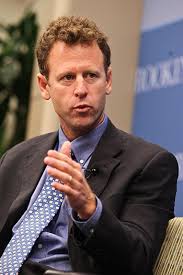
Michael O’Hanlon is the director of foreign policy research at the centrist Brookings Institution in Washington. A senior fellow with the think tank’s “Center for 21st Century Security and Intelligence,”[1] O’Hanlon is a prolific writer and frequently cited military analyst who often collaborates with counterparts at neoconservative think tanks, including the American Enterprise Institute (AEI). O’Hanlon supported the Iraq war, backed troop escalations in Iraq and Afghanistan, and has supported the advocacy campaigns of pressure groups like the notorious Project for the New American Century.
O’Hanlon is well known for his “liberal hawk” views on U.S. foreign affairs, having promoted numerous U.S. overseas military interventions. In his 2015 book The Future of Land Warfare, for example, he criticizes reductions in U.S. troop sizes because of a range of real and potential conflicts across the globe that he thinks may require American intervention. Among the scenarios that justify maintaining U.S. forces, “deterring Russia from even contemplating attacks against the Baltic states; deterring China from considering an unfriendly future role on the Korean peninsula; handling an asymmetric threat in the South China Sea with the construction and protection of a number of bases in the Philippines and elsewhere; handling the aftermath of a major and complex humanitarian disaster superimposed on a security crisis…; addressing a further meltdown in security conditions in Central America.”[2]
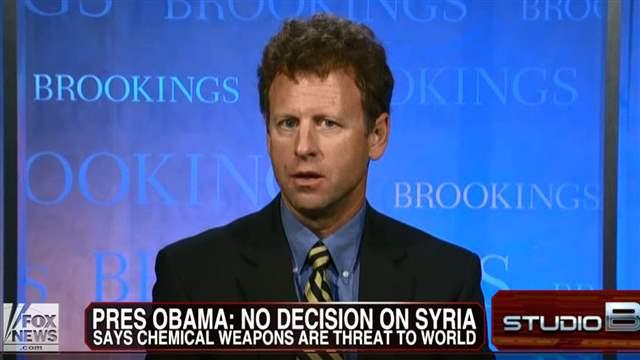
In recent years, O’Hanlon has also pushed for U.S. intervention in Syria’s civil war, writing in a May 2013 USA Today op-ed that President Barack Obama would “have to act” if allegations that Bashar al-Assad’s forces had used chemical weapons were confirmed, adding that he “tend[s] to support” calls to “arm the rebels, establish a no-fly zone,” and “set up areas for internally displaced persons and refugees.” However, he cautioned that such action should not be undertaken in the absence of a fully developed “exit strategy,” offering the resolution of the conflict in Bosnia-Herzegovina—in effect, an eventual “soft partition” of Syria along ethnic and religious lines—as a model.[3]
Such a plan, O’Hanlon argued, would “imply a number of U.S. peacekeepers on the ground, perhaps comparable in number to the 20,000 who began the job in Bosnia in 1995.” He said the deployment should only occur if Arab countries and Turkey pledge to provide a majority of the needed troops.[4]
Commenting on O’Hanlon’s proposal, a writer for the Daily Beast blog “Open Zion” wrote: “You’ll quickly note that O’Hanlon’s number is well shy of the 75,000 troops recommended by the Pentagon to secure chemical weapons. … It’s also a harrowing proposition: putting fewer troops on the ground than necessary to secure chemical weapons might leave them subject to precisely a chemical weapons attack.”[5]
Like other liberal interventionists, O’Hanlon insists that “hard power” must be complemented by “soft power,” particularly the strategic employment of foreign aid. In an April 2013Politico piece, O’Hanlon and retired Gen. David Petraeus argued that “America’s ability to protect itself and advance its global interests often depends as much on its ‘softer’ power as it does on our nation’s armed forces.” To that end, the two proposed a robust foreign aid program consisting of economic assistance to Egypt, energy assistance to Pakistan, security aid to the Democratic Republic of the Congo, and “aid for transitional governments in Libya, Yemen and Mali, and perhaps someday Syria,” as well as Afghanistan.[6]
Compared to neoconservatives, O’Hanlon has been less hawkish on Iran, ruling out short-term strikes on the country’s nuclear facilities as ineffective and counterproductive. He still tends to favor, however, a robust threat of force as a key component of U.S. strategy with respect to the country’s alleged nuclear weapons program.
As the historic nuclear deal with Iran was being finalized in 2015, O’Hanlon gave qualified support for the deal, arguing that he supports it “at the margin” because “of its limited time duration and its sunset clauses.” He nevertheless predicted that the deal would lead to a second Nobel Peace Prize for Barack Obama, which he amusingly argued Obama should share with George W. Bush, in part because it was the Bush administration that developed “smart sanctions.”[7]
In March 2012 O’Hanlon and his Brookings colleague Bruce Riedel proposed a policy they described as “constriction,” in which the United States “would continue to delay and minimize the scale of Iran’s nuclear program as we have been doing through sanctions and other means. We would keep doing this indefinitely, even if Iran gets a nuclear weapon. Force would not be categorically ruled out under such a policy. But it would have to pass a cost-benefit test.”[8]
Using the example of North Korea, O’Hanlon and Riedel argued that although the Iranian nuclear weapons program should be resisted, a small Iranian nuclear arsenal would not fundamentally shift the regional balance of power away from the United States and Israel. They added that multilateral strikes should be considered if “Iran ejected IAEA inspectors from existing facilities in a manner globally recognized as brazen and threatening,” but concluded that “Incremental Iranian progress toward a bomb, or even a few, is not reason enough to upend an international policy that is slowing the Tehran regime’s pursuit of nuclear capabilities much more than was once thought possible.”[9]
O’Hanlon was a vociferous booster of “surging” troop levels in both Iraq and Afghanistan in support of controversial counterinsurgency strategies pushed by think tanks like the Center for a New American Security. In support of his hawkish views, O’Hanlon often pointed to his experiences visiting war zones at the invitation of the U.S. military. In November 2009, for instance, shortly after a military-sponsored trip to Afghanistan, O’Hanlon wrote a two-part perspective article for the right-wing Washington Times based on his recent trip to the country. He argued that despite setbacks in the war, there was reason to be optimistic, especially if President Barack Obama approved “all” of Gen. Stanley McChrystal’s recommendations for more troops.[10]
Several months later, in May 2010, as the situation continued to deteriorate in Afghanistan despite the surge of new troops there, O’Hanlon returned for another tour. He again lauded the military’s plan, arguing that the “real dilemma concerns corruption.”[11]
O’Hanlon played a similar role promoting the “surge” in Iraq in 2007. In July of that year, shortly after coming back from a visit to Iraq with Gen. David Petraeus, O’Hanlon and coauthor Kenneth Pollack, a colleague at Brookings, published a New York Times op-ed titled “A War We Might Just Win.” The two analysts claimed that their tour of Iraq revealed that as a result of the surge, “morale was high,” the bad guys were on the run, and while the situation remained “grave,” the military escalation merited continued congressional support.[12] Exactly the message that Petraeus hoped to transmit, commented Brian Katulis of the Center for American Progress, who in an interview with Right Web called the O’Hanlon-Pollack article a “propaganda piece.”[13]
That O’Hanlon would have been chosen for such a tour was not surprising, said one commentator in an interview with Right Web.[14] During the months before his Iraq tour, O’Hanlon had helped promote the surge ideas pushed by neoconservatives at AEI, coauthoring a paper with AEI’s Fred Kagan, and inviting him to talk at a Brookings event. Said Bernard Finel of the American Security Project, “Petraeus knew that the Bush administration’s credibility was low, that it was going to have trouble selling the surge,” so he hand-picked a number of civilians who he knew were behind this policy and helped turn them into media “experts.”[15]
The paper O’Hanlon cowrote with Fred Kagan was published in April 2007 by the Stanley Foundation. Titled “The Case for Larger Ground Forces,” the paper laid out a number of scenarios that might require future U.S. military intervention, including in Iran, if that country gets close to developing a nuclear weapons capability and declares war against Israel; in North Korea, if Pyongyang invades its southern neighbor or collapses; in Pakistan, if intelligence indicates that Islamic extremists could gain access to nuclear weapons; and in Saudi Arabia, if there is a coup d’etat that leads to the establishment of a fundamentalist regime. According to O’Hanlon and Kagan, thinking through such scenarios is a necessary in order to develop criteria for enlarging U.S. ground forces and reshaping what the authors regard as a military suffering from, “the greatest strain and danger since the elimination of conscription in 1973.”[16]
They wrote, “Sound U.S. grand strategy must proceed from the recognition that, over the next few years and decades, the world is going to be a very unsettled and quite dangerous place, with Al Qaeda and its associated groups as a subset of a much larger set of worries. The only serious response to this international environment is to develop armed forces capable of protecting America’s vital interests throughout this dangerous time. Doing so requires a military capable of a wide range of missions—including not only deterrence of great power conflict in dealing with potential hotspots in Korea, the Taiwan Strait, and the Persian Gulf but also associated with a variety of Special Forces activities and stabilization operations. For today’s U.S. military, which already excels at high technology and is increasingly focused on re-learning the lost art of counterinsurgency, this is first and foremost a question of finding the resources to field a large-enough standing Army and Marine Corps to handle personnel-intensive missions such as the ones now under way in Iraq and Afghanistan.”
Commenting on the paper, Gareth Porter, a historian and contributor to the Inter Press Service, wrote, “The list of Islamic countries which Kagan and O’Hanlon suggest the United States should prepare to invade and occupy begins with Iran. That recommendation can only be called truly bizarre. Dick Cheney has more or less openly advocated the military option against Iran, but even he does not advocate trying to occupy a country three times bigger than Iraq and fully mobilized to resist a U.S. invasion. Kagan and O’Hanlon insist, however, that the occupation option cannot be ruled out, invoking a scenario in which Iran would go to war against Israel ‘as it also neared completion of a nuclear weapon.’ Aggressive war by Iran before it even has a nuclear weapon? Even in the magical world of national security scenarios, the illogic of that one is spectacular.”[17]
In December 2006, O’Hanlon and the Brookings Institution provided a forum for Kagan to present his Iraq troop “surge” ideas, which Kagan had developed as part of an AEI-led study group which many observers regarded as a transparent attempt to fend off the conclusions of the James Baker-led Iraq Study Group (ISG), an independent panel tasked by the administration to come up with alternative strategies for solving the debacle in Iraq. Among the ISG’s conclusions, which were contained in a final report released in late 2006, were shifting more U.S. troops to training efforts and approaching Syria and Iran as part of a regional peace effort.[18]
In contrast, the Kagan-AEI plan, entitled “Choosing Victory: A Plan for Success in Iraq,” eschewed negotiations with Iraq’s neighbors, arguing that only by substantially increasing U.S. troop strength in Iraq would it be possible to avoid a defeat that could lead to “regional conflict, humanitarian catastrophe, and increased global terrorism.” It proposed a “surge of seven army brigades and Marine regiments to support clear-and-hold operations” beginning in the spring of 2007, which would be aimed at securing “the Iraqi population and contain[ing] the rising violence”; lengthening the tours of ground troops and increasing deployments of National Guard forces; making a “dramatic increase in reconstruction aid for Iraq”; and mobilizing military industry “to provide replacement equipment” for troops.
Responding to Kagan’s presentation of the AEI plan at a Brookings event in December 2006, O’Hanlon agreed with Kagan’s argument that more troops were needed on the ground, although he disagreed with the idea that the U.S. military should stay in Iraq indefinitely. O’Hanlon explained that while he had earlier argued that U.S. troops seemed to be the major “irritant” in Iraq and pullout plans should be developed, he had had a change of heart. He said: “Well, there is some truth to that argument [about why the United States should begin to pullout of Iraq], but of course we all know that the big development in 2006 has been the beginning of a civil war in which the Sunni and Shi’ah fear each other more than us and they hate each other more than they hate the United States or the international community. I think, in broad terms, that is a fair conclusion to reach. So the idea of staying a little longer or staying a little bigger, I think is no longer a huge added irritant compared to what it might have seemed three years ago. Even though [Kagan] makes me a little nervous with this aspect of his plan, I think on balance there are more things that are more serious in Iraq in terms of stoking hatred, stoking violence.”[19]
In late March 2003, shortly after the United States invaded Iraq, O’Hanlon contributed his name to an open letter published by the Project for the New American Century (PNAC), a neoconservative advocacy outfit closely associated with AEI that played a major role generating public support for the invasion of Iraq and pushing an expansive “war on terror.” The letter, titled “Second Statement on Post-War Iraq,” departed from earlier PNAC proposals—which had typically pushed unilateral U.S. actions and ignored the need to engage the United Nations—in calling for greater cooperation with U.S. allies and other international actors in stabilizing Iraq. The letter stated, “Building a stable, peaceful, and democratic Iraq is an immense task. It must be a cooperative effort that involves international organizations—UN relief agencies, the World Bank, the International Monetary Fund, and other appropriate bodies—that can contribute the talent and resources necessary for success. It is therefore essential that these organizations be involved in planning now to ensure timely allocation of resources.” Among those contributing their names to the document were a passel of hardline neoconservatives—like Max Boot, Eliot Cohen, Joshua Muravchik, and William Kristol—as well as several foreign policy elites more closely associated with realism and liberal interventionism, including O’Hanlon and Ivo Daalder, also a scholar based at Brookings.[20]
O’Hanlon, a frequent op-ed writer for major news outlets like the Washington Post, also writes on other major U.S. security issues, like strategic policies and weapons programs. In a May 17, 2007 op-ed for the New York Times, O’Hanlon argued against rushing to deploy a missile defense system in Poland and the Czech Republic. Although he viewed the initiative as a “worthy idea”—despite the fact that later in the same op-ed he acknowledged that the missile defense system might not even work—O’Hanlon wrote that any benefits that might be gained from the base were outweighed by the detrimental impact the plan was having on U.S.-Russian relations. Instead, he pushed for waiting until new presidents were installed in Moscow and Washington before moving ahead with the plan. He concluded: “The next president, Republican or Democrat, will carry far less baggage than Mr. Bush, and may have an easier time making the final sale on missile defense to the Europeans. Given the gradual pace at which any threat is materializing and the relative slowness with which our technology is advancing, this is clearly a matter where haste makes waste. Most important, we must bear in mind that, as Secretary of Defense Robert Gates reminded Mr. Putin this winter, ‘One cold war was quite enough.’”[21]
Books and studies written or co-written by O’Hanlon includeHealing the Wounded Giant: Maintaining Military Preeminence while Cutting the Defense Budget (Brookings, 2013); Bending History: Barack Obama’s Foreign Policy (Brookings, 2012); The Wounded Giant: America’s Armed Forces in an Age of Austerity (Penguin, 2011); A Skeptic’s Case for Nuclear Disarmament (Brookings, 2010); Toughing It Out in Afghanistan (Brookings, 2010); The Science of War (Princeton, 2009); A War Like No Other (Wiley, 2007); Defense Strategy for the Post-Saddam Era (Brookings, 2005); The Future of Arms Control (Brookings, 2005); Neither Star Wars nor Sanctuary: Constraining the Military Uses of Space (Brookings, 2004); Crisis on the Korean Peninsula (McGraw-Hil,l 2003); Defense Policy Choices for the Bush Administration (Brookings, 2002); Defending America: The Case for National Missile Defense (Brookings, 2001); Technological Change and the Future of Warfare (Brookings, 2000); and Winning Ugly: NATO’s War to Save Kosovo (Brookings, 2000).