
Max Kampelman (1920-2013)
last updated: April 2, 2013
Please note: The Militarist Monitor neither represents nor endorses any of the individuals or groups profiled on this site.
Affiliations
- Jewish Institute for National Security Affairs: Former Member, Board of Advisors
- Freedom House: Former Chairman, Board of Trustees
- American Academy of Diplomacy: Former Chairman
- American Bar Association Standing Committee on Law and National Security: Former Counselor
- Jerusalem Foundation: Former Honorary Chairman
- Council for a Community of Democracies: Former Senior Advisor
- Project for the New American Century: Letter Signatory
- National Institute for Public Policy: Study Participant
- Committee on the Present Danger (2000s version): Former Member
- Committee on the Present Danger (1970s version): Former Member, Executive Committee
- American Committee for Peace in the Caucasus: Former Advisor
- Woodrow Wilson International Center for Scholars: Former Chair, Board of Trustees
- Social Democrats-USA: Former Member
- Coalition for a Democratic Majority: Former Vice Chairman
Government
- U.S. Institute for Peace: Former Vice Chairman, Board of Directors
- State Department: Ambassador and Head of the United States Delegation to the Negotiations with the Soviet Union on Nuclear and Space Arms (1985-1989); Counselor (1987-1989)
- U.S. Delegation to the Conference on Security and Cooperation in Europe: Ambassador and Head of Delegation, Various Administrations
- U.S. Delegation to the United Nations: Former Senior Advisor
- Staff of Sen. Hubert Humphrey: Legislative Counsel (1949-1955)
Business
- Fried Frank: Counsel
Education
- New York University: BA, 1940
- New York University School of Law: J.D., 1945
- University of Minnesota: MA, 1946; Ph.D. in Political Science, 1951
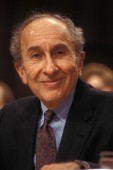
Max Kampelman, a Cold War-era arms control negotiator who supported numerous neoconservative-led policy campaigns, passed away in January 2013 at the age of 92.
Kampelman’s career spanned the Cold War, during which time he shifted between his private law practice and various government jobs, including serving as a legislative aide for several years to Sen. Hubert Humphrey (D-MN) and in various diplomatic posts under Presidents Jimmy Carter and Ronald Reagan.[1] Kampelman is best known for his work as Reagan’s chief arms control negotiator, serving from 1985 to 1989 as head of the U.S. negotiating teams that worked with the Soviet Union on nuclear and space weapons issues. He also served as ambassador to the Conference on Security and Cooperation in Europe from 1980 to 1983 and as counselor to the State Department from 1987 to 1989.
Like many of his neoconservative contemporaries, Kampelman's early politics leaned left, and at one time he was a member of the Social Democrats-USA, a splinter group of the Socialist Party that served as an early center of neoconservative activism in the United States.
A pacifist and conscientious objector during the Second World War, Kampelman fulfilled his selective service requirements by volunteering for an experiment in controlled starvation at the University of Minnesota. However, while working for Hubert Humphrey in the 1940s, Kampelman "underwent a transformation," according to the New York Times, "from being a declared pacifist to a centrist regarded as a hawk by left-leaning Democrats." According to Kampelman, "The development of atomic and hydrogen bombs led me to doubt my earlier faith in the power of nonviolence to overcome evil in international relations.”[2]
The transformation helped pave the way for Kampelman to serve as a hard-nosed negotiator for both the Carter and Reagan administrations, representing the United States in talks that eventually led to major U.S.-Soviet agreements on human rights in 1983 and the first Strategic Arms Reduction Treaty in 1991. Kampelman apparently maintained warm ties with the Reagan administration despite his campaign work for Walter Mondale, Reagan's Democratic challenger in 1984.[3]
Kampelman’s decades-long support for hardline “pro-Israel” advocacy groups reveals that his political transformation evolved beyond centrism, and toward a militaristic view of U.S. and Middle East security. He was a signatory to letters published by the Project for the New American Century (PNAC), an organization that played an important role building public support for the U.S.-led invasion of Iraq; chairman of the Freedom House board of trustees[4]; a member of the board of advisers of the Jewish Institute for National Security Affairs; and a "strategic adviser" to the Foundation for Defense of Democracies.
In the 1970s, Kampelman worked with the Coalition for a Democratic Majority (CDM), which served as a springboard for the evolution of the neoconservative political faction in the United States, and the Committee on the Present Danger (CPD), a group that helped push for an end to détente with the Soviet Union and served as a major source of Reagan administration appointees.
In 2001, Kampelman collaborated with the hardline National Institute for Public Policy (NIPP) on an influential policy document aimed at promoting aggressive new nuclear weapons policies. According to a 2002 World Policy Institute report, “In general, the NIPP report calls future security threats to the U.S. unknown and unpredictable. Therefore, the report concludes that the U.S. must maintain its nuclear arsenal, and the ability to design, build and test new nuclear weapons. The report asserts that conventional weapons are inadequate replacements for nuclear weapons because they do not have the same ‘destructive power.’ As a solution the report recommends the development of ‘low-yield, precision-guided nuclear weapons.’ In other words, a nuclear weapon the U.S. can actually use.”[5]
Yet Kampelman eventually became a proponent of global nuclear disarmament. In an April 2006 New York Times op-ed, Kampelman wrote that despite having witnessed “two successful titanic struggles by civilized society against totalitarian movements, those against Nazi fascism and Soviet communism,” he had “never been more worried about the future." Fretting that "The number of countries possessing nuclear arms is increasing, and terrorists are poised to master nuclear technology with the objective of using those deadly arms against us,” Kampelman wrote that "President Bush should consult with our allies, appear before the United Nations General Assembly and call for a resolution embracing the objective of eliminating all weapons of mass destruction. He should make clear that we are prepared to eliminate our nuclear weapons if the Security Council develops an effective regime to guarantee total conformity with a universal commitment to eliminate all nuclear arms and reaffirm the existing conventions covering chemical and biological weapons.”[6]
Shortly after penning this op-ed, Kampelman helped lead a Hoover Institution forum on nuclear disarmament. Other participants included an elite group of former policy makers, including Henry Kissinger, William Perry, Sam Nunn, and George Shultz. At the October 2007 conference, Kampelman repeated many of the same points he mentioned his New York Times op-ed. According to a Hoover Institution press release, “The theme of former U.S. ambassador Max Kampelman’s remarks was the importance of moving from ought to is. He compared the goals of the Reykjavik II conference to those of the U. S. Constitution. Kampelman said that the principles of the Constitution may have seemed idealistic when they were introduced, but the founders had a vision that what ought to be would eventually become reality. Kampelman believes that pursuing zero tolerance of nuclear weapons is a goal the U.S. government should energetically pursue to prepare for the future. ‘What ought calls for is to get rid of nuclear weapons,’ he declared.”[7]
President Bill Clinton awarded Kampelman the Presidential Medal of Freedom in 1999, and President Ronald Reagan awarded him the Presidential Citizens Medal in 1989.
Kampelman's books include Entering New Worlds: The Memoirs of a Private Man in Public Life (1991), and The Communist Party vs. The C.I.O: A Study in Power Politics (1957).