
David Gompert
last updated: June 28, 2011
Please note: The Militarist Monitor neither represents nor endorses any of the individuals or groups profiled on this site.
Affiliations
- Council on Foreign Relations: Member
- Carnegie Commission on Preventing Deadly Conflict: Commissioner
- International Institute for Strategic Studies: Member
- Foreign Policy Association: Member
- Atlantik Bruecke: Member
- George Marshall Center: Member, Board of Advisers
- RAND Pardee Center for Long Range Global Policy and the Future Human Condition: Member, Board of Advisers
- National Defense University: Former Distinguished Research Professor, 1997-1998
- United States Naval Academy: Former Visiting Professor
- RAND Transition 2001 Panel: Member
Government
- Office of the Director of National Intelligence: Deputy Director/Acting Director, 2009-2010
- Chief of Naval Operations' Executive Panel: Former Member
- National Security Council: Special Assistant to the President and Senior Director for European and Eurasian Affairs, 1990-1993
- Department of State: Various positions, 1973-1983
Business
- Unisys Corp.: Former President of Systems Management Group, and Vice President for Strategic Planning and Corporate Development
- AT&T: Former Vice President of Civil Sales and Programs, Former Director of International Market Planning
Education
- U.S. Naval Academy: Degree in Engineering
- Princeton's Woodrow Wilson School: M.A. in Public Affairs
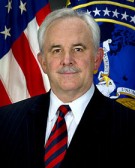
David Gompert is a former vice president of the RAND Corporation who served briefly as President Barack Obama’s acting director of national intelligence. Known for his sometimes hawkish views on defense policy, Gompert also served for many years in the State Department and as an advisor to Henry Kissinger and President George H.W. Bush.[1]
Among his more controversial ideas is that the United States should broaden the targets of its nuclear arsenal to include non-nuclear rogue regimes and expand deterrence policy to include the threat of nuclear attack in retaliation for chemical or biological attacks.
In a 2000 article for the Bulletin of the Atomic Scientists, Gompert argued that in combination with a no-first-use nuclear weapons policy, the “United States should retract its pledge not to use nuclear weapons against any non-nuclear states. If a non-nuclear state used a biological weapon against the United States, it should be on notice that it could pay a heavy nuclear price. … Rogue states are on the ropes, but they can hang on and do great harm if they acquire weapons of mass destruction. By concentrating nuclear deterrence on this particular problem, by creating a sharp fear, and by limiting the purpose of nuclear weapons to retaliation for attacks by weapons of mass destruction, the United States may help move the world a step closer to a world in which none of these horrible weapons would ever again be used.”[2]
One Bulletin reader, responding to Gompert’s article, wrote: “I disagree with the view that the United States should consider a nuclear response to a chemical or biological attack. The sole role of U.S. nuclear weapons should be to retaliate after a first use of nuclear weapons by another. I searched in vain in Gompert's piece for any recognition of the extent of death, destruction, and contamination that would result from a nuclear explosion in a populated place. Such an oversight is a common failing among those who propose the use of nuclear weapons, although the world outside that of nuclear proponents appears to have developed an appropriate revulsion to the wanton slaughter of innocents.”[3]
Another commentator wrote, “Twenty-first-century terrorists who deliver weapons of mass destruction and leave no return address are, unfortunately, unlikely to be stopped by the fear of ‘mutual assured destruction.’ Where exactly would the United States aim its ‘presumably selective nuclear detonation’?[4]
The type of analysis provided by Gompert has been reflected in the writings of various factions in the U.S. politics, including neoconservatives. For instance, Washington Post columnist Charles Krauthammer, in his well known 1990 article “The Unipolar Moment,” argued that “rogues states” armed with weapons of massive destruction “will constitute the greatest single threat to world security for the rest of our lives.” However, in contrast to Gompert’s call for clarifying strategic weapons policy, Krauthammer proposed robust U.S. military interventionism, arguing that if “America wants stability, it will have to create it.”[5]
Gompert first joined the Obama administration in 2009 as principal deputy director of national intelligence. After Dennis Blair stepped down as head of national intelligence in 2010, Gompert stepped in to serve as acting director, a post he held during May-August 2010.[6] One of Gompert’s more notable actions as acting director was his response to a two-year Washington Post investigation into the U.S. national intelligence bureaucracy that resulted in the 2010 Post special series “Top Secret America,” which was sharply critical of “the huge national security buildup in the United States after the Sept. 11, 2001,” calling into question its ability to protect the U.S. public.[7]
Responding to the series, Gompert said: “The reporting does not reflect the Intelligence Community we know. We accept that we operate in an environment that limits the amount of information we can share. However, the fact is, the men and women of the Intelligence Community have improved our operations, thwarted attacks, and are achieving untold successes every day. In recent years, we have reformed the IC in ways that have improved the quality, quantity, regularity, and speed of our support to policymakers, warfighters, and homeland defenders, and we will continue our reform efforts.”[8]
After leaving the Obama administration, Gompert became a director at the defense contractor Global Integrated Security (GIS), which describes itself as “one of the world’s leading providers of integrated security and defense technology for clients operating in high-stakes situations—when the problem is complex, when the mission is vital and when ingenuity is key. We empower our clients to achieve their toughest goals by strengthening national security, transforming critical environments and enabling opportunities.”[9]
Describing a Defense Department contract for work in Afghanistan, GIS reported on its website, “Our client is tasked with providing sustainable development programmes that employ the local populace, build skilled human capital and promote the future stability of Afghanistan. A major part of their work includes reconstruction and infrastructure development efforts in often hostile environments. As part of this major reconstruction initiative, GLOBAL Integrated Security has combined a broad range of intelligence and operational support services and defence technologies to facilitate the rebuilding and development of critical infrastructure in Afghanistan on behalf of our client. To address the wide range of security threats faced, we have leveraged Global Strategies Group-wide capabilities to create a centralised National Operations Centre to orchestrate activities and optimise our performance on the contract. Employing our combined Group experience, technology and expertise we designed and created the National Operations Centre to serve as the focal point for intelligence collection and analysis, information dissemination and asset tracking.”[10]
According to an unofficial bio, “Mr. Gompert was a Senior Fellow at the RAND Corporation, from 2004 to 2009. Before that he was Distinguished Research Professor at the Center for Technology and National Security Policy, National Defense University. From 2003 to 2004, Mr. Gompert served as the Senior Advisor for National Security and Defense, Coalition Provisional Authority, Iraq. He has also been on the faculty of the RAND Pardee Graduate School, the United States Naval Academy, and the National Defense University. Mr. Gompert served as President of RAND Europe from 2000 to 2003, during which period he was on the RAND Europe Executive Board and the Chairman of RAND Europe-UK. He was Vice President of RAND and Director of the National Defense Research Institute from 1993 to 2000. From 1990 to 1993, Mr. Gompert served as Special Assistant to President George H. W. Bush and Senior Director for Europe and Eurasia on the National Security Council staff. He has held a number of positions at the State Department, including Deputy to the Under Secretary for Political Affairs (1982-83), Deputy Assistant Secretary for European Affairs (1981-82), Deputy Director of the Bureau of Political-Military Affairs (1977-81), and Special Assistant to Secretary of State Henry Kissinger (1973-75). Mr. Gompert worked in the private sector from 1983-1990. At Unisys (1989-90), he was President of the Systems Management Group and Vice President for Strategic Planning and Corporate Development. At AT&T (1983-89), he was Vice President, Civil Sales and Programs, and Director of International Market Planning. Mr. Gompert has published extensively on international affairs, national security policy, and information technology. His books include Underkill: Capabilities for Military Operations amid Populations;War by Other Means: Building Complete and Balanced Capabilities for Counterinsurgency; BattleWise: Achieving Time-Information Superiority in Networked Warfare;Nuclear Weapons and World Politics (ed.);America and Europe: A Partnership for a new Era (ed.);Right Makes Might: Freedom and Power in the Information Age;Mind the Gap: A Transatlantic Revolution in Military Affairs;and Shoulder to Shoulder: The Road to US-European Military Co-operability.”[11]