
Steven Emerson
last updated: January 15, 2015
Please note: The Militarist Monitor neither represents nor endorses any of the individuals or groups profiled on this site.
Affiliations
- Investigative Project on Terrorism: Founder
- Counterterrorism Blog: Contributor
Business
- SAE Productions
- International Association of Counterterrorism and Security Professionals
Government Service
- U.S. Senate Foreign Relations Committee: Former Aide (Early 1980s)
Education
- Brown University: BA, MA
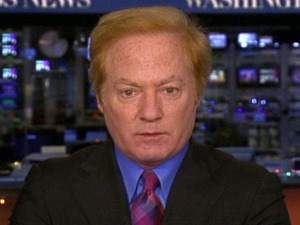
Steve Emerson, founder of the Investigative Project on Terrorism, is an author and media pundit who has made a career of issuing warnings about purported terrorist threats to the United States and the West.[1] A former freelance journalist, Emerson emerged as a terrorism “expert” in the 1990s when he began writing sensationalist pieces about the purported activities of Islamic terrorists operating on American soil.[2]
Although he has been repeatedly criticized for producing faulty analyses and having a distinctly anti-Islamic agenda, Emerson is a frequent guest commentator on news programs, particularly right-wing outlets like Fox News, and he has been invited to give testimony to Congress.[3] His work has also been lauded by a number of public figures. His personal website quotes Andrew McCarthy, a former federal prosecutor now with the neoconservative Foundation for Defense of Democracies, saying: “[Emerson] is a valuable source of information and knowledge. And in terms of trying to find places to look for evidence, he's a very good person to talk to. He's got a lot of insight." Emerson’s website also quotes the hawkish Republican Sen. Jon Kyl, who describes Emerson as “the most authoritative expert on Middle Eastern terrorism in the United States today.”[4]
Emerson was widely ridiculed after his appearance on a Fox News segment in January 2015 discussing attacks on the French satirical magazine Charlie Hebdo, during which he described the city of Birmingham, England, as a “Muslim-only city” where non-Muslims “don’t go.”[5] British Prime Minister David Cameron called Emerson “a complete idiot”[6] and Birmingham’s member of Parliament described his statements as “stupid.”[7] In light of the outrage, Emerson issued an apology, saying he had “relied on sources he had used in the past” and that he had made an “egregious error” in not doing his “homework.”[8]
Wrote Dan Murphy of the Christian Science Monitor: “If Emerson knows this little about Britain, what can he possibly know about Egypt and Iraq and Syria and all the other nations he regularly opines on?” Murphy added: “His efforts on Fox yesterday put him squarely in the middle of a know-nothing community of analysts whose careers are built on sounding the shrillest alarms, and encouraging the most drastic actions, in response to Islamist terrorism.”[9]
Since the 9/11 attacks and the onset of the “war on terror,” Emerson has played a key role in promoting what some observers describe as “Islamophobic” rhetoric, arguing that civil rights groups like the Council on American Islamic Relations (CAIR) are terrorists sympathizers and that liberals like President Barack Obama coddle Middle East terrorists.
In a 2009 article for the Hudson Institute-New York, Emerson repeated discredited [10] claims made by the likes of Daniel Pipes that CAIR—which has repeatedly denounced violent extremism—supports radical Islamic groups. Pointing to CAIR’s purported beginnings in the early 1990s as a front group for funneling money to violent Palestinian groups, Emerson wrote: “For 14 years, CAIR got away with lying to us about who they are, justifying Islamic terrorist attacks, legitimizing suicide bombings, presenting speakers who had been Holocaust deniers, making incendiary presentations about the United States and urging Muslims not to talk to the FBI.”[11]
Emerson has claimed that the Obama administration has prevented the FBI from monitoring U.S. members of the so-called Islamic State (or ISIS) who have returned to the United States. “The FBI has been handcuffed in terms of investigating religious extremists in mosques, as a result of guidelines put out by the attorney general earlier this year,” Emerson told Fox News in September 2014. “And so therefore, there is … a definite problem now in investigating those militants in the United States who are either recruiting for ISIS or have returned from Syria or Iraq having fought for ISIS, and are ready to carry out freelance or directed terrorist attacks on behalf of ISIS against the United States.”[12]
After President Obama added his voice to the international condemnation of the Israeli raid on a Gaza aid flotilla in early 2010 that resulted in the deaths of several pro-Palestinian activists, Emerson wrote in Forbes: “Appearing on CNN's Larry King show on June 3, [Obama] repeated his demand for an Israeli investigation. But this time, Obama revealed his own biased predisposition when he told King, ‘You've got loss of life that was unnecessary.’” Misleadingly claiming that there is no humanitarian crisis in Gaza, Emerson added that “the president blurted out his real agenda when he criticized the Israelis for their blockade of Gaza: ‘you've got a blockade up that is preventing people in Palestinian Gaza from having job opportunities and being able to create businesses and engage in trade and have opportunity for the future.’ Here, [the president] joined the world Hamas lobby—Islamic and European countries—in piling on Israel for creating such a humanitarian mess in Gaza, which in reality does not exist.”[13]
In a widely noted 2011 report about U.S. actors who promote anti-Muslim views, the Center for American Progress (CAP) included Emerson on a short-list of individuals who have been instrumental in demonizing Islam and generating fear about the purported existential threat this religion poses to the West. Among the other figures highlighted in the report, titled Fear Inc: The Roots of the Islamophobia Network in the United States, were Daniel Pipes, David Horowitz, Frank Gaffney, Brigitte Gabriel, Pamela Geller, and Zuhdi Jasser.
According to the CAP report, Emerson’s Investigative Project on Terrorism (IPT)—which claims to be “the world's most comprehensive data center on radical Islamic terrorist groups”—has been the beneficiary of considerable largesse from a small group of donors who have propped up a tightly networked group of Islamophobic institutions in the United States. CAP also reports how IPT has apparently turned its anti-Islam work into a lucrative, for-profit enterprise:
Reports Fear Inc.: “Emerson’s nonprofit organization IPT received a total of $400,000 from Donors Capital Fund in 2007 and 2008, as well as $100,000 from the Becker Foundation, and $250,000 from Daniel Pipes’ Middle East Forum, according to our research. Emerson’s nonprofit organization, in turn, helps fund his for-profit company, SAE Productions. IPT paid SAE Productions $3.33 million to enable the company to ‘study alleged ties between American Muslims and overseas terrorism.’ Emerson is SAE’s sole employee. Even more intriguingly, a review of grants in November 2010 showed large sums of money contributed to the ‘Investigative Project,’ or ‘IPT,’ care of the Counterterrorism & Security Education and Research Foundation. An examination of CTSERF’s 990 forms showed that, much like the Investigative Project, all grant revenue was transferred to a private, for-profit entity, the International Association of Counterterrorism and Security Professionals. Emerson did not respond to requests for comment by time of publication. The Russell Berrie Foundation has contributed $2,736,000 to CTSERF, and Richard Scaife foundations contributed $1,575,000.”[14]
Commenting on the creative accounting of these various institutions, Ken Berger, president of Charity Navigator, a nonprofit watchdog group, said that “basically, you have a nonprofit acting as a front organization, and all that money going to a for-profit.”[15]
According to the CAP report, in his capacity as head of the Investigative Project on Terrorism, Emerson—who was cited twice in Anders Breivik’s manifesto—“frames Islam as an inherently violent and antagonistic religion.” It quotes Emerson as saying: “The level of vitriol against Jews and Christianity within contemporary Islam, unfortunately, is something that we are not totally cognizant of, or that we don’t want to accept. We don’t want to accept it because to do so would be to acknowledge that one of the world’s great religions, which has more than 1.4 billion adherents, somehow sanctions genocide, planned genocide, as part of its religious doctrine.”[16]
Trajectory and Track Record
Discussing the trajectory of Emerson's career, Zachary Lockman, a scholar at New York University, wrote in 2005: "[Emerson's] main focus during the 1990s was to sound the alarm about the threat Muslim terrorists posed to the United States. By the end of that decade Emerson was describing himself as a 'terrorist expert and investigator' and 'Executive Director, Terrorism Newswire, Inc.' Along the way, critics charged, Emerson had sounded many false alarms, made numerous errors of fact, bandied accusations about rather freely, and ceased to be regarded as credible by much of the mainstream media. The September 11 attacks seemed to bear out Emerson's warnings, but his critics might respond that even a stopped clock shows the right time twice a day.”[17]
Among his claims to fame is Emerson’s February 14, 1998 testimony to the Senate Judiciary Committee in which he stressed the growing threat from a host of Islamic extremists, including Osama bin Laden. Testified Emerson: "In the five years since the [1993 World Trade Center] bombing, intelligence officials and law enforcement agents have discovered that militant Islamic extremists have established extensive networks throughout the United States. Although there is no established hierarchy that centrally coordinates the activities of the myriad militant networks, the intelligence and law enforcement communities agree that the entire spectrum of radical groups from the Middle East has been replicated in the United States." Among the groups Emerson highlighted were Hamas, Islamic Jihad, Hezbollah, "followers of Osama bin Laden," the Taliban, "and support groups of mujahideen (holy warriors) in Bosnia, Philippines, Chechnya, and other places." According to Emerson, "These groups have created large networks of supporters from whom they have raised tens of millions of dollars for their movements, recruited and trained new followers, underwritten their brethren organizations in the Middle East and elsewhere, and even remotely directed terrorist operations back in the Middle East or Europe."[18]
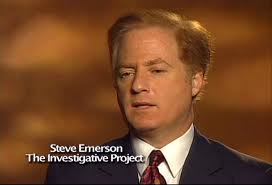
Earlier, in 1994, Emerson produced the Frontline piece “Jihad in America,” which won the George Polk Award for best TV documentary. The film was also credited in part with leading to the Patriot Act: "Congressman Christopher Smith told the Washington Post in November 2001 that Jihad in America, which was distributed to members of Congress after September 11, 2001, 'played a real role in the House passage of the Patriot Act antiterrorism legislation.'"[19] This is a dubious honor, as parts of the act were ruled unconstitutional and several states and cities have passed laws condemning what they see as the act's infringement on civil liberties. Despite that, in his 1998 testimony, Emerson said: "The film included previously unknown videos of the clandestine activities of radical Islamic terrorist groups operating in the United States and featured interviews with moderate Muslims and federal counterterrorism officials speaking for the first time about the magnitude of the threat posed by militant Muslim groups on U.S. soil. I was gratified by the fact that the film served as the impetus for the counterterrorism legislation passed by Congress, and that it became a standard part of federal law enforcement education and training."
Emerson also claimed during his 1998 congressional testimony that the media attention generated by the film made him a target of terrorism: "I became the target of radical fundamentalist groups throughout the United States (and internationally) who fiercely denied the existence of 'Islamic extremism' and accused me of engaging in an 'attack against Islam.' For this 'transgression,' my life has been permanently changed. One morning, in late 1995, I was paged by a federal law enforcement official. I found out why I had been summoned: I was told a group of radical Islamic fundamentalists had been assigned to carry out an assassination of me."[20]
Emerson has turned the claims about threats to his life into a signature aspect of his professional persona, one that he has highlighted in his promotional materials and interviews. As Slate.com reported in 2003, "People who visit Emerson's DC office must be blindfolded en route, and employees call it 'the bat cave.'"
Despite its awards, Jihad in America was criticized by some observers as mere "agit-prop," as journalist John Sugg termed it.[21] In a 1999 article for Extra!, a publication of the watchdog group Fairness and Accuracy in Reporting (FAIR), Sugg documented how the film's apparent efforts to target certain Middle Eastern professors resulted in a rash of inflammatory articles published by the Tampa Tribune that were later heavily criticized for lacking fairness and balance. According to Sugg, the Miami Herald undertook a lengthy investigation into the Tribune's reporting, concluding that "the Tampa newspaper had ignored 'perfectly innocent' interpretations of activity, giving vent only to characterizations that suggested 'extremely dark forces were on the prowl.'"[22]
Sugg also contested Emerson's claims that he was targeted for assassination because of his film and challenged the accuracy of his 1998 congressional testimony. In a 1998 article for the Weekly Planet, Sugg said that when he queried FBI spokesman John Russell regarding Emerson's claims about being notified by the agency of a hit squad that was targeting him and the possibility of being put in the witness protection program, Russell responded: "You pushed the right button asking about your friend Steve Emerson. We've never given any thought to putting him in the witness protection program." Regarding whether there was any truth to the claims of an assassination squad, Russell said: "No, none at all.”[23]
In 1995, Emerson founded the Investigative Project on Terrorism. The project's website has been an important promotional tool plugging Emerson's various books, including Jihad Incorporated: A Guide to Militant Islam in the United States (Prometheus Books, 2006). In a review of the book posted on the American Library Association's Booklist web site, Brendan Driscoll wrote: "Emerson matter-of-factly names and catalogues a host of organizations and narrates each group's specific activities, footnoted to news articles and government reports. Given the nature of the topic, it is difficult to tell which of Emerson's many claims are credible and which err on the side of overstatement (something Emerson has been accused of before). This book will be most sought after by readers hungry for factual specifics about possible threats rather than for more nuanced theoretical or historical approaches to the topic.”[24]
Although some of Emerson's supporters include the likes of former antiterrorism czar Richard Clarke, who told Brown Alumni Magazine that he saw Emerson "as the Paul Revere of terrorism," his biggest boosters seem to be among hardline neoconservatives and rightists who frequently cite Emerson as one of the country's foremost experts on Islamic terrorism. Daniel Pipes of the Middle East Forum, who has collaborated with Emerson on numerous occasions since the 1990s, once wrote of Emerson: "While Emerson remains doggedly on the trail of Islamists, especially those among them who support terrorism, he has for four years been forced to live at a clandestine address, always watching his movements. Like the case of Rashad Khalifa, murdered in Tucson for his views, the case of Steven Emerson suggests that, despite the Constitution's guarantees of freedom of religion and freedom of speech, when it comes to Islam, unapproved thinking can lead to personal danger or even death.”[25]
In October 2006, the Fox News program Hannity & Colmes featured Emerson during a show highlighting the purported connections between leftists in the United States and Islamic extremists. Asked whether there was a "quasi-alliance" between radical Islamists and radical left academics, Emerson said: "You're 100 percent right.”[26]
Among some of his more notorious claims, Emerson told a reporter shortly after the 1995 Oklahoma City bombing that he believed the perpetrators were likely Islamic terrorists. The reporter, Tampa Tribune's Michael Fechter, wrote: "More and more, terrorism experts in the United States and elsewhere say Wednesday's bombing in Oklahoma City bears the characteristics of other deadly attacks linked to Islamic militants." Describing the incident, Eric Boehlert of Salon.com wrote: "Fechter seemed to be an odd choice to write the piece, since at the time the county news reporter had virtually no experience covering religion, politics, or terrorism for the Tribune. Instead, he wrote crime stories, covered local city council politics, and monitored neighborhood action groups. But what readers didn't know was that Fechter had recently befriended controversial terrorism expert Steve Emerson—who has been accused of sloppy journalism and with having a pervasive anti-Arab bias—and behind the scenes was remaking himself into a self-styled authority on terrorism.”[27]
In an effort to downplay his claims, which he repeated to a number of journalists other than Fechter, Emerson later wrote that criticism of his allegations, especially from the likes of the Council on American-Islamic Relations (CAIR), was misplaced. In an article for the conservative WorldNetDaily, Emerson wrote: "Less than six hours after the bombing I was asked on television whether I thought militant Islamic groups were involved. There was good reason for thinking they might be. The bombing, after all, was in Oklahoma City, where I had first encountered such militant groups in 1992. Several Hamas operatives were known to be living in the Oklahoma City area. At first, federal law enforcement officials were suspicious themselves."[28]
Emerson also received criticism for claiming the 2013 Boston Marathon bombings were conducted by “a Saudi national.” Once it became clear this was not the case, Emerson insisted the Saudi role in the bombing was being covered up and the “Saudi national” was being deported to Saudi Arabia.[29]
Emerson has contributed to the CounterterrorismBlog.org, which describes itself as "a unique, multi-expert blog dedicated to providing a one-stop gateway to the counterterrorism community." In a July 28, 2005, entry titled "The American Islamic Leaders' 'Fatwa' Is Bogus," Emerson derided the well-intentioned "fatwa" against terrorism and extremism announced by a number of American Islamic groups, including the Fiqh Council of North America and CAIR. "The fatwa is bogus," Emerson argued. "Nowhere does it condemn the Islamic extremism ideology that has spawned Islamic terrorism. It does not renounce nor even acknowledge the existence of an Islamic jihadist culture that has permeated mosques and young Muslims around the world. It does not renounce Jihad let alone admit that it has been used to justify Islamic terrorist acts. It does not condemn by name any Islamic group or leader. In short, it is a fake fatwa designed merely to deceive the American public into believing that these groups are moderate.”[30]
Emerson and his supporters have gone to great lengths to defend his reputation. Responding to the 1999 Extra! article penned by John Sugg about Emerson, the Journal of Counterterrorism and Security International (now the Journal of Counterterrorism and HomelandSecurity International) published a press release accusing AIR, CAIR, and Sugg of having "collectively fabricated evidence in manufacturing a conspiracy against investigative journalist and terrorism expert Steven Emerson." The press release also opined that FAIR was "an ultra-left wing group that has defended Iraqi dictator Saddam Hussein, supported Islamic and Middle Eastern terrorists, and even promoted a known anti-Semite." The journal, which has featured articles by Emerson, is published by the International Association of Counterterrorism and Security Professionals, thefor-profit entity connected to Emerson’s Investigative Project on Terrorism.[31]
In response the press release, FAIR said: "The press release features the same kind of inaccurate and reckless charges that Extra! said were characteristic of Emerson's work. [T]he Journal seems to share Emerson's chronic inability to differentiate between criticism of U.S. policies and endorsement of the targets of those policies. FAIR, of course, has never defended the actions of Saddam Hussein or supported terrorism of any kind. As for the 'known anti-Semite,' FAIR (whose founder and executive director is Jeff Cohen) has no idea whom the Journal is talking about." The "conspiracy," said FAIR, was nothing more than a typical reporting investigation, involving interviews with various supporters and critics of Emerson. FAIR highlighted a number of inaccuracies in the Journal's accusation, including that fact that CAIR was not involved in the production of the article, but merely released its own comments about the article after the fact.[32]
Emerson went on to sue Sugg and his employer at the time of the 1999 Extra! article, the Weekly Planet, for defamation. The lawsuit, which sought $11 million in damages, contended that Sugg and the Weekly Planet "maliciously and repeatedly published false and defamatory utterances" in an "ongoing campaign to undermine Emerson's credibility and damage his professional and personal reputation."[33] According to CounterPunch, in May 2003, Emerson decided to file for dismissal of the lawsuit.