
Condoleezza Rice
last updated: November 21, 2014
Please note: The Militarist Monitor neither represents nor endorses any of the individuals or groups profiled on this site.
Affiliations
- Hoover Institution: Thomas and Barbara Stephenson Senior Fellow
- Washington Institute for Near East Policy: Board of Advisers (2014- )
- Stanford University: Professor, Political Science, Business; Director, Global Center for Business and the Economy; Former Provost
- Council on Foreign Relations: Member, Former Fellow
- American Academy of Arts and Sciences: Former Fellow
- Flora Hewlett Foundation: Former Board Member
- University of Notre Dame: Former Board Member
- Carnegie Corporation: Former Board Member
- Carnegie Endowment for International Peace: Former Board Member
- National Council for Soviet and East European Studies: Former Board Member
Government
- Secretary of State (2005-2009)
- National Security Advisor (2001-2005)
- Special Assistant to the President for National Security Affairs and Senior Director for Soviet Affairs: George H.W. Bush Administration
- National Security Council: Director of Soviet and East European Affairs (1989)
- Joint Chiefs of Staff: Council on Foreign Relations Fellow on Nuclear Strategic Planning (late 1980s)
- Advisory Committee on Gender/Integrated Training in the Military: Member, 1997
Business
- Rice Hadley Group: Cofounder
- Dropbox: Board Member
- Chevron: Former Board Member
- Hewlett Foundation: Former Board Member
- Charles Schwab: Former Board Member
- J.P. Morgan: Former Member, International Advisory Board
- Transamerica Foundation: Former Board Member
- Hewlett Packard: Former Board Member
Education
- University of Denver: B.A. in Political Science
- University of Notre Dame: M.A. in Political Science
- University of Denver's Graduate School of International Studies: PhD
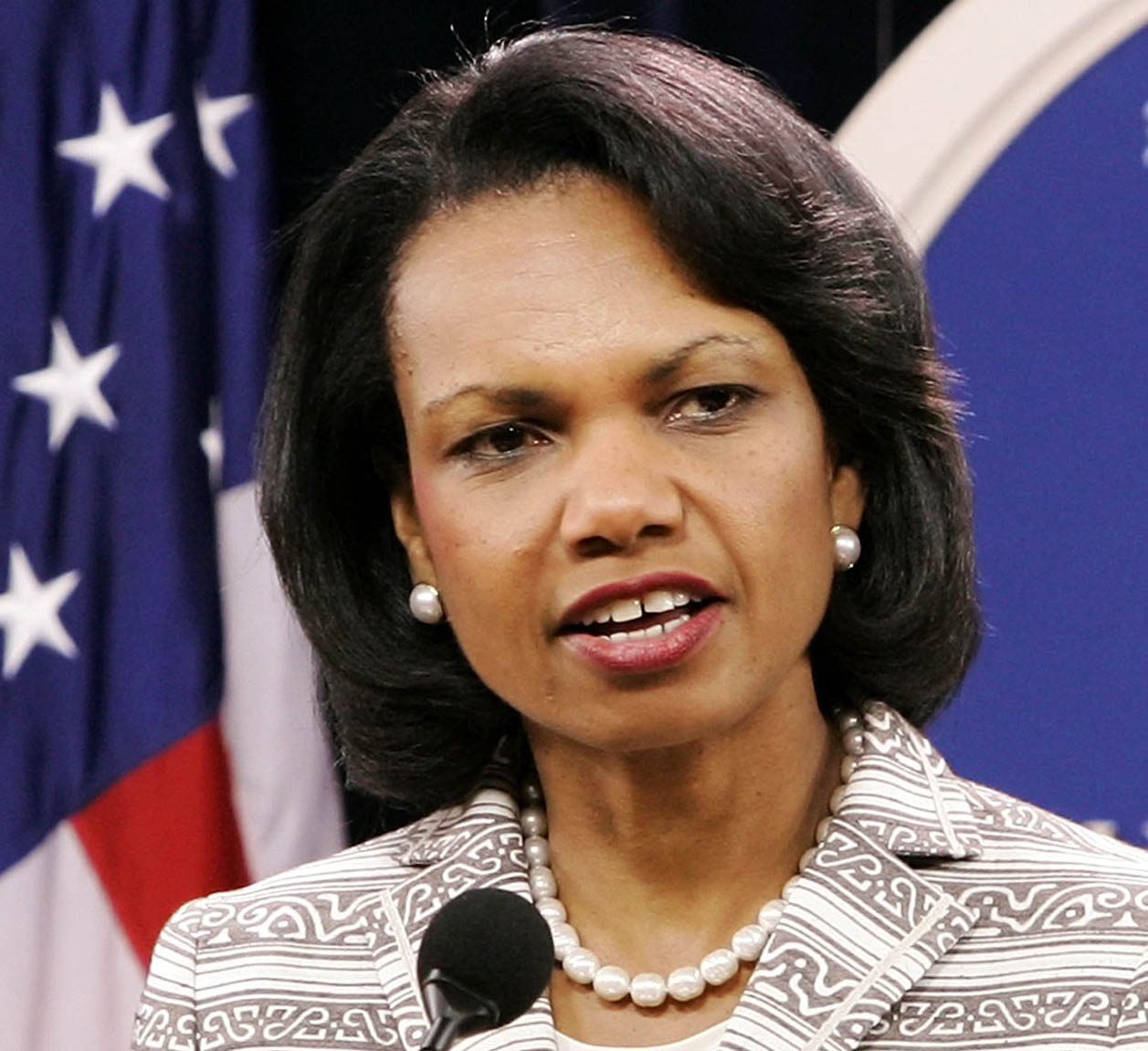
Condoleezza Rice is a conservative academic and writer who served as national security adviser and later secretary of state in the George W. Bush administration.[1] Shortly after leaving the administration, Rice became a senior fellow at Stanford University’s Hoover Institution, a hawkish think tank where Rice had been based before Bush was elected. In November 2013, Rice joined the board of advisers of the Washington Institute for Near East Policy, a spinoff of the American Israel Public Affairs Committee.[2]
Rice has also been active in private business. In 2009, she co-founded with fellow ex-Bush official Stephen Hadley a consulting firm, the Rice Hadley Group.[3]
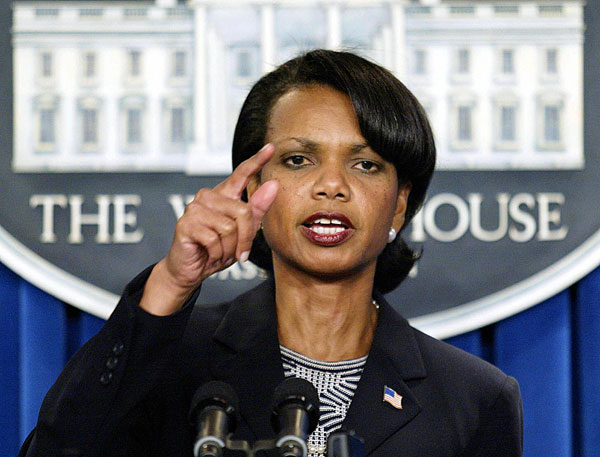
Rice joined the Board of Directors of the popular online cloud-storage service Dropbox in 2014, spurring much controversy. A website called “Drop Dropbox” was set-up shortly after Rice’s appointment was announced that argued for a boycott of Dropbox because of Rice’s record of support for the National Security Agency’s warrantless wiretapping program.[4]
A blog post on the website asked, “Why on earth would we want someone like her involved with Dropbox, an organization we are trusting with our most important business and personal data?”[5]
Rice also worked to boost the 2012 GOP presidential ticket of Mitt Romney and Paul Ryan, implying in her public statements that President Obama was weak in his leadership on foreign affairs.
During her speech at the 2012 Republican Party Convention in Tampa, Florida, Rice purported: "We cannot be reluctant to lead. And you cannot lead from behind. Mitt Romney and Paul Ryan understand this reality, that our leadership abroad and our well-being at home are inextricably linked.” She then added, paraphrasing a rallying cry of neoconservative groups like the Center for Security Policy, “Our adversaries must have no reason to doubt our resolve because peace really does come through strength.”[6]
In October 2014 it emerged that Rice was behind the killing of a 2003 New York Times story by journalist James Risen about a failed CIA attempt to sabotage Iran’s nuclear program. In an interview with the television program 60 Minutes, former New York Times executive editor Jill Abramson revealed that Rice, then national security adviser, requested a personal visit from her, during which Rice sternly told her to cease Risen’s reporting on the story. Abramson said in a 60 Minutes interview she has since come to regret giving in to Rice’s demand.[7]
Risen, who later told the CIA story in a 2006 book titled State of War, became engaged in series of legal battles with the U.S. government over the identity of his sources, which he eventually lost.[8]
Hoover Institution
From her perch at Hoover, Rice has written op-eds for major news and opinion outlets covering mainly foreign policy issues, including everything from relations with Russia to the impact of the Arab Spring.[9]
In early 2012, after protests erupted in Russia over the election of Prime Minister Vladimir Putin as president, Rice wrote that “this victory may be both Putin’s last and the final one for Putinism. The future turns on the behavior of a rising Russian middle class that is integrated into the world and alienated by the Kremlin’s corrupt politics.” She concluded that the United States has “a stake in their success and an obligation to help them achieve it.”[10]
Rice, a former board member at the Chevron oil company, conceded that the United States did not have much influence on the outcome, but suggested that the United States could assist the Russian protesters by speaking out for human rights—and by developing its own domestic energy resources.[11]
“Undoubtedly,” she wrote, “lower oil prices would rob the Kremlin of the easy money that fuels corruption, personal fortunes and authoritarianism. This is yet another compelling argument for developing North America’s significant sources of energy.”[12]
In response to the 2014 Ukraine crisis, Rice stressed the need for the United States to “restore its standing in the international community.” Writing for the Hoover Digest, Rice said the events in Ukraine should be a “wake-up call to those on both sides of the aisle who believe that the United States should eschew the responsibilities of leadership.” She went on to call for the authorization of the controversial Keystone XL pipeline to “swamp Moscow’s capacity” and thereby hurt Russia by bringing down the price of hydrocarbons.[13]
Rice saw a bigger hand for the United States in Egypt following the fall of Hosni Mubarak, although she expressed a measure of regret for past U.S. policies in the region.
In a February 2011 Washington Post op-ed published shortly after Mubarak’s ouster, Rice conceded that “the United States had, in the Middle East more than any other region, sought stability at the expense of democracy, and had achieved neither.” Although U.S. support for Egypt’s military had sustained the Mubarak regime for decades, Rice suggested preserving such ties during Egypt’s democratic transition, “We cannot determine the foreign policy preferences of Egypt's next government,” she admitted. “But we can influence them through our ties to the military, links to civil society, and a promise of economic assistance and free trade to help improve the lot of the Egyptian people. The most important step now is to express confidence in the future of a democratic Egypt.”[14]
Secretary of State
Rice served as a secretary of state during Bush’s second term, replacing Colin Powell. Her tenure was marked in part by her efforts to revive U.S. diplomacy, which had severely languished during Bush’s first term.
In an apparent departure from the preemptive, go-it-alone posture that had dominated U.S. policy in the wake of the 9/11 attacks, Bush allowed Rice to attempt to repair relations with key allies in Europe and elsewhere, initiate talks with "enemy" states like Iran, and pursue multilateral diplomatic efforts, most notably in response to North Korea's provocative missile tests in July 2006.[15]
After the outbreak of hostilities between Israel and Hezbollah in July 2006, for example, Rice echoed neoconservatives like Richard Perle in arguing that the Israeli strikes are "an entirely appropriate response to the existential struggle in which Israel is now engaged."[16]
Rice rejected calls for an early ceasefire, arguing that it "would be a false promise if it simply returns us to the status quo." As for the destruction wrought by the Israeli strikes, Rice commented that these were the "birth pangs of a new Middle East.”[17]
Contradictory postures were also apparent in the Rice State Department's dealings with Iran. While offering direct negotiations with Iran if the country were to cease its uranium enrichment program, the State Department at the same time pursued a regime-change agenda, budgeting some $85 million for this purpose and establishing a bevy of specialized outfits—including the Office of Iranian Affairs and the Iran-Syria Policy and Operations Group—which at minimum seemed aimed at communicating that the administration's real goal was overturning Tehran’s “mullahocracy.”[18]
As Richard Haass, president of the Council on Foreign Relations and a State Department official under Colin Powell, told the Los Angeles Times, "We are telling Iran, 'We want regime change, but while you're still here, we'd like to negotiate with you to stop your nuclear program.’ "[19]
National Security Advisor
Rice’s tenure as Bush’s national security advisor was plagued with controversy. Her assistant, Stephen Hadley, took the fall for the administration’s effort to push the idea that Iraq tried to buy uranium from Niger, which threw a harsh light on the National Security Council.
According to the Washington Post, then-CIA Director George Tenet told Hadley that the Niger allegations, which President Bush and Vice President Richard Cheney repeatedly used as a justification for invading Iraq, were probably bogus and should be discarded.[20]
Both Hadley and Rice were subjects of the 9/11 Commission's investigation of the intelligence failures that preceded the attacks. Even though both had seen a counterterrorism report in August 2001 warning that Al Qaeda was planning an attack on the United States, Rice told the commission, "There was no silver bullet that could have prevented the 9/11 attacks. There was nothing demonstrating or showing that something was coming in the United States. If there had been something, we would have acted on it."[21]
During the debate over her nomination as secretary of state, lawmakers charged Rice with refusing to acknowledge errors in planning or judgment and avoiding accountability for the absence of weapons of mass destruction in Iraq.
"In the end, I could not excuse Dr. Rice's repeated misstatements," Sen. Dick Durbin (D-IL), said of his vote against Rice.[22]
The Washington Post reported at the that Rice “has become enmeshed in the controversy over the administration's use of intelligence about Iraq's weapons in the run-up to the war. She has been made to appear out of the loop by colleagues' claims that she did not read or recall vital pieces of intelligence. And she has made statements about U.S. intelligence on Iraq that have been contradicted by facts that later emerged. Either she missed or overlooked numerous warnings from intelligence agencies seeking to put caveats on claims about Iraq's nuclear weapons program, or she made public claims that she knew to be false.”[23]
Rice also had a controversial record as national security adviser on the issue of warrantless wiretaps. She notoriously defended the Bush administration’s wiretapping of American citizens, saying such programs were aimed at collecting “information on a limited number of people with connections to al Qaeda.”[24]
In 2005, Raw Story revealed that in 2003 National Security Adviser Rice authorized a plan to secretly wiretap the “home and office and monitor private email accounts of members of the United Nations Security Council … to determine how foreign delegates would vote on a U.N. resolution that paved the way for the U.S.-led war in Iraq.”[25]
Rice also played a role in the creation of the Bush administration’s detainee interrogation programs during which alleged “enemy combatants” were tortured. A 2009 Senate Intelligence Committee reported that Rice met with then CIA director George Tenet on July 17, 2002, to personally deliver the president’s approval of the water-boarding techniques the CIA was using to interrogate alleged Al Qaeda operatives.[26]
The Senate report also notes that in 2003 Rice—along with fellow Bush administration officials Dick Cheney and John Ashcroft—were briefed on the use of water-boarding, sleep deprivation, forced nudity, and stress positions and “reaffirmed that the CIA program was lawful and reflected administration policy.”
Professional Trajectory
Prior to Bush's election in 2000, Rice was known for advocating a restrained foreign policy, one that would be strictly tied to U.S. national interests. But Rice quickly expressed a new comfort level with the aggressive ideological agendas promoted by the likes of Paul Wolfowitz and Dick Cheney. In September 2002, for instance, she famously claimed, "There will always be some uncertainty about how quickly [Saddam Hussein] can acquire nuclear weapons. But we don't want the smoking gun to be a mushroom cloud."[27]
During her tenure in the Bush adminstration, Rice often resorted to neocon-flavored rhetoric, as in her February 2003 remark, "Power matters. But there can be no absence of moral content in American foreign policy, and furthermore, the American people wouldn't accept such an absence. Europeans giggle at this and say we're naive and so on, but we're not Europeans, we're Americans—and we have different principles.”[28]
Since the mid-1980s, Rice has moved briskly through the revolving door connecting government, corporate America, academia, and think tanks. Rice got her start in government in 1986, when she received a Council on Foreign Relations fellowship to serve on the strategic planning staff of the Joint Chiefs of Staff. During the administration of President George H.W. Bush, Rice was an assistant to the National Security Council (NSC), where she became a go-to person for Soviet affairs. Bush senior once told Gorbachev, "This is Condoleezza Rice. She tells me everything I know about the Soviet Union."[29]
Rice's ties with corporate America include her former membership on the boards of Transamerica Corporation, Hewlett Packard, and Chevron. Chevron named an oil tanker after her but renamed it after she became national security advisor.
Over the years, Rice developed a close relationship with the Bush family, including with former first lady Barbara Bush. During the two years prior to the election of George W. Bush, Rice was one of the most frequent overnight guests at the then Governor Bush’s mansion in Austin. During the presidential campaign, Rice repeatedly demonstrated her loyalty to candidate Bush, once referring to him as "someone of tremendous intellect."
When George W. Bush began assembling advisors for his run at the White House, his foreign policy team, which included Rice, was nicknamed the "Vulcans," a reference to the Roman god of fire and metal, as well as to Rice's hometown of Birmingham, Alabama, which is known as the center of the Southern steel industry.
Among the other Vulcans were Hadley, Cheney, Donald Rumsfeld, and Wolfowitz. "The Vulcans," wrote James Mann in his 2004 history of the Bush war cabinet, "represented the generation that bridged what are commonly depicted as two separate and distinct periods of modern history: Cold War and post-Cold War. For the Vulcans, the disintegration of the Soviet Union represented only a middle chapter in the narrative, not the end or the beginning."[30]
A year before Bush took office, Rice wrote a widely noted essay in Foreign Affairs entitled "Promoting the National Interest." Her prescription for a new U.S. foreign policy centered on a critique of Clinton policy, which she argued was disconnected from U.S. national interests and was tied too closely to multilateral concerns.[31]
"Foreign policy in a Republican administration will proceed from the firm ground of the national interest, not from the interests of an illusory international community," she wrote. According to Rice, "multilateral agreements and institutions should not be ends in themselves" and measures such as the Kyoto Protocol and the Comprehensive Test Ban Treaty would constrain U.S. national interests.[32]
The United States, she argued, should return to the core principle that "power matters." Rice asserted that rather than "exercising power legitimately only when doing so on behalf of someone else," the United States should focus solely on pursuing its national interest. The "second-order effect" of this pursuit, she said, would be that the rest of the world would benefit. Concerning Iraq, Rice wrote: "Nothing will change until Saddam is gone, so the United States must mobilize whatever resources it can, including support from the opposition, to remove him."[33]