
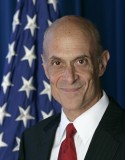
Michael Chertoff
last updated: October 9, 2016
Please note: The Militarist Monitor neither represents nor endorses any of the individuals or groups profiled on this site.
Affiliations
- Federalist Society: Associate, Speaker
Government Service
- Department of Homeland Security: Secretary, 2005-2009
- Justice Department: Assistant Attorney General, 2001-2005
- Whitewater Committee: Special Counsel, 1994-1996
- Supreme Court: Law Clerk for Hon. William Brennan, 1979-1980
Private Sector
- Chertoff Group: Founder
- Covington & Burling: Senior of Counsel, 2009-
- Latham and Watkins: Partner, 1994-2001
Education
- Harvard Law School: JD, 1978
- Harvard College: BA, 1975
Michael Chertoff is a long-standing Republican Party figure who served in the George W. Bush administration and has supported militarist U.S. foreign policies.[1] A Harvard-trained lawyer affiliated with the right-wing Federalist Society, Chertoff’s record includes serving as the first secretary of the Department of Homeland Security (2005-2009), as a federal judge in the U.S. Court of Appeals for the Third Circuit (2003-2005), as Assistant Attorney General under John Ashcroft, and as special counsel to the Clinton-era Whitewater Commission.[2]
Since leaving the Department of Homeland Security (DHS) in 2009, Chertoff has been active in both business and politics. Among his corporate activities, Chertoff founded a risk management firm called the Chertoff Group to “advise corporate clients and governments, including foreign governments” on security matters; served as senior of counsel to the high-power legal and lobbying firm Covington & Burling; and served as board chairman at the military contractor BAE Systems.
Chertoff has also been involved in presidential politics. In 2011, Republican presidential candidate Mitt Romney included Chertoff on his campaign advisory team on foreign and defense policy. Joining Chertoff was a host of other former Bush administration officials like Dov Zakheim and Eric Edelman, as well as several high-profile neoconservatives, including Robert Kagan, Paula Dobriansky, Eliot Cohen, and Dan Senor.[3]
In 2016, Chertoff switched political allegiances after the nomination of Donald Trump. In an October 2016 interview with Bloomberg, Chertoff endorsed Hillary Clinton for president, arguing that Clinton “has good judgment and a strategic vision how to deal with the threats that face us”and that Trump’s “loyalties are misplaced.” “Some of our NATO allies sent troops overseas, at the same time he is defending Russia and trying to dismiss what is widely acknowledged to be Russian intrusions into the databases of our political parties and political figures.” Chertoff argued that this was in effect “making enemies of your friends and cozying up to your adversaries.”
Earlier, in August 2016, Chertoff was one of several dozen former “national security officials” from Republican administrations dating as far back as Richard Nixon published an open letter saying they would not vote for Trump. They argued that he would be a “dangerous president,” that he appeared to “lack basic knowledge about and belief in the U.S. Constitution,” has “little understanding of America’s vital national interests,” displays “an alarming ignorance of basic facts of contemporary international politics,” and persistently “compliments our adversaries and threatens our friends and allies.”
Track Record
At the Justice Department in 2001, Chertoff helped to craft the Patriot Act. As head of DHS in the aftermath of the 9/11 terror attacks, Chertoff was heavily criticized on a number of counts, most notably for his role in the Bush administration’s response to hurricane Katrina. Chertoff also helped push the Bush administration’s controversial immigration reform agenda, including the effort to expand law enforcement to intensify the detention of undocumented migrants.
Chertoff was a vocal proponent of many “war on terror” policies. In an April 22, 2007 op-ed for the Washington Post, Chertoff repeated the oft-used rhetoric of neoconservatives and hardliners comparing Al Qaeda and Islamic radicals to venerable villains like Hitler and Stalin. Criticizing Zbigniew Brzezinski, President Jimmy Carter’s national security advisor, and other scholars for arguing that administration officials are “falsely depicting or hyping a ‘war on terror’ to promote a ‘culture of fear,’” Chertoff wrote that the United States is “at war with a global movement and ideology whose members seek to advance totalitarian aims through terrorism.” He added: “Today’s extreme Islamist groups such as al-Qaida do not merely seek political revolution in their own countries. They aspire to dominate all countries. Their goal is a totalitarian, theocratic empire to be achieved by waging perpetual war on soldiers and civilians alike.”[4]
Commenting on the op-ed, Ivan Eland, an author based at the Independent Institute, argued that many of Chertoff’s characterizations were simply wrong. “The 9/11 attacks were treacherous acts of terrorism, but Chertoff and the Bush administration, the U.S. foreign policy establishment, and the American media act as if they were the beginning of history,” Eland wrote. “Only in religion and quantum physics are there events without cause. Most Americans are unaware of their government’s history of unnecessary and profligate meddling in the affairs of countries throughout the Middle East. For their own safety and security, Americans cannot continue to ignore that the Islamist venom resulting in 9/11 was rooted in this U.S. interventionist and quasi-imperial foreign policy. Instead of perpetuating the myth that the United States is at war with ‘fanatics’ who have a reflexive hatred of America, the nation’s homeland security chief could better spend his time examining the real motivator for such terrorism—U.S. foreign policy—and recommending a policy of military restraint in the Middle East to reduce the chances of terrorist attacks at home.”[5]
In a 2006 speech at Harvard, Chertoff defended wire-tapping and other Bush administration domestic anti-terror tactics. Arguing that fighting terror requires going beyond law enforcement, Chertoff asserted that “Before 9/11, the tools that existed had not been fashioned for a war on terror, but on criminal prosecution.” Al Qaeda’s activities, he said, “revealed three fundamental elements” that placed the anti-terror struggle in the category of a war: they have well-defined political aims, attempt to acquire territory, and can cause wide-scale damage. He also argued that critics of the “war” lack reasonable alternatives. “The consequences have to be measured with real world decisions when deciding on matters that deal with life or death. Terrorism in real life doesn’t wait until you are done reviewing the evidence.”[6]
A sign of Chertoff’s political partisanship is his longtime association with the Federalist Society, a national organization of rightist lawyers and judicial reform activists dedicated to realigning the U.S. legal system to reflect a more conservative interpretation of the Constitution. One of Chertoff’s first assignments in the George W. Bush administration was working with John Ashcroft, another Federalist Society associate, to investigate the 9/11 attacks.[7]
While at DHS, Chertoff addressed the Federalist Society on several occasions. As keynote speaker for the group’s 2006 convention, Chertoff raised the specter of international lawyers threatening U.S. security. He urged Federalist Society members “to confront a new challenge, and that is the rise of an increasingly activist, left-wing, and even elitist philosophy of law that is flourishing not in the United States but in foreign courts and in various international courts and bodies.”
Chertoff said that the International Criminal Court and legal decisions taken in other international fora threaten to constrain U.S. action. Chertoff concluded, “[I]f you take some of the ideas you’ve developed [at the Federalist Society], and you take them overseas and you take them to academia, and you take them into the legal-philosophical salons in Europe, you will eventually start to persuade because the merit of these ideas I think is strong. And what’s wanting is the energy and the initiative and the courage to take them to a place where until now they have not been very seriously heard.”[8]
One of the highlights of Chertoff’s career before joining the Bush administration was his service as special counsel to the Whitewater Commission. In 1994, the Republican-led Congress created the Commission to investigate Bill and Hillary Clinton’s involvement in Arkansas real estate and other business deals. Now widely regarded as a political witch-hunt spearheaded by Sen. Alfonse D’Amato (R-NY) and Independent Counsel Kenneth Starr, the Whitewater Commission spent $40 million on the investigation, which ultimately failed to find that the Clintons had done anything illegal. Chertoff contributed a total of $2,000 to the “Friends of Senator D’Amato Committee” in 1997 and 1998.[9]
Chertoff’s record as a federal appeals court judge became a matter of contention when he was nominated to become DHS secretary. Immigration rights activists charged that Chertoff had often appeared overtly dismissive of asylum claims, ruling against such claimants in 14 of 18 cases. In one case, he denied asylum to a Bangladeshi man who was imprisoned, severely beaten in jail, and forced to denounce his dissident political party.[10]
In 2007, Chertoff helped draft the compromise immigration bill that Sen. Jon Kyl (R-AZ) and Sen. Ted Kennedy (D-MA) attempted to push through the Senate.[11] In the first go-round, in June, the bill (which called for increased border security and employee-verification programs for immigrants, among other things) failed, short 15 votes due largely to Republican resistance. But the Bush administration—and Chertoff—refused to give up. According to the New York Times, after the bill stalled, Chertoff “pleaded for its passage, saying the administration “was willing to consider a number of proposed Republican amendments, including one that would require illegal immigrants to ‘touch back’ in their home countries (or some other country) to apply for legal status.”[12]
Working under Ashcroft as an architect of the post-9/11 initiatives on the domestic war on terror, Chertoff helped supervise the roundup of 750 Arabs and Muslims on suspicion of immigration violations. Alleged to be terrorist sympathizers or material witnesses to terrorist acts, the “suspects” were held without bond for as long as three months, often in solitary confinement, despite never having been charged with a crime. Eventually, most were released or deported after trials by secret tribunals.[13]
In a 2003 report, the Justice Department’s inspector general criticized these draconian measures as “indiscriminate and haphazard.” The report also concluded that Chertoff and other top government officials had instituted a “hold until clear” policy for immigrant detainees, even though immigration officials questioned the policy’s legality. In his book After, author Steven Brill describes how Chertoff obstructed detainees’ access to lawyers, reasoning that they “could be questioned without lawyers present because they were not being charged with any crime.”[14]
Writing in the neoconservative flagship Weekly Standard in December 2003, Chertoff attempted to refute charges that the Bush administration’s war on terror measures had in many instances violated the Constitution. According to Chertoff, Bush “avoided the kind of harsh measures common in previous wars.” Although engaged in a war on both domestic and international fronts, the president did not authorize the “evacuation or preventive detention of American citizens based on ethnic heritage.” Nor was there any “government suppression of dissent or criticism,” wrote Chertoff, adding that unlike such respected predecessors as John Adams or Woodrow Wilson, Bush “has not prosecuted those who argue against the administration, nor has the government seized newspapers or banned them from the mails, as Lincoln did.”[15]
Concerning the detention of “enemy combatants,” Chertoff argued in the same Weekly Standard article that the Bush administration followed the “customary and well-accepted practice of incapacitating enemy soldiers overseas.” Regarding such matters as deciding “how long combatants can be held when we are fighting a war of extended or indefinite duration,” Chertoff said the United States must “think outside the box but not outside the Constitution.”[16]
In a June 2004 op-ed in the Wall Street Journal, Chertoff opined that the United States cannot win the war against terrorism if it “fight[s] in a legal fog, constantly speculating and litigating piecemeal about what the law might be. A murky legal climate only obscures our options and hamstrings our forces.” Regarding the role courts might have in monitoring U.S. intelligence agencies’ domestic actions, Chertoff wrote: “Basic policy questions like this cannot be simply left to the judiciary.” Similarly, in his December 2003 Weekly Standard article, he wrote that it was time for “the most creative legal thinking” about the role of the U.S. justice system in “fighting a war of extended duration,” arguing: “We are at a transition point in the evolution of legal doctrine to govern the armed conflict of terror.”[17]
[1] Chertoff Group, Michael Chertoff,” http://chertoffgroup.com/bios/michael-chertoff.php.
[2] Doug Ireland, “Mike Chertoff’s Dirty Little Secrets,” LA Weekly, January 12, 2005; White House press release, “Michael Chertoff, Secretary of Homeland Security,” http://web.archive.org/web/*/%20http://www.whitehouse.gov/government/chertoff-bio.html (Web Archive); Tom Barry, “Chertoff No Friend of Immigrants,” Counterpunch, April 1, 2005.
[3] Mitt Romney 2012 Presidential Campaign press release, “Mitt Romney Announces Foreign Policy And National Security Advisory Team,” October 6, 2011, http://www.mittromney.com/blogs/mitts-view/2011/10/mitt-romney-announces-foreign-policy-and-national-security-advisory-team.
[4] Michael Chertoff, “Make No Mistake: This Is War,” Washington Post, April 22, 2007
[5] Ivan Eland, “Chertoff Uses Totalitarian Comparisons To Defend War on Terror,” Independent Institute, April 23, 2007
[6] Kevin Zhou, “Chertoff Defends Bush Policies on Terror, Immigration,” Harvard Crimson, October 17, 2007
[7] Doug Ireland, “Mike Chertoff’s Dirty Little Secrets,” LA Weekly, January 12, 2005; Tom Barry, “Chertoff No Friend of Immigrants,” Counterpunch, April 1, 2005.
[8] Federalist Society, “2006 NLC Address—Michael Chertoff,” http://www.fed-soc.org/publications/pubID.780/pub_detail.asp
[9] Campaign Contribution Search, Michael Chertoff, http://www.newsmeat.com/washington_political_donations/Michael_Chertoff.php
[10] “Review Shows Chertoff Firm on Asylum Claims,” Associated Press, February 8, 2005.
[11] Michael Luo, “Change on Immigration Turns Senator Kyl into Lightning Rod,” New York Times, May 29, 2007
[12] Carl Hulse and Jeff Zeleny, “Bush Lobbies GOP Senators on Immigration,” New York Times, June 13, 2007.
[13] Alliance for Justice, “Report on the nomination of Michael Chertoff to the U.S. Court of Appeals for the Third Circuit,” May 2003, http://web.archive.org/web/20031205224307/http://www.independentjudiciary.com/resources/docs/Chertoff+Report.pdf
[14] Nat Hentoff, “Ashcroft in Conference,” Village Voice, June 27, 2003
[15] Michael Chertoff, “Law, Loyalty, and Terror,” The Weekly Standard, December 1, 2003
[16] Michael Chertoff, “Law, Loyalty, and Terror,” The Weekly Standard, December 1, 2003
[17] Michael Chertoff, “Law, Loyalty, and Terror,” The Weekly Standard, December 1, 2003