
William Bennett
last updated: April 17, 2012
Please note: The Militarist Monitor neither represents nor endorses any of the individuals or groups profiled on this site.
Affiliations
- Empower America: Founder
- Americans for Victory Over Terrorism: Founder/Senior Adviser
- Campaign for America's Children: National Board of Advisers
- Project for the New American Century: Signatory
- Heritage Foundation: Former Fellow
- Hudson Institute: Former John M. Olin Fellow
- Notre Dame Center for Ethics and Culture: Board of Advisers
- Partnership for a Drug-Free America: Co-chair
- Foundation for Community and Faith Centered Enterprise: Board of Visitors, 2002
- National Commission on Civic Renewal: Co-Chairman
- Center for Security Policy: National Security Advisory Council
- George W. Bush Presidential Campaign 2000: Speech writer/editor, 1999
- National Humanities Center (Raleigh, NC): President, 1979-1981; Executive Director, 1976-1979
- University of North Carolina at Chapel Hill: Former Adjunct Associate Professor of Philosophy
- North Carolina State University: Former Adjunct Associate Professor of Philosophy, late 1970s
- Boston University College of Liberal Arts: Assistant to the President and Assistant Professor of Philosophy, 1972-1976
- Institute of Educational Affairs: Former Trustee
- Madison Center: Former Member
- Committee for a Free World: Former Trustee
- National Science Foundation: National Research Council, Member
- National Academy of Education: Special Panel Member
- Marymount University: Distinguished Visiting Professor, 1995
- Intercollegiate Studies Institute: Wrote introduction to Choosing the Right College, 1998
- Ashbrook Center for Public Affairs: Major Issues Lecture Series, 1993
- Center for the Study of Popular Culture: Former Member, Board of Directors
- Catholic Campaign for America: Board of Directors
- National Review: Former Senior Editor
- FoxNews: Former Contributor
Government
- Office of National Drug Control Policy: Director, 1989-1990
- President's Child Safety Partnership: Member, 1986
- Department of Education: Secretary of Education, 1985-1988
- National Endowment of the Humanities: Chairman, 1981-1985
Business
- SmartCOP: Board of Directors
- K12 Inc.: Former Chairman
Education
- Williams College: B.A. in Philosophy, 1965
- University of Texas in Austin: Ph.D. in Philosophy, 1970
- Harvard Law School: J.D., 1971
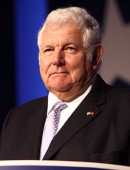
William Bennett, a Republican Party stalwart for several decades, is a right-wing pundit who has a nationally syndicated radio show, “Bill Bennett’s Morning in America,” and holds a fellowship at the Claremont Institute, a California-based neoconservative research institution.[1] Bennett has founded a number of advocacy groups supported by high-profile hawks and neoconservatives like Donald Rumsfeld and Michael Novak that promote conservative social policies and hawkish foreign policies, including Americans for Victory over Terrorism and Empower America.
A founding member of the Project for the New American Century (PNAC), Bennett often devotes space on his radio show to pushing neoconservative talking points on foreign policy, frequently featuring fellow PNAC veterans on the air. In a March 2012 broadcast, for example, Bennett interviewed Weekly Standard editor and PNAC cofounder William Kristol, who claimed during the interview that President Barack Obama was “leading from behind” on Iran and outlined a “serious” agenda for the United States in the Middle East: “If we were being serious in the Middle East,” Kristol told a sympathetic Bennett, “we would be using air strikes in Syria, we would topple the Assad regime, and we’d go right ahead and take out the Iranian nuclear program.”[2]
Echoing PNAC’s breezy assessment of the risks of a U.S. invasion of Iraq, Kristol told Bennett, “I don't think we're talking about a big deal here. … The more I think about it, the more I think [taking out Iran’s nuclear program] is something we can do."[3]
On other occasions, Bennett has taken to other outlets to parrot the talking points of his guests. “On my radio show,” he wrote on CNN.com in October 2011, “Michael Rubin, who is the American Enterprise Institute's Middle East expert and teaches our troops at the Naval Postgraduate School, said with no qualifications that he thinks we will lose Iraq because of” President Obama’s withdrawal. “Dan Senor,” Bennett continued, “senior adviser and the chief spokesman for the U.S.-led coalition in Iraq in 2003-2004, told me that the president's decision shocked and perplexed him. Iraq cannot survive sectarian violence and Iranian influence on its own, he added. Baghdad will surely move closer to Tehran in our absence.”[4]
Bennett first rose to prominence in the early 1980s when he was appointed to head the National Endowment for the Humanities (NEH), and then in 1985 as Secretary of Education. Both appointments surprised observers because of Bennett's apparent lack of credentials. Only 34 years old at the time of his 1981 NEH appointment, Bennett had little academic experience and even less publishing experience. What Bennett lacked in experience, however, he made up in connections. As historian Philip Burch writes, “Bennett had been director of the rightist Committee for the Free World, a body whose executive director was Midge Decter, who was a trustee of the Heritage Foundationand the wife of Commentary's influential editor, Norman Podhoretz. … In addition, in 1980 Bennett had been an adjunct scholar at the Heritage Foundation, and later that year had contributed to that body's 'politically prescriptive' Mandate for Leadership volume [which served as a policy blueprint for the Reagan administration]. … Throughout the 1980s, [Bennett was also] a member of the board of directors of the New York-based Institute for Education Affairs," which was created in 1978 by Irving Kristoland William Simon.[5]
Bennett was appointed education secretary after he helped produce Heritage's "Mandate for Leadership," which argued that the creation of the Department of Education had been a "historic blunder, a combination of overweening federal ambition and pandering to interest groups. Still, the department exists. The question now becomes: How can it be turned into an agency of minimum nuisance? … A suitably reformed Department of Education would resemble a three-room schoolhouse.”[6] He served as education secretary until 1988, and in 1989 was appointed as the nation's first "drug czar" by President George H.W. Bush; Bennett served in that post until 1990.[7]
Though he has been out of government for years, Bennett remains a key right-wing figure, exercising his influence through a coterie of rightist policy organizations that he helped form. In 1993, he founded Empower America, which in 2004 merged with Citizens for a Sound Economy to form FreedomWorks, a Tea Party-aligned group whose motto is "Lower taxes, less money, and more freedom," and which has counted on a number of well known conservative Republicans to serve on its board, including Steve Forbes. Bennett also founded the now-defunct Americans for Victory over Terrorism, a post-9/11 pressure group that was taken over by the Claremont Institute.
Bennett was sharply critical of post-9/11 thinkers who dared to question the Bush White House's handling of the war on terror. When Professor Eric Foner of Columbia University wondered shortly after 9/11, "I'm not sure which is more frightening: the horror that engulfed New York City or the apocalyptic rhetoric emanating daily from the White House,'' Bennett seized the thought and turned it into an issue of morality and patriotism. In a piece for the Boston Globe, Bennett wrote: "Just whose principles are the Columbia, Williams College, and Harvard faculties promoting? Have they criticized Osama bin Laden as much as they have President George W. Bush?”[8]
Bennett's strain of unquestioning flag-waving and vilification of liberal educators helped blaze a trail followed by the likes of David Horowitz, who in 2006 published a book of the supposed "most dangerous" (i.e., liberal) U.S. professors. Bennett at one time served on the board of Horowitz's Center for the Study of Popular Culture, which later became the Horowitz Freedom Center.
In 2006, Bennett was part of an anti-immigration letter-writing campaign organized by the Hudson Institute, where Bennett was once a fellow. "We are in the middle of a global war on terror," the letter read. "2006 is not 1986. Today, we need proof that enforcement (both at the border and in the interior) is successful before anything else happens. As Ronald Reagan used to say 'trust, but verify.'" The letter was signed by Bennett along with other right-wing and neoconservative figures, such as Newt Gingrich, Robert Bork, Daniel Pipes, David Frum, Fred Ikle, and Frank Gaffney, among others.[9]
Bennett has served on the advisory board for Gaffney's Center for Security Policy, along with the likes of Morris Amitay, Phyllis Kaminsky, Paula Dobriansky, Richard Perle, Robert Joseph, former Rep. Curt Weldon, former Rep. Chris Cox, Michael Rubin, and many other right-wing voices.
Bennett is perhaps best known for his advocacy of right-wing domestic policies, including on education and race. In 1997, Bennett declared that "Homosexuality 'takes 30 years off your life,'" reported Slate.com.[10] According to Slate, he repeated it in the pages of the November 24, 1997 Weekly Standard.
In fall 2005, Bennett was criticized “for comments he made on a radio program about the potential for reducing crime by aborting all black children," reported the New York Times.[11] Bennett had said: "I do know that it's true that if you wanted to reduce crime, you could, if that were your sole purpose, you could abort every black baby in this country, and your crime rate would go down. … That would be an impossible, ridiculous, and morally reprehensible thing to do, but your crime rate would go down."
The uproar over Bennett's comments reportedly led him to resign from his post at K12 Inc., an online resource for home-schooling that was under investigation by the General Accountability Office for its “involvement in a project that received an improper multimillion-dollar grant from the Department of Education during Bennett's tenure at the firm," according to Media Matters for America.[12]
In 2003, Bennett was harshly criticized for his gambling habits, which seem to run counter to his many moral crusades. As Joshua Green reported in the Washington Monthly: "Few vices have escaped Bennett's withering scorn. He has opined on everything from drinking to 'homosexual unions' to 'The Ricki Lake Show' to wife-swapping. There is one, however, that has largely escaped Bennett's wrath: gambling. If Bennett hasn't spoken out more forcefully on an issue that would seem tailor-made for him, perhaps it's because he is himself a heavy gambler. The Washington Monthly and Newsweek have learned that over the last decade Bennett has made dozens of trips to casinos in Atlantic City and Las Vegas, where he is a 'preferred customer' at several of them, and sources and documents provided to The Washington Monthly put his total losses at more than $8 million".[13]
"By furtively indulging in a costly vice that destroys millions of lives and families across the nation, Bennett has profoundly undermined the credibility of his word on this moral issue," Green wrote.
Bennett has written or edited several books, including The Book of Virtues (1993) and Why We Fight: Moral Clarity and the War on Terrorism (2003). He has also been a trustee at the conservative-leaning Sarah Scaife Foundation; in the late 1980s he was a director at the Lynde and Harry Bradley Foundation.