
Dick Cheney
last updated: June 15, 2018
Please note: The Militarist Monitor neither represents nor endorses any of the individuals or groups profiled on this site.
Affiliations
- Alliance for a Stronger America: Cofounder
- American Enterprise Institute: Member, Board of Trustees (as of 2012); Senior Fellow (1993-1995)
- Project for the New American Century: Founding signatory (1997)
- Jewish Institute for National Security Affairs (JINSA): Advisory Board Member (2000)
- American Political Science Association: Congressional Fellow (1968-1969)
Government
- Former Vice President (2001-2009)
- Department of Defense: Secretary of Defense (1989-1993)
- House of Representatives: Minority Whip (1988)
- House Republican Conference: Chairman (1987)
- Republican Policy Committee: Chairman (1981-1987)
- House of Representatives: Congressman (R-WY) (1978-1989)
- White House: Chief of Staff for President Gerald Ford (1975-1977); Deputy Assistant to President Gerald Ford (1974-1975); Staff Assistant (1971)
- Cost of Living Council: Assistant Director (1971-1973)
- Office of Economic Opportunity: Special Assistant to Director Donald Rumsfeld (1969-1971)
Business
- Halliburton, Inc.: President and Chief Executive Officer (1995-2000)
Education
- University of Wisconsin: Graduate studies
- University of Wyoming: B.A., 1965, and M.A. in Political Science, 1966
- Caspar College: Undergraduate classes
- Yale University: Three undergraduate semesters
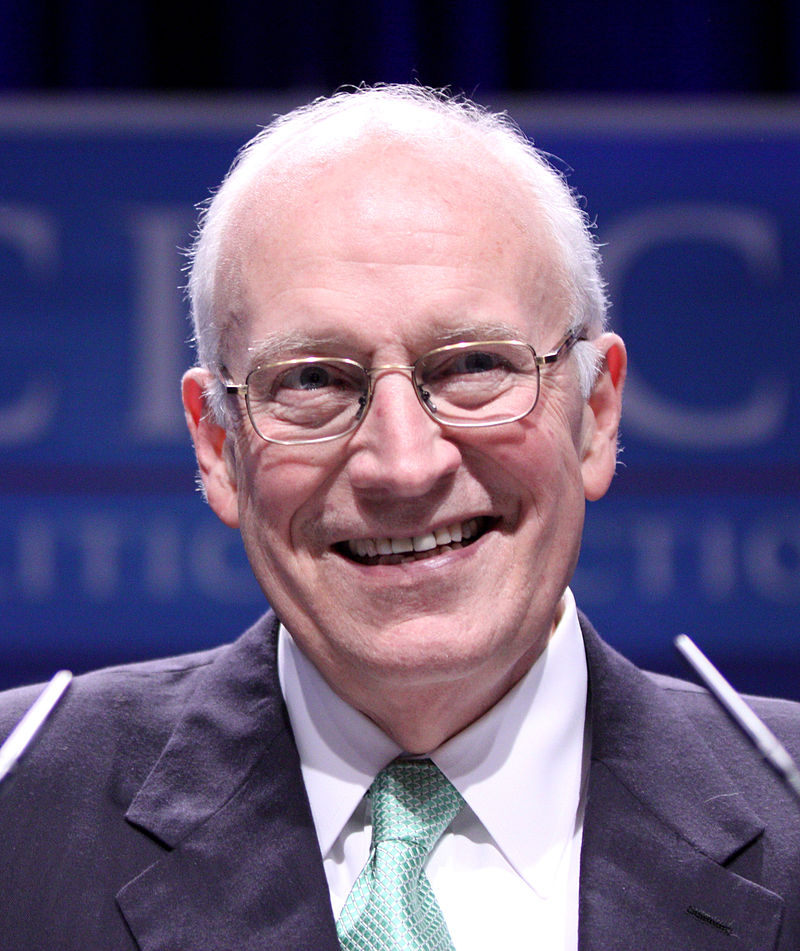
Dick Cheney, U.S. vice president under George W. Bush (2001-2009), has been an influential figure in Republican Party politics since the 1970s. Widely considered one of the most powerful vice presidents in U.S. history, Cheney played an instrumental role in everything from expanding presidential war powers to pushing an aggressive “war on terror” that included overturning unfriendly Mideast regimes and indefinitely detaining terrorism suspects without charge.
His influential role dictating the agenda of the Bush administration helped focus attention on the many erroneous statements and prognostications he made while in office. During the lead up to the invasion of Iraq, for example, he said that there was “no doubt” that the Saddam Hussein regime had “weapons of mass destruction” and predicted that Iraqis would greet U.S. troops as “liberators.” In 2005, Cheney insisted that the Iraqi insurgency was in its final stages. Faced with criticism for his mistaken views, Cheney has been unrepentant, arguing in July 2014: “I look back on it now, [the invasion of Iraq] was absolutely the right thing to do.”[1]
In 2015, Senator Rand Paul (R-KY) said that Cheney’s foreign policy decisions had been a “disaster for this country. … I think Dick Cheney has probably been wrong about almost every foreign policy decision over the last 20 or 30 years.”[2]
Since leaving office, Cheney has remained politically active, founding a fear-monger pressure group called Alliance for a Stronger America, becoming a member of the board of trustees of the neoconservative American Enterprise Institute, and promoting massive military budgets to support U.S. war-fighting abilities.
He is the spouse of the writer and AEI fellow Lynne Cheney. His daughters are the neoconservative activist Liz Cheney and pro-gay rights Republican activist Mary Cheney. In 2015, Cheney and his daughter Liz released a book titled Exceptional: Why the World Needs a Powerful America. A Washington Post review described the book as “part history of America’s role in the world since World War II, part assault on Obama’s record on foreign and defense policy, and part relentlessly militaristic to-do list for the next commander in chief.”[3]
The Post said of the book’s to-do list for the next president: “Obama’s successor must junk the [Iran nuclear] deal, they argue—just one of many items a new president must get to right away. Their list is a throwback. It features a massive military buildup, including new missile-defense systems, more nuclear weapons and a force prepared to wage war in multiple geographic locations simultaneously. The Cheneys also call for the restoration of National Security Agency’s surveillance authorities, the return of ‘enhanced’ interrogation of terrorism suspects, the deployment of thousands of military ‘advisors’ to battle the Islamic State and a halt to the U.S. withdrawal from Afghanistan. They also advocate aggressive actions against rival nations, such as sending troops to NATO countries that border Russia, in order to ‘signal American determination.’”[4]
Cheney and Trump: An Ambiguous Relationship
Cheney was a reluctant supporter of Donald Trump in the 2016 presidential race. To the surprise of some, his boldest public statement during the campaign was a criticism of Trump’s position on banning Muslims from entering the United States.[5](Note: Trump later narrowed his proposed ban to include only citizens from certain Muslim countries, yet it continued to fall before legal challenges.)[6]
“I think this whole notion that somehow we can just say no more Muslims, just ban a whole religion, goes against everything we stand for and believe in,” he told conservative radio host Hugh Hewitt. “I mean, religious freedom has been a very important part of our history and where we came from. A lot of people, my ancestors got here, because they were Puritans.”[7]
Conversely, shortly after Trump won the 2016 election, Cheney publicly offered Trump advice that seems to have foreshadowed much of Trump’s foreign policy thinking. “One of the most important things [President-elect Trump] can do is exactly the opposite of what his predecessor did, with respect to Iran and nuclear weapons, and don’t make the mistakes that the situation he is inheriting from the Obama administration represented. With respect to our status in the world, the capabilities of our forces, the belief on the part of, I believe, many of our friends and allies that they can no longer trust the United States or count on our guarantees. I think we need to do major progress and reverse the Obama policies and that’s not a bad place for President Trump to start.”[8]
Cheney—who has long had private investments in the oil business—lobbied the Senate enthusiastically in support of Rex Tillerson’s nomination as Secretary of State. He called Tillerson—the former CEO of the Exxon Corporation—an “inspired choice” and said, “He has the vast experience, ability, and judgment to deal with the very dangerous world we find confronting us. His extensive knowledge of the global situation will be an asset in representing our nation…I’m confident that he will do a superb job promoting our national interests in dealing with the complex and difficult choices that are on the agenda for the next administration.”[9]
In March 2017, Cheney stated firmly that, “[T]here’s no question that there was a very serious effort made by Mr. Putin and his government, his organization to interfere in major ways with our basic, fundamental democratic process. In some quarters, that would be considered an act of war.”[10]
Cheney’s pronouncement reflected his view of Russia becoming a greater threat once again to the U.S. security. He stated that he believed that Russian President Vladimir Putin “has designs on the Baltics…We know he wanted Crimea, he took it. Has aspirations in respect to Ukraine and is doing everything he can to find ways to undermine NATO.”[11]
As Trump’s term in office has proceeded, Cheney, a lukewarm supporter, seemed to warm to the new president. He praised Trump’s decision to pardon I. Lewis “Scooter” Libbyin April 2018, saying “Scooter Libby is one of the most capable, principled and honorable men I have ever known. He is innocent, and he and his family have suffered for years because of his wrongful conviction. I am grateful today that President Trump righted this wrong by issuing a full pardon to Scooter, and I am thrilled for Scooter and his family.”[12]Libby had been Cheney’s chief of staff and was convicted of lying to federal agents investigating the case of the revelation of undercover operative Valerie Plame’s identity.[13]
Cheney also praised Trump for violating U.S. commitments by unilaterally withdrawing from the Iran nuclear deal. “I fundamentally opposed it when it was entered into. I didn’t like all that crash that was going to back to Iran. And I really felt based in part on my relationships with go back many, many years with the Saudi’s and the Emirates and the Egyptians, that the United States is turning its back on our traditional friends and choosing that of the Iranians and that’s not a course of action we could sustain overtime,” Cheney said in a Fox News interview.
When asked about the United States’ involvement in Syria’s civil war, Cheney espoused the view that the United States needed to remain engaged throughout the region. “I am a firm believer and it’s not a popular position to take, everybody thinks we’ve been there everybody thinks we’ve been there 17 years we need to get out kind of thing. That’s not the way I look at it. I think we have to be president in that part of the world. You look at 9/11, 9/11 coming on well. You had Osama bin Laden operating in that part of the world ultimately putting his team together in Afghanistan. Afghanistan is important to us who controls Afghanistan. It’s important to us how those other nations fall out there and we can’t afford to turn our back and walk away and say well it’s a nasty business we’re not going to be involved anymore. I think that’s a dead end for us and I think we cannot afford given the importance of the United States the importance of that part of the world. We have to be engaged, we have to be involved. We have to know who our friends and allies are.”[14]
In a talk at Cornell University in May 2018, Cheney was again critical of Trump’s job performance, although he moderated the criticism considerably. In his view, “Trump has good people around him, but they don’t last very long. Numerous ambassadorships are still empty…I think he is ignoring one of the most important responsibilities now.”
Cheney also voiced the view that the controversies that Trump created—and which have been a prominent feature of his entire tenure as president—were a serious impediment to his ability to do his job. “When you are focused on stuff that doesn’t really advance the cause…who’s going to run the store? Who’s going to put together… talks with North Korea? When we look back on this period, especially when we encounter major crisis down the road and we lack the talent that can cope with it…I think it’ll be potential tragedy.”[15]
Despite the overwhelming consensus to the contrary, even among Republicans,[16]Cheney continues to maintain that the decision to invade Iraq in 2003 was the right one. “We looked at [the intelligence] in 47 different ways, and in the end, I’m convinced that we did the right thing that needed to be done…We did change the regime in Iraq. We went in, we took down Saddam Hussein. I think the world is a better place without Saddam in it, I think the president had all the justification he needed.”[17]
Cheney was a vocal supporter of Gina Haspel, who was confirmed as director of the Central Intelligence Agency (CIA) in May 2018. “I think she’d be a great CIA director,” Cheney said. “I think she’s done a great job in terms of the career she’s built, and the people I know at the agency are very enthusiastic about having one of their own, so to speak, in the driver’s seat at the CIA.”[18]
Haspel’s nomination—made by Trump to replace Mike Pompeo, who was named to replace Rex Tillerson as Secretary of States—was controversial due to her participation in interrogations that were said to involve the use of torture. But Cheney defended the practices themselves. “I think the techniques we used were not torture. A lot of people try to call it that, but it wasn’t deemed torture at the time,” he told Fox News. “People want to go back and try to rewrite history, but if it were my call, I’d do it again.”[19]
“Alliance for a Stronger America”
In June 2014, Cheney announced that he was starting a new 501(c)4 group with his daughter Elizabeth called Alliance for a Stronger America.
In a YouTube video promoting the new organization, the duo issued starkly partisan broadsides against the Obama administration’s foreign policy. “The policies of the last six years have left America diminished and weakened,” said Dick. “We know America’s security depends upon our ability to reverse President Obama’s policies,” added Elizabeth. “We know that America is the exceptional nation, and that there is no substitute for American leadership around the world.”[20]
“If all this sounds familiar to you, you are right,” wrote national security blogger Heather Hurlburt for the Daily Beast. “Seems like just yesterday—2009, in fact—that Liz Cheney, along with Bill Kristoland Debra Burlingame (whose brother died on 9/11), founded Keep America Safe,” a neoconservative advocacy group that was shuttered during Elizabeth Cheney’s ill-fated Senate bid in Wyoming. Arguing that the group seemed like more like a vehicle for the Cheneys’ self-promotion than serious issue advocacy, Hubert wrote that their “appeals to fear and canny marketing give them a continuing place in American life, as long as they can raise money for a media booker and a website. It’s a strategy the extremists and Saddamists who melted away when the U.S. ‘cakewalked’ into Baghdad and Kabul, and waited for us to get distracted, would recognize.”[21]
As part of the group’s rollout, the two Cheneys penned an op-ed in the Wall Street Journal assailing the Obama administration’s decision to withdraw troops from Iraq. Claiming that Obama “seems determined to leave office ensuring he has taken America down a notch,” the Cheneys argued that Obama had “abandoned Iraq, and we are watching American defeat snatched from the jaws of victory.” In a line repeatedly cited by critics who accused Cheney of ignoring the Bush administration’s own record on the country, the Cheneys added, “Rarely has a U.S. president been so wrong about so much at the expense of so many.”[22]
The backlash was considerable. On the left, commentators noted Cheney’s role in promoting falsehoods about Iraq’s non-existent weapons of mass destruction programs and links to al-Qaeda. “Cheney was the war’s chief propagandist, who told the American public more spectacular falsehoods than anyone, including Bush himself,” noted Paul Waldman. “Cheney had a central role in bringing on a war in which 4,500 Americans gave their lives, tens of thousands more were gravely injured, we spent a couple of trillion dollars, and somewhere between 100,000 and 500,000 Iraqis died.”[23]
Cheney also encountered considerable pushback from the right. “Time and time again, history has proven that you got it wrong as well in Iraq, sir,” said Fox News’ Megyn Kelly in an on-air interview with Cheney. “You said there were no doubts Saddam Hussein had weapons of mass destruction. You said we would be greeted as liberators. You said the Iraq insurgency was in the last throes back in 2005. And you said that after our intervention, extremists would have to, quote, ‘rethink their strategy of Jihad.’” Another Fox News contributor wrote in the right-wing Washington Examiner that “any article pointing out the Obama administration’s mistakes in Iraq would be far more credible if it included even a brief admission of the Bush administration’s errors.” Even conservative commentator Glenn Beck admitted, “Liberals, you were right…You cannot force democracy on the Iraqis or anybody else.”[24]
Given the unexpected right-wing backlash to the op-ed, some observers argued that the Cheneys’ new group was likely aimed at rolling back increasing libertarian influence on the foreign policy preferences of some Republican activists. “It should be apparent,” wrote the Washington Post’s Philip Bump, “that the Cheneys’ target audience wasn’t really America at large, and almost certainly wasn’t liberals who are unlikely to reconsider their existing opinions of the former VP. Instead, the audience is Republicans. More specifically, Republicans inclined to support a 2016 candidacy by Sen. Rand Paul (R-KY).”[25]
In the Obama Era
Cheney has been a bombastic critic of the Obama White House on foreign policy. In May 2014, Cheney claimed in typical exaggerated tones that Obama was “a very, very weak president, maybe the weakest—certainly in my lifetime.”[26]
Cheney was particularly critical of the Obama administration’s negotiations with Iran over its nuclear program. “We all know, for example, what the mullahs in Iran want most of all—to acquire nuclear weapons,” he said in a September 2014 speech at the American Enterprise Institute. “We should make clear that a nuclear-armed Iran is an existential threat to Israel, and to other nations in the region as well. We should refuse to accept any deal that allows them to continue to spin centrifuges and enrich uranium. The regime in Tehran must be made to understand that the United States will not allow that to happen, and that we will take military action if necessary to stop it.”[27]
Responding to the speech, one commentator quipped: “Given his past record, Cheney’s certainties or lack of doubts about just about anything having to do with the Middle East, let alone nuclear weapons and the greatest desires of Shia Muslim clerics living half a world away—should be subject to a high degree of skepticism.”[28]
Cheney denounced the July 2015 nuclear accord reached between Iran and the P5+1 world powers, telling Fox News at the time that the Iranians “got everything they asked for.”[29]In a speech at the American Enterprise Institute shortly after the deal was finalized, Cheney said the only way to stop Iran’s nuclear program was through serious military threats. Pointing to instances where military intervention led to the destruction of Iraqi and Syrian nuclear reactors (in 1981 and 2007, respectively), Cheney opined: “[T]here are lessons from the past on which we can draw, it was either military action or the credible threat of military action that persuaded these rogue regimes to abandon their weapons programs. Iran will not be convinced to abandon its program peacefully unless it knows it will face military action if it refuses to do so.”[30]
Atlantic writer Peter Beinart said in response: “The closer you look, the more revealing Cheney’s litany is. Obama has been vilified for suggesting that opponents of the nuclear deal are putting the United States on the road to war. But at the end of his AEI speech, Cheney all but proposes war. Sure, he says America just needs the ‘credible threat of military action.’ But he offers no suggestions for how Obama could make that threat credible without actually going to war. Nor does he explain why his own administration’s military threats against Iran weren’t credible during its eight years in office.”[31]
Cheney’s attacks began almost immediately after Obama took office. In a highly publicized March 2009 interview on “60 Minutes,” Cheney defended the Bush administration’s “war on terror,” including the treatment of prisoners at places like Guantanamo Bay. He claimed that President Obama’s decision to close Guantanamo and prohibit “enhanced interrogation techniques” like waterboarding jeopardized U.S. security. “President Obama campaigned against [some Bush administration national security policies] all across the country and now he’s making some choices that in my mind will in fact raise the risk to the American people of another attack,” Cheney said.[32]Responding to the attack, Obama said, “How many terrorists have actually been brought to justice under the philosophy that is being promoted by Vice President Cheney? It hasn’t made us safer. What it has been is a great advertisement for anti-American sentiment.”[33]
Cheney also claimed that the Obama administration was “dithering” on Afghanistan. “Make no mistake. Signals of indecision out of Washington hurt our allies and embolden our adversaries,” Cheney said in a 2009 address to the Center for Security Policy.[34]Though Obama’s eventual approach to Afghanistan—a troop surge followed by a phrased troop drawdown—closely mirrored the Bush administration’s conduct in Iraq, Cheney described it in 2014 as “stupid,” adding, “It’s as though he wasn’t even around when 9/11 happened.”[35]
In 2012, the neoconservative Hudson Institutehonored Cheney with its annual Herman Kahn Award, according to a press release, “for his decades of high-level public service during some of the most fraught and critical moments in recent American history.” The award was presented by Lewis “Scooter” Libby, Cheney’s former chief of staff, who was convicted of lying to federal prosecutors about his office’s role in the “Plamegate” scandal during the Bush administration.[36]
Cheney used the occasion to criticize the Obama administration’s policies in the Middle East, stoking fears about the “Muslim Brotherhood and radical Islamists” in the region. “That entire part of the world appears to be, or a good part of it certainly, to be moving in the direction that is fundamentally hostile to the long-term U.S. interest,” Cheney claimed, “and yet we seem to be unable to influence events in that part of the world partly because we are headed for the exits and everybody knows we are headed for the exits.”[37]
Cheney also used the occasion to rally the crowd against anticipated reductions in the U.S. military budget. “Barack Obama isn’t just dealing with his budget problems,” he said. “He in fact is restricting the future capabilities of the next president two or three times down the road in terms of our capacity to be able to deal with fundamental threats to the United States. They are out there, and we can be absolutely certain that there are people out there tonight planning to do what happened on 9/11 only with deadlier weapons than 19 hijackers armed with airline tickets and box cutters.”[38]
Cheney has also criticized President Obama for putting infrastructure and social welfare spending ahead of military spending, telling Politico in July 2014 that the next president would have to “turn around the whole trend” of reducing the defense budget. “That ought to be our top priority for spending. Not food stamps, not highways or anything else,” Cheney declared.[39]
On the other hand, Cheney has supported the Obama administration’s controversial targeted assassination program, calling the president’s aggressive use of drone strikes “a good policy” and dismissing the need for checks and balances on the program.[40]Commenting on this praise, Salon’s Justin Elliott wrote that “the bigger story, though, is the gradual alignment of Obama’s foreign policy worldview with Cheney’s. It’s not Cheney who has moved. That’s a state of affairs that bears further inspection.”[41]
Cheney was an important promoter of Mitt Romney’s 2012 presidential campaign, helping raise campaign money for the GOP candidate and warning that the reelection of Obama would be an “unmitigated disaster” for the United States.[42]While the Romney campaign happily courted Cheney’s support, the New York Times reported that, given Cheney’s unpopularity, “Mr. Romney’s team went to great lengths to avoid any public images of the two men together.”[43]
Vice Presidential Hallmarks
A hallmark of Cheney’s tenure as vice president was his aggressive championing of a militarist “war on terror” after the 9/11 attacks, in particular the invasion of Iraq. Long before 9/11, both Cheney and former Defense Secretary Donald Rumsfeldhad pushed for invading Iraq. Both were charter signatories of the Project for the New American Century(PNAC), a pressure group tied to the neoconservative American Enterprise Institute (AEI) that was founded in the late 1990s to advocate hardline U.S. policies in the Middle East and elsewhere, including overthrowing Saddam Hussein. After 9/11, the vice president and his many neoconservative advisers played key roles in implementing the war on terror, whose centerpiece was ousting Hussein from power.[44]
Another key feature of Cheney’s vice presidential tenure was secrecy. He continually fought to shield his office records from official scrutiny and fended off a number challenges to get documents from his meetings publicly released. The most infamous instance of this was Cheney’s attempt to prevent the release of any information about his meetings with energy industry executives early in the George W. Bush administration. Those notoriously secret meetings, whose main purpose was to help formulate the Bush administration’s energy policies, became the focus of a drawn-out lawsuit spearheaded by the conservative group Judicial Watch.[45]Summarizing this aspect of Cheney’s tenure, the Washington Post opined: “Across the board, the vice president’s office goes to unusual lengths to avoid transparency. Cheney declines to disclose the names or even the size of his staff, generally releases no public calendar, and ordered the Secret Service to destroy his visitor logs. His general counsel has asserted that ‘the vice presidency is a unique office that is neither a part of the executive branch nor a part of the legislative branch,’ and is therefore exempt from rules governing either.”[46]
Cheney also stridently fought off attempts to report on his office’s classification activities, despite an executive order from Bush requiring every agency “within the executive branch that comes into the possession of classified information” to do so.[47]Commenting on Cheney’s refusal to comply with the order, Steven Aftergood, director of the Project on Government Secrecy at the Federation of American Scientists, said, “It undermines oversight of the classification system and reveals a disdain for presidential authority. It’s part of a larger picture of disrespect that this vice president has shown for the norms of oversight and accountability.”[48]
In June 2007, Cheney and his staff, led by chief of staff David Addington, proposed eliminating the Information Security Oversight Office (ISOO), which is charged with reviewing agency classification activities. In response, Rep. Henry Waxman (D-CA), then the chairman of the House Committee on Oversight and Government Reform, wrote in a letter to Cheney that the proposal to abolish the ISOO “could be construed as retaliation.”[49]
“I know that the vice president wants to operate with unprecedented secrecy. But this is absurd,” Waxman told the New York Times. “The [executive order] is designed to keep classified information safe. His argument is really that he’s not part of the executive branch, so he doesn’t have to comply.”[50]
In the run-up to the war in Iraq, Cheney repeatedly and consistently made misleading allegations regarding Iraq’s weapons arsenal and connections to terrorist groups. Two days before the United States invaded Iraq, for example, the vice president lambasted comments by International Atomic Energy Agency Director-General Mohamed ElBaradei, who had stated that there was “no evidence or plausible indication of the revival of a nuclear weapons program” in Iraq. In response, Cheney repeated the discredited notion that Saddam Hussein had nuclear weapons: “We know he has been absolutely devoted to trying to acquire nuclear weapons. And we believe he has, in fact, reconstituted nuclear weapons. I think Mr. ElBaradei frankly is wrong.”[51]
Cheney also repeatedly asserted that 9/11 hijacker Mohamed Atta had met with an Iraqi intelligence agent named Ahmed Khalil Ibrahim Samir al-Ani. Before and after the invasion of Iraq, Cheney tried to establish a link between Saddam Hussein and the hijackers by claiming that Atta and Samir al-Ani had met in Prague in early 2001. He repeated this even after the Czech Republic acknowledged that it could not verify the meeting took place and despite U.S. intelligence agencies’ inability to prove that Atta was outside the United States at the time of the alleged meeting. According to the Washington Post, Cheney and two key advisers—Stephen Hadleyand I. Lewis Libby—made sure that references to the alleged meeting appeared in speeches and policy briefings even after “intelligence” regarding the event had been discredited.[52]
Observers also criticized Cheney for his reported role in pushing allegations in 2007 that Iran was responsible for arming groups in Iraq and Afghanistan, despite the fact that field military officers expressed deep skepticism about the charges. Asked about the allegations—which were also made by Sen. Joseph Lieberman(I-CT) and Undersecretary of State Nicholas Burns—Dan McNeill, NATO’s commander in Afghanistan, said, “What we’ve found so far hasn’t been militarily significant on the battlefield.” McNeill also said that more likely sources for the arms are drug traffickers, black market dealers, or al Qaeda groups.[53]
In 2011, Cheney released his memoir In My Time, a book covering his four decades in public life that the former vice president promised would have “heads exploding all over Washington.” However, Michito Kakutani, in his review for the New York Times, wrote that “heads are more likely to explode from frustration than from any sense of revelation. Indeed, the memoir—delivered in dry, often truculent prose—turns out to be mostly a predictable mix of spin, stonewalling, score settling and highly selective reminiscences.” Coauthored with his daughter Elizabeth Cheney, the book “reiterates Mr. Cheney’s aggressive approach to foreign policy and his hard-line views on national security, while sidestepping questions about many of the Bush administration’s more controversial decisions, either by cherry-picking information (much the way critics say the White House cherry-picked intelligence in making the case to go to war against Iraq) or by hopping and skipping over awkward subjects with loudly voiced assertions.”[54]
Trajectory
Washington Post writer Barton Gellman, in his award-winning 2008 expose The Angler: The Cheney Vice Presidency, argued that a key element in Cheney’s arsenal as vice president was his ability to manipulate the federal bureaucracy to achieve his ends.[55]
As Daniel Luban wrote in a review of the bookfor Right Web, “Angler dispels some of the lazier caricatures of Cheney that have been put forth. The vice president comes across not as a rapacious Halliburton war profiteer, but as a man of deeply held principle; not as a Svengali pulling Bush’s strings, but as a bureaucrat and policy wonk par excellence. It is in fact the image of Cheney as master bureaucrat that comes through most strongly and provides the key to understanding how he held and exercised power.”[56]
Cheney’s reputation as a formidable bureaucratic player dates back some 30 years to his time in the Nixon and Ford administrations, when he rose through the ranks to become the youngest White House chief of staff in history. After Nixon resigned and Ford took office, Cheney and then-White House chief of staff Donald Rumsfeldhelped convince Ford to carry out a purge. Veteran journalist T.D. Allman recounted the episode: “Rumsfeld and Cheney staged a palace coup. They pushed Ford to fire Defense Secretary James Schlesinger, tell Vice President Nelson Rockefeller to look for another job, and remove Henry Kissinger from his post as national security adviser. Rumsfeld was named secretary of defense, and Cheney became chief of staff to the president. The Yale dropout and draft dodger was, at the age of 34, the second-most-powerful man in the White House.”[57]
As a congressman in the 1980s, Cheney solidified his conservative credentials. He opposed a ban on selling armor-piercing bullets, opposed sanctions against apartheid-era South Africa, and voted against a resolution calling for the release of Nelson Mandela from prison. He voted for a constitutional amendment to ban school busing, against Head Start, the Equal Rights Amendment, and the Clean Water Act. He was one of only four representatives to oppose a ban on guns that can pass undetected through metal detectors.[58]
Cheney’s alliance with neoconservatives, including I. Lewis Libbyand Paul Wolfowitz, also began long ago. Both Wolfowitz and Libby worked under Cheney when he was George H.W. Bush’s defense secretary. In 1992, the three oversaw the creation of the notorious Defense Planning Guidance(DPG), the first draft of which is often regarded as an early blueprint for Bush’s post 9/11 foreign policy. The scholars Chris Dolan and David Cohen write: “While the realists, most members of Congress, and the Clinton administration rejected the 1992 DPG draft, it would later be used by the neocons as a policy foundation from which to initiate the Bush doctrine in response to 9/11.”[59]
Five years later, Cheney joined his neoconservative colleagues in launching the Project for the New American Century(PNAC). PNAC’s founding statement of principlesmirrored many of the goals laid out in the draft DPG, including the use of preemptive force. Signatories included Cheney, Libby, Wolfowitz, Rumsfeld, Elliott Abrams, and a coterie of other core neoconservatives and right-wing Republicans.[60]
Despite his many associations with neoconservatives, some longtime Cheney associates were surprised when became the central player in the drive for the Iraq War.
During the 1991 Gulf War, when he was George H.W. Bush’s secretary of defense, Cheney was eager not to press the fight after Hussein had been driven out of Kuwait. As Henry Rowen, then-assistant secretary of defense for international security affairs, told author James Mann: “As the war was coming to an end, I went to Cheney and said, ‘You know, we could change the government and put in a democracy.’ The answer he gave was that the Saudis wouldn’t like it.”[61]
Commenting on Cheney’s transformation into a leading Iraq War advocate, George H.W. Bush’s national security adviser Brent Scowcroft said, “The real anomaly in the [George W. Bush] administration is Cheney. I consider Cheney a good friend—I’ve known him for 30 years. But Dick Cheney I don’t know anymore. … I don’t think Dick Cheney is a neocon but allied to the core of neocons is that bunch who thought we made a mistake in the first Gulf War, that we should have finished the job. There was another bunch who were traumatized by 9/11, and who thought, ‘The world’s going to hell and we’ve got to show we’re not going to take this, and we’ve got to respond, and Afghanistan is okay, but it’s not sufficient.’”[62]
Scowcroft has argued that Cheney’s transformation into a Middle East hawk was partly due to the influence of Bernard Lewis, a Princeton Middle East scholar whom Cheney and other administration figures consulted after the 9/11 terrorist attacks. As Jeffrey Goldbergreported: “Lewis, Scowcroft said, fed a feeling in the White House that the United States must assert itself. … Cheney, in particular, Scowcroft thinks, accepted Lewis’s view of Middle East politics.” Said Scowcroft: “It’s that idea that we’ve got to hit somebody hard. … And Bernard Lewis says, ‘I believe that one of the things you’ve got to do to Arabs is hit them between the eyes with a big stick. They respect power.’”[63]
SOURCES
[1]Taylor Wofford, “Dick Cheney: I have No Regrets About the Iraq War,” Newsweek, July 14, 2014, http://www.newsweek.com/dick-cheney-i-have-no-regrets-about-iraq-war-258835.
[2]Dhyana Taylor, “Rand Paul: Dick Cheney ‘Wrong’ About Almost Every Foreign Policy Decision,” Huffington Post, September 3, 2015, https://www.huffingtonpost.com/entry/rand-paul-dick-cheney-iraq_us_55e86077e4b0aec9f3563f73
[3]Carlos Lozada, “The last throes of Dick Cheney,” The Washington Post, September 3, 2015, http://www.washingtonpost.com/news/book-party/wp/2015/09/03/the-last-throes-of-dick-cheney/.
[4]Carlos Lozada, “The last throes of Dick Cheney,” The Washington Post, September 3, 2015, http://www.washingtonpost.com/news/book-party/wp/2015/09/03/the-last-throes-of-dick-cheney/.
[5]Igor Bobic, “Donald Trump Calls For ‘Complete Shutdown’ Of Muslims Entering U.S.” Huffington Post, December 8, 2015, https://www.huffingtonpost.com/entry/donald-trump-muslim-immigration-us_us_5665f75de4b072e9d1c7252b
[6]Subha Varadarajan, “Trump’s Latest Muslim Ban Makes Its Way to the Supreme Court,” National Immigration Law Center, April 2, 2018, https://www.nilc.org/2018/04/02/latest-muslim-ban-on-its-way-to-scotus/
[7]Marina Fang, “Dick Cheney: Donald Trump’s Anti-Muslim Plan ‘Goes Against Everything We Stand For,’” Huffington Post, December 8, 2015, https://www.huffingtonpost.com/entry/dick-cheney-donald-trump-muslims_us_5666345ae4b079b2818fe17c
[8]Ian Schwartz, “Cheney To CNN’s Barbara Starr: Trump Took Us To Point Where We Don’t Need You Guys Anymore,” Real Clear Politics, December 4, 2016, https://www.realclearpolitics.com/video/2016/12/04/cheney_to_cnns_barbara_starr_trump_took_us_to_point_where_we_dont_need_you_guys_anymore.html
[9]Eric Bradner, Jamie Gangel and Daniella Diaz, “Top GOP establishment figures back Tillerson’s selection,” CNN, December 13, 2016, https://www.cnn.com/2016/12/13/politics/rex-tillerson-cheney-baker-trump/index.html
[10]Kristine Phillips, “Cheney delivers a statement on Russian meddling: It’s an ‘act of war,’” Washington Post, March 28, 2017, https://www.washingtonpost.com/news/the-fix/wp/2017/03/28/cheney-is-the-latest-republican-to-call-russias-alleged-meddling-in-u-s-elections-an-act-of-war/?utm_term=.cf61e96a8e5a
[11]Petra Cahill, “Dick Cheney: Russian Election Interference Possibly ‘Act of War,’” NBC News, March 28, 2017, https://www.nbcnews.com/politics/white-house/dick-cheney-russian-election-interference-could-be-seen-act-war-n739391
[12]Kevin Liptak, “Trump pardons ex-Cheney aide Scooter Libby,” CNN, April 13, 2018, https://www.cnn.com/2018/04/13/politics/donald-trump-pardons-scooter-libby/index.html
[13]“Key Players in the CIA Leak Investigation,” Washington Post, July 3, 2007, http://www.washingtonpost.com/wp-srv/politics/special/plame/Plame_KeyPlayers.html?noredirect=on
[14]Transcript, “Sunday Morning Futures,” Fox News, May 13, 2018, http://www.foxnews.com/transcript/2018/05/13/rep-michael-mccaul-on-iran-deal-flaws-immigration-policy.html
[15]Meredith Liu, “Former Vice President Dick Cheney Says Iraq War and Controversial Interrogation Techniques Were ‘Right Things to Do,’” Cornell Daily Sun, May 2, 2018, http://cornellsun.com/2018/05/02/former-vice-president-dick-cheney-says-iraq-war-and-controversial-interrogation-techniques-were-right-things-to-do/
[16]Matthew Cella and Paul D. Shinkman, “The Great Iraq Mistake,” U.S. News and World Report, May 26, 2015, https://www.usnews.com/news/the-report/articles/2015/05/26/gop-agrees-bush-was-wrong-to-invade-iraq-now-what
[17]Meredith Liu, “Former Vice President Dick Cheney Says Iraq War and Controversial Interrogation Techniques Were ‘Right Things to Do,’” Cornell Daily Sun, May 2, 2018, http://cornellsun.com/2018/05/02/former-vice-president-dick-cheney-says-iraq-war-and-controversial-interrogation-techniques-were-right-things-to-do/
[18]Eli Okun, “Dick Cheney: Restart enhanced interrogation programs,” Politico, May 10, 2018, https://www.politico.com/story/2018/05/10/dick-cheney-enhanced-interrogation-579910
[19]Morgan Gstalter, “Cheney calls for US to restart interrogation programs,” The Hill, May 10, 2018, http://thehill.com/homenews/news/387109-cheney-calls-for-the-us-to-restart-enhanced-interrogation-programs
[20]Paige Lavender, “Liz And Dick Cheney Launch Anti-Obama Group,” Huffington Post, June 18, 2014, http://www.huffingtonpost.com/2014/06/18/liz-and-dick-cheney_n_5507068.html?utm_hp_ref=politics.
[21]Heather Hurlburt, “The Cheneys’ Permanent War,” The Daily Beast, June 18, 2014, http://www.thedailybeast.com/articles/2014/06/18/the-cheneys-permanent-war.html.
[22]Dick Cheney and Liz Cheney, “The Collapsing Obama Doctrine,” Wall Street Journal, June 17, 2014, http://online.wsj.com/articles/dick-cheney-and-liz-cheney-the-collapsing-obama-doctrine-1403046522.
[23]Paul Waldman, “Dick Cheney’s amazing chutzpah on Iraq,” CNN.com, June 19, 2014, http://www.cnn.com/2014/06/19/opinion/waldman-cheney-iraq/.
[24]Quoted by Howard Kurtz, “Megyn Kelly vs. Dick Cheney: An accountability moment for the ex-veep,” FoxNews.com, June 20, 2014, http://www.foxnews.com/politics/2014/06/20/megyn-kelly-vs-dick-cheney-accountability-moment-for-ex-veep/.
[25]Philip Bump, “Dick Cheney’s new group is all about Rand Paul,” Washington Post, June 18, 2014, http://www.washingtonpost.com/blogs/the-fix/wp/2014/06/18/dick-cheneys-new-group-is-all-about-rand-paul/.
[26]David Martosko, “Dick Cheney blasts Obama for ‘stupid’ Afghanistan withdrawal,” Daily Mail, May 29, 2014, http://www.dailymail.co.uk/news/article-2642903/Dick-Cheney-blasts-White-House-foreign-policy-Obama-weak-president-weakest-I-seen-lifetime.html.
[27]Jim Lobe, “The Certainties of Dick Cheney,” LobeLog, September 12, 2014, http://www.lobelog.com/the-certainties-of-dick-cheney/.
[28]Jim Lobe, “The Certainties of Dick Cheney,” LobeLog, September 12, 2014, http://www.lobelog.com/the-certainties-of-dick-cheney/.
[29]Peter Beinart, “What Dick Cheney Has Learned From History,” The Atlantic, September 9, 2015, http://www.theatlantic.com/international/archive/2015/09/dick-cheney-iran-deal-military-force/404296/.
[30]Peter Beinart, “What Dick Cheney Has Learned From History,” The Atlantic, September 9, 2015, http://www.theatlantic.com/international/archive/2015/09/dick-cheney-iran-deal-military-force/404296/.
[31]Peter Beinart, “What Dick Cheney Has Learned From History,” The Atlantic, September 9, 2015, http://www.theatlantic.com/international/archive/2015/09/dick-cheney-iran-deal-military-force/404296/.
[32]6o Minutes, Dick Cheney Interview, March 22, 2009, transcript available on Politico, http://news.yahoo.com/s/politico/20090322/pl_politico/20344
[33]Mark Silva, “Obama Rebuts Cheney’s Charges,” Los Angeles Times, March 22, 2009.
[34]CBS News, “Cheney: Stop ‘dithering’ over Afghanistan,” October 21, 2009, http://www.cbsnews.com/news/cheney-stop-dithering-over-afghanistan/.
[35]David Martosko, “Dick Cheney blasts Obama for ‘stupid’ Afghanistan withdrawal,” Daily Mail, May 29, 2014, http://www.dailymail.co.uk/news/article-2642903/Dick-Cheney-blasts-White-House-foreign-policy-Obama-weak-president-weakest-I-seen-lifetime.html.
[36]PR Newswire, “Dick Cheney to Receive Hudson Institute’s Herman Kahn Award,” December 4, 2012, http://www.prnewswire.com/news-releases/dick-cheney-to-receive-hudson-institutes-herman-kahn-award-182046351.html.
[37]FoxNation, “Cheney Takes Flamethrower To Obama,” December 6, 2012, http://nation.foxnews.com/dick-cheney/2012/12/06/cheney-takes-flamethrower-obama.
[38]FoxNation, “Cheney Takes Flamethrower To Obama,” December 6, 2012, http://nation.foxnews.com/dick-cheney/2012/12/06/cheney-takes-flamethrower-obama.
[39]Jennifer Bendery, “Dick Cheney: Spend More On Defense, Not on Roads or Food Stamps,” The Huffington Post, July 14, 2014, http://www.huffingtonpost.com/2014/07/14/dick-cheney-defense-spending_n_5585129.html.
[40]AP, “Dick Cheney: Obama Drone Program Is ‘A Good Policy,’” Huffington Post, February 12, 2013, http://www.huffingtonpost.com/2013/02/12/dick-cheney-obama-drone_n_2668511.html.
[41]Justin Elliott, “The latest Obama cheerleader is … Dick Cheney?” Salon, January 17, 2011, http://www.salon.com/2011/01/17/cheney_obama_national_security/.
[42]Noah Rothman, “Dick Cheney: Obama ‘An Unmitigated Disaster To The Country,’” Mediaite, April 16, 2012, http://www.mediaite.com/tv/dick-cheney-obama-an-unmitigated-disaster-to-the-country/.
[43]Ashley Parker, “Cheneys Host Fund-Raiser for Romney in Wyoming,” New York Times “The Caucus” blog, July 13, 2012, http://thecaucus.blogs.nytimes.com/2012/07/13/cheneys-host-fund-raiser-for-romney-in-wyoming/.
[44]For more on the history of these advocacy efforts, see Jim Lobe and Michael Flynn, “The Rise and Decline of the Neoconservatives,” Right Web, November 17, 2009, http://www.rightweb.irc-online.org/articles/display/The_Rise_and_Decline_of_the_Neoconservatives.
[45]Judicial Watch, “Appeals Court Permits Energy Task Force Records to Remain Secret,” Press Release, May 10, 2005, http://web.archive.org/web/20050514063332/http://www.judicialwatch.org/5309.shtml.
[46]Barton Gellman and Jo Becker, “A Different Understanding with the President,” Washington Post, June 24, 2007, http://blog.washingtonpost.com/cheney/chapters/chapter_1/.
[47]Mark Silva, “Cheney’s Secret Classifications,” The Swamp, Chicago Tribune’s Washington Bureau blog, May 26, 2006, http://newsblogs.chicagotribune.com/news_theswamp/2006/05/cheneys_secret_.html
[48]Mark Silva, “Cheney’s Secret Classifications,” The Swamp, Chicago Tribune’s Washington Bureau blog, May 26, 2006, http://newsblogs.chicagotribune.com/news_theswamp/2006/05/cheneys_secret_.html
[49]Rep. Henry Waxman, House Committee on Oversight and Government Reform, Letter to Vice President Dick Cheney, June 21, 2007, www.fas.org/irp/congress/2007_cr/waxman062107.pdf.
[50]Scott Shane, “Agency Is Target in Cheney Fight on Secrecy Data,” New York Times, June 22, 2007, http://www.nytimes.com/2007/06/22/washington/22cheney.html?pagewanted=all.
[51]Meet the Press, Interview with Dick Cheney, NBC News, March 16, 2003, https://www.mtholyoke.edu/acad/intrel/bush/cheneymeetthepress.htm
[52]Dana Priest and Glenn Kessler, “Iraq, 9/11 Still Linked by Cheney,” Washington Post, September 29, 2003, http://www.truth-out.org/archive/component/k2/item/45726:iraq-911-still-linked-by-cheney.
[53]Gareth Porter, “New Arms Claim Reveals Cheney-Military Rift,” Inter Press Service, June 20, 2007, http://www.ipsnews.net/2007/06/us-iran-new-arms-claim-reveals-cheney-military-rift/.
[54]Michito Kakutani, “Leaving Regrets to Others, Cheney Speaks,” New York Times, August 25, 2011, http://www.nytimes.com/2011/08/26/books/dick-cheney-tells-his-side-in-memoir-in-my-time-review.html?_r=1&pagewanted=1&hpw.
[55]Barton Gellman homepage, http://www.bartongellman.com/
[56]Daniel Luban, “Cheney : Master Bureaucrat,” Right Web, December 22, 2008, http://www.rightweb.irc-online.org/articles/display/Cheney_Master_Bureaucrat.
[57]T.D. Allman, “The Curse of Dick Cheney,” Rolling Stone, August 25, 2004
[58]”Inside Politics,” CNN Transcripts, August 2, 2000; and Cheney’s voting profile at On The Issues, http://www.ontheissues.org/Dick_Cheney.htm).
[59]Chris Dolan and David Cohen, “The War about the War: Iraq and National Security Advising in the GW Bush Administration’s First Term,” Politics & Policy, vol. 34, no. 1, March 2006.
[60]Project for the New American Century, Statement of Principles, 1997, www.newamericancentury.org/statementofprinciples.htm.
[61]James Mann, Rise of the Vulcans, (New York: Viking, 2004), p. 192.
[62]Jeffrey Goldberg, “Breaking Ranks,” New Yorker, October 24, 2005, http://www.newyorker.com/archive/2005/10/31/051031fa_fact2?currentPage=all.
[63]Jeffrey Goldberg, “Breaking Ranks,” New Yorker, October 24, 2005, http://www.newyorker.com/archive/2005/10/31/051031fa_fact2?currentPage=all.