
Michael Makovsky
last updated: April 28, 2014
Please note: The Militarist Monitor neither represents nor endorses any of the individuals or groups profiled on this site.
Affiliations
- Jewish Institute for National Security Affairs: CEO
- Bipartisan Policy Center: Former Foreign Policy Director, 2006-2013
- Claremont Institute: Former visiting fellow
Business
- MSM Consulting LLC: Founder
Government
- Defense Department: Special assistant for Iraqi energy policy in the Office of Secretary of Defense and Director of Essential Services in the Washington office of the Coalition Provisional Authority (2002-2006)
Education
- University of Chicago: BA
- Columbia Business School: MBA
- Harvard University: PhD in diplomatic history
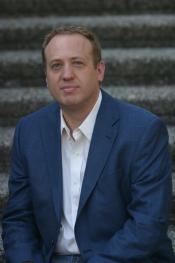
Michael Makovsky is the CEO of the Jewish Institute for National Security Affairs (JINSA), a neoconservative advocacy group that promotes hardline U.S. policies in the Middle East and works to establish ties between U.S. and Israeli security officials. A dual U.S.-Israeli citizen, Makovsky reportedly served in the Israeli army.[1]
Makovsky has promoted numerous confrontational "pro-Israel" U.S. policies in the Middle East, particularly on Iran. For instance, Makovsky opposed a 2013-2014 interim deal struck between Iran and the P5+1 negotiating powers to exchange limited sanctions relief for restrictions on Iran's nuclear enrichment while a comprehensive deal was negotiated. He was especially critical of the Obama administration's refusal to consider leveraging new sanctions against Iran during the comprehensive negotiations, accusing the president of taking a "potential source of leverage off the table."[2] Critics of the new sanctions—which were introduced by Sens. Mark Kirk and Robert Menendez and vigorously supported by the American Israel Public Affairs Committee (AIPAC)—argued that they were designed to scuttle the talks altogether.
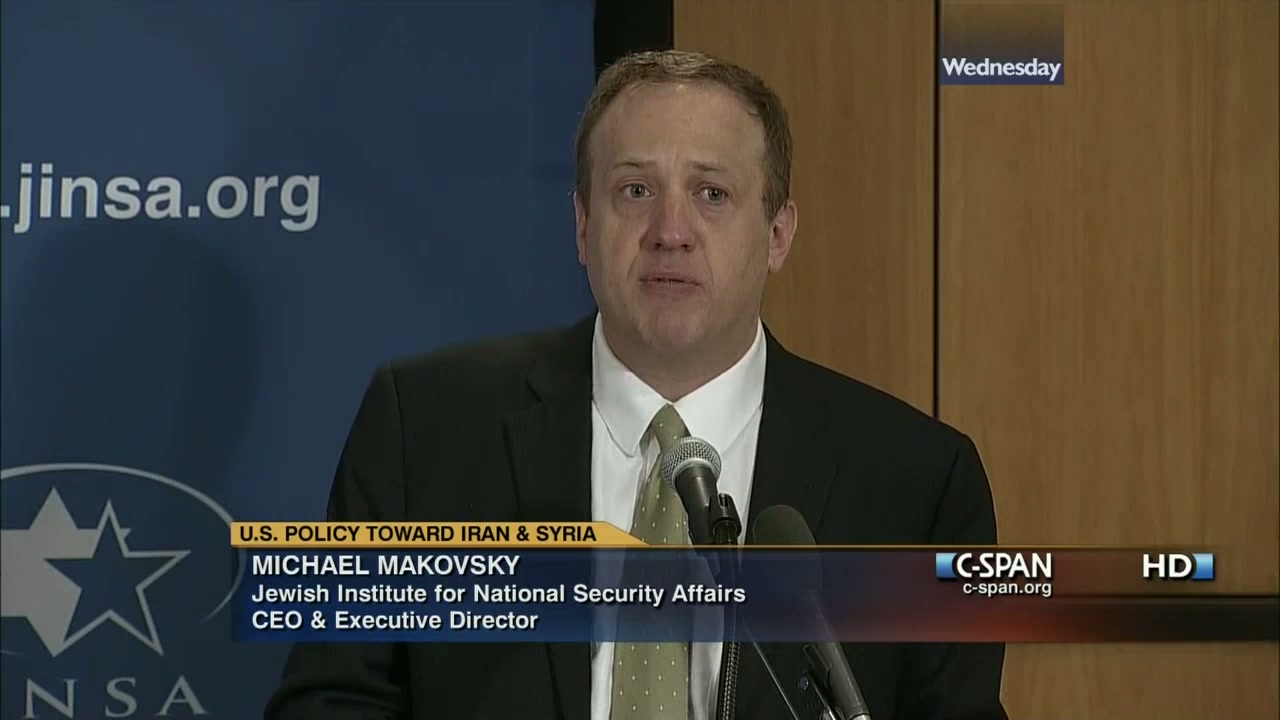
In a 2014 Wall Street Journal op-ed coauthored with former Lt. Gen. David Deptula, Makovsky argued that if the administration wouldn't agree to pass new sanctions on Iran, it should instead arm Israel with B-52 bombers and "bunker buster" bombs capable of destroying underground facilities like the Iranian enrichment plant at Fordow. "Iranian planners," they wrote, "might hope that [Israel's existing bunker buster arsenal] will prove insufficient to do major damage. The U.S. should remove such doubt by providing Israel with the capability to reach and destroy Iran's most deeply buried nuclear sites." By arming Israel with such advanced weaponry, Makovsky and his coauthor concluded, Washington "would send a signal that its ally, which already has the will, now has the ability to prevent a nuclear Iran. Once they are delivered—ideally as the current six-month interim deal is set to expire in July—Iran will be put on notice that its nuclear program will come to an end, one way or another."[3]
Critics argued that making such a weapons transfer would implicitly green-light an Israeli strike on Iran and effectively make U.S. policy toward Iran contingent on Israel's discretion about using the weapons. In his memoir, former Secretary of Defense Robert Gates recalled counseling President George W. Bush against a similar transfer in 2007. "I recommended saying no to all the Israelis’ requests," Gates wrote. "Giving them any of the items on their new [military wish] list would signal U.S. support for them to attack Iran unilaterally: 'At that point,' [Gates told Bush,] 'we lose our ability to control our fate in the entire region.' I said we would be handing over the initiative regarding U.S. vital national interests to a foreign power."[4]
Track Record
Makovsky has long been associated with key neoconservative figures, many of whom he worked with in the Washington office of the Coalition Provisional Authority, the U.S.-created entity that governed Iraq in the wake of the 2003 invasion.[5] The office operated within the Donald Rumsfeld Pentagon, where Makovsky served under Douglas Feith and reportedly advised the Office of Special Plans.[6] Before joining the George W. Bush administration, he worked as an energy market analyst for trading companies, “focusing on markets and hedging strategies for oil, petroleum products, natural gas and electric power, as well as regulatory and tax issues.”[7]
Before joining JINSA in April 2013, Makovsky worked for six years as foreign policy director at the Bipartisan Policy Center (BPC), an ostensibly centrist think tank that espoused a hawkish approach on Iran and other foreign policy issues during Makovsky's tenure. His track record also includes working as a visiting fellow at the rightist Claremont Institute and at the Institute of Contemporary British History.
Some reports suggest that Makovsky, a dual U.S.-Israeli citizen, has associated in the past with various far-right Israeli factions. Discussing his research into Makovsky’s background, Justin Raimondo of Antiwar.com wrote: “A USA Today article published in 1995 quotes a Michael Makovsky who lived at a settlement in the West Bank, and was a friend of Yigal Amir—the right-wing extremist who murdered Yitzhak Rabin. According to this report, Makovsky’s extremist allegiances aren’t limited to palling around with assassins. He was reportedly a member, in his student days at least, of the neo-fascist ‘Betar’ organization, which has a military structure (members wear uniforms, and engage in ‘drills’) and calls for a ‘Greater Israel.’”[8]

On Iran
A major theme in Makovsky's work on Iran is the purported need to maintain a "credible" military threat against the country. In this regard, he has proposed arming Israel with sophisticated weaponry that could encourage Tel Aviv to unilaterally strike Iran, opposed negotiations with Tehran over its nuclear energy programs, and called for U.S. military build up in the region.
In a March 2012 Weekly Standard article published during the lead-up to President Barack Obama’s appearance at the annual AIPAC convention, Makovsky argued that the United States should work to prevent Iran from developing the “capability” to build nuclear weapons—in contrast to preventing the acquisition of the weapons themselves.[9] In another Standard article published in February 2013, Makovsky claimed that Iran was using the P5+1 negotiations with the UN Security Council and Germany to delay "the day when it is ready to make the dash to a nuclear weapon," thus skirting the Israeli "red line" of nuclear capability, but ultimately "ensuring that the dash will be as short as possible." Makovsky did not elaborate on how exactly the United States could prevent Iran from securing nuclear capability, except to say that Washington "should make abundantly clear, in both word and deed, that it remains committed to using all means of power to prevent a nuclear Iran."[10]
However, a February 2012 BPC policy paper produced by Makovsky's program suggested a plan of action aimed at making U.S. and Israeli threats to Iran appear more “credible.”[11] The report, titled “Meeting the Challenge: Stopping the Clock,” argued that the United States should “increase its naval deployments to the Gulf, scale up the frequency and size of its military exercises there, and augment the offensive strike capabilities of its Gulf Arab allies.”[12]
At a September 2012 Henry Jackson Society event in London, Makovsky went further, concluding that ultimately "the only way to fully resolve the problem is regime change." Although he claimed that he would not advocate an Iraq- or Afghanistan-style invasion of Iran, he said Iranians would only comply with demands about their nuclear program if they thought they were facing a “credible military option.”[13]
Earlier, in March 2010, Makovsky wrote an op-ed for the San Francisco Chronicle pressuring the Obama administration to clearly state its willingness to pursue a military option to shut down Iran’s nuclear program. Arguing that “senior administration officials should stop downplaying the viability of a U.S. or Israeli military strike on Iranian nuclear facilities,” Makovsky claimed that demonstrating a commitment to use “all means available” provided the “best chance of resolving [the Iran situation] peacefully.”[14]
Despite his enthusiasm for using "all means available" to curtail Iran's alleged nuclear ambitions, Makovsky has downplayed the effectiveness of sanctions, opting instead for more confrontational measures. In a May 2009 article for the New Republic, Makovsky and coauthor Ed Morse contended that sanctions on companies that sell gas to Iran would be ineffective, and that the only “effective option” was to impose a naval blockade.[15]
According to the Inter Press Service, the New Republic article was “notable because it topples one of the pillars on which Iran hawks in the U.S. have based their arguments: the notion that targeted sanctions on the Iranian energy sector would cause serious damage to Iran’s economy and coerce Tehran into abandoning its nuclear program. … Instead, Makovsky and Morse urge the U.S. to implement a ‘naval blockade to interdict Iran’s gasoline imports, and possibly its oil exports.’ Since the authors admit that a naval blockade would be ‘tantamount to an act of war,’ they urge that it be used only ‘as a last measure short of a military strike on Iranian nuclear facilities,’ and that the U.S. prepare to mitigate the spike in energy prices that would likely result from Iranian retaliation. The article essentially says that AIPAC and other components of the lobby … are wasting their time and should be pushing stronger measures now.”[16]
In 2008, Makovsky led a BPC team that produced the report “Meeting the Challenge: U.S. Policy Toward Iranian Nuclear Development.” The lead drafter of the report was then-American Enterprise Institute fellow Michael Rubin, an outspoken proponent of militarist U.S. policies in the Middle East. Other participants included Henry Sokolski; former Obama administration staffer Dennis Ross; Stephen Rademaker, the husband of AEI’s Danielle Pletka; and Kenneth Weinstein, CEO of the Hudson Institute.[17]
The report argued that despite Iran’s assurances to the contrary, its nuclear program aims to develop nuclear weapons and is thus a threat to “U.S. and global security, regional stability, and the international nonproliferation regime,”[18] a conclusion that contrasted sharply with the CIA’s November 2007 National Intelligence Estimate, which found that Iran had put its efforts to develop nuclear warheads on hold.[19] The report stated, “As a new president prepares to occupy the Oval Office, the Islamic Republic’s defiance of its Non-Proliferation Treaty safeguards obligations and United Nations Security Council resolutions will be among the greatest foreign policy and national security challenges confronting the nation.” In contrast to many realist assessments of the situation, the report contended that “Cold War deterrence” is not persuasive in the context of Iran’s program, due in large measure to the “Islamic Republic’s extremist ideology.” Thus, even a peaceful uranium enrichment program would place the entire Middle East region “under a cloud of ambiguity given uncertain Iranian capacities and intentions.”[20]
The report advised that the new U.S. president bolster the country’s military presence in the Middle East, which would include “pre-positioning additional U.S. and allied forces, deploying additional aircraft carrier battle groups and minesweepers, emplacing other war material in the region, including additional missile defense batteries, upgrading both regional facilities and allied militaries, and expanding strategic partnerships with countries such as Azerbaijan and Georgia in order to maintain operational pressure from all directions.” In addition, the new administration should suspend bilateral cooperation with Russia on nuclear issues to pressure it to stop providing assistance to Iran’s nuclear, missile, and weapons programs. And, if the new administration agrees to hold direct talks with Tehran without insisting that the country first cease enrichment activities, it should set a pre-determined compliance deadline and be prepared to apply increasingly harsh repercussions if the deadlines are not met, leading ultimately to U.S. military strikes that would “have to target not only Iran’s nuclear infrastructure, but also its conventional military infrastructure in order to suppress an Iranian response.”[21]
Calling the report a “roadmap to war,” Jim Lobe of the Inter Press Service wrote, “In other words, if Tehran is not eventually prepared to permanently abandon its enrichment of uranium on its own soil—a position that is certain to be rejected by Iran ab initio—war becomes inevitable, and all intermediate steps, even including direct talks if the new president chooses to pursue them, will amount to going through the motions (presumably to gather international support for when push comes to shove).… What is a top Obama advisor [Dennis Ross] doing signing on to it?”[22]
Additional Experience
Makovsky is the author of the 2008 book Churchill’s Promised Land: Zionism and Statecraft (Yale). According to one reviewer, Makovsky attempts to use a short-lived Churchill campaign strategy to woo Jewish voters to argue that Churchill's life was “spent serving the Zionist cause.” This simply wasn’t the case, writes Ugo Paladini. “Churchill maintained a lively interest in the affairs of Palestine, but his theatre was so vast that his focus could not stray for too long from the overall picture,” which included a “steadfast belief that a West-supporting Jewish state in the heart of the Middle East was essential to the balance of power in that region.” According to Paladini, Makovsky’s "deep attachment to the Zionist cause skews not only his vision of the state of affairs in the Middle East, but the image of Churchill himself.”[23]
Makovsky’s brother, David Makovsky is a fellow at the Washington Institute for Near East Policy, a spin-off of the American Israel Public Affairs Committee. David has written extensively on Mideast policy, including a 2009 book co-written with Dennis Ross titled Myths, Illusions, and Peace: Finding a New Direction in the Middle East.