
Dov Zakheim
last updated: December 5, 2012
Please note: The Militarist Monitor neither represents nor endorses any of the individuals or groups profiled on this site.
Affiliations
- Center for Strategic and International Studies: Senior Adviser
- National Interest: Advisory Council Member
- CNA Corporation: Senior Fellow
- Center for Security Policy: Former Member, Advisory
- Defense Business Board: Former Member
- Chief of Naval Operations Executive Panel: Former Member
- Aspen Ideas Festival: 2006 Speaker
- Royal Institute of International Affairs: Member
- International Institute for Strategic Studies: Member
- Heritage Foundation: Former Adjunct Scholar
- Project for the New American Century: Participant, Rebuilding America's Defenses Report (2000); Letter Signatory
- Search for Common Ground: Board of Directors
- American Jewish Committee: Chair, Office of Government and International Affairs
Government
- U.S. Department of Defense: Under Secretary of Defense (Comptroller) and Chief Financial Officer (2001-2004); Deputy Under Secretary of Defense for Planning and Resources in the Office of the Under Secretary of Defense (Policy) (1985-1987); Various Posts (1981-1985)
- Transition 2001 Panel: Member
- Defense Science Board: Member of Task Force on "The Impact of DoD Acquisition Policies on the Health of the Defense Industry" (2000)
- Task Force on Defense Reform: Member (1997)
- U.S. Commission for the Preservation of America's Heritage Abroad: Member of the Board
- Congressional Budget Office: Former Staff Member of National Security and International Affairs Division
Business
- Booz Allen Hamilton: Former Vice President (2004-2010)
- System Planning Corp: Former Corporate Vice President
- SPC International: Former Chief Executive Officer
- Northrop Grumman: Former Member, Advisory Board
- McDonnell Douglas: Former Consultant
Education
- Columbia University: BA
- London School of Economics: Degree Not Specified
- University of Oxford, St. Antony's College: D.Phil., Economics, and Politics
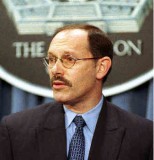
Dov S. Zakheim is a former Pentagon official who worked in both the George W. Bush and Ronald Reagan administrations. His track record includes collaborating with a number of militarist advocacy groups—including the neoconservative Project for the New American Century and the Center for Security Policy—and working as an executive at a host of defense contractors such as Booz Allen Hamilton and Northrop Grumman. Zakheim has also been a fellow at CNA Corporation (home to the Center for Naval Analyses), an adviser to the Center for Strategic and International Studies, a member of the advisory council of the National Interest, and a lecturer at numerous universities, including the National War College, Yeshiva University, and Columbia.
In 2011, Republican presidential candidate Mitt Romney named Zakheim as a member of his advisory team on foreign and defense policy. Joining Zakheim was a host of other former Bush administration officials like Michael Chertoff and Eric Edelman, as well as several high-profile neoconservatives, including Robert Kagan, Paula Dobriansky, Eliot Cohen, and Dan Senor.[1]
In recent years, Zakheim has written about and participated in numerous public forums on U.S. foreign policy issues. In June 2012, he was a featured speaker at an event organized by the right-wing Heritage Foundation titled “The Liberation of the Falklands, Thirty Years After: Why the United States Must Back Britain Now.”[2] Also in June 2012, Zakheim was a panelist at a conference organized by the liberal-hawk Center for a New American Security titled “Rethinking U.S. Security: Navigating a World in Transition.”[3]
Zakheim is the author most recently of A Vulcan’s Tale: How the Bush Administration Mismanaged the Reconstruction of Afghanistan (Brookings Institution Press 2011), which claims to provide an insider’s view of the failures of the Bush administration in waging wars in Iraq and Afghanistan.[4]
Bush Administration
Zakheim was part of an informal team of foreign policy advisors assembled by candidate George W. Bush during the 2000 presidential campaign who were nicknamed the “Vulcans.” Among the other Vulcans were Stephen Hadley, Dick Cheney, Donald Rumsfeld, Condoleezza Rice, and Paul Wolfowitz. “The Vulcans,” wrote James Mann in his award-winning 2004 history of the Bush “war cabinet,” “represented the generation that bridged what are commonly depicted as two separate and distinct periods of modern history: Cold War and post-Cold War. For the Vulcans, the disintegration of the Soviet Union represented only a middle chapter in the narrative, not the end or the beginning.”[5]
After Bush’s election, Rumsfeld tapped Zakheim to serve as his undersecretary for defense –comptroller, a post from which Zakheim oversaw Pentagon spending in the wake of the 9/11 terrorist attacks and the onset of the “war on terror.” Zakheim remained as comptroller until 2004, overseeing three defense budgets, each totaling more than $300 billion, and implementing six wartime supplementary budget requests.[6]
Zakheim served as the Defense Department's chief financial officer during the 2003 efforts to streamline the department's spending procedures to reflect Defense Secretary Donald Rumsfeld’s vision of a 21st-century military. Critics say some of the reforms removed congressional oversight and accountability from the defense budget. During Zakheim's tenure, the Defense Department's Inspector General found that the Pentagon could not properly account for more than $1 trillion of spent funds.[7]
As the Pentagon comptroller, Zakheim also served as coordinator of the Defense Department's civilian programs in Afghanistan and as an international fundraiser for Iraq reconstruction monies, organizing the October 2003 Madrid donors conference and the June 2003 UN potential donors conference.
In 2004 Zakheim stepped down from his post at the Pentagon with little explanation. However, his resignation followed a highly critical audit by the General Accountability Office.
Like other former Bush administration officials, Zakheim became heavily critical of the administration’s track record after leaving office. In 2006, he coauthored a piece in the National Interest with Daniel Pipes, Tommy Franks, and four others, stating: "Iraq's seemingly never-ending violence, whether it is termed a civil war, or, more euphemistically, 'sectarian strife,' has created a sense of instability, insecurity, and raw fear, for all but those Kurds living in Kurdistan. Democracy in this environment is nothing more than a sorry catch-phrase."[8]
In January 2007, Zakheim argued in an op-ed for the Financial Times that Iraq had fallen into a civil war and advocated that the United States pull back to Iraq's borders. "No doubt some will see this as the United States giving up on democracy and being content to stand by as Iraqis kill each other. Yet clearly democracy in Iraq must await the end of the civil war. … The strategic shift would bring relief to our overstretched and over-deployed military. It would reduce combat losses. Above all, it would give the military a mission that they can achieve. This way we can finally bring to an end a bitter domestic debate over Iraq policy that has so undermined public faith in the judgment and wisdom of their leaders on both sides of the political aisle."[9]
Defense Industry and Advocacy
Shortly after leaving the Pentagon in 2004, Zakheim became a vice president at Booz Allen Hamilton, a defense contractor that has employed a number hawkish policy figures, including former CIA head James Woolsey and retired air force general Thomas Moorman. Among the group’s more notorious activities were its efforts during the lead-up to the 2003 invasion of Iraq to assist corporations in securing contracts for work in that country.[10]
Zakheim's involvement with the defense industry began when he first joined the Pentagon in 1981, serving in various posts including special assistant to the assistant secretary for international security and assistant undersecretary for policy and resources, before moving up into the post of deputy undersecretary of defense for planning and resources, working in systems acquisition and strategic planning.
When Zakheim left the Defense Department in 1987, it was for an executive vice president post with the Virginia-based government contractor Systems Planning Corporation (SPC), which has supplied the Defense Department with military technology for several decades and has been a support contractor for the Defense Advanced Research Projects Agency (DARPA). Zakheim also served as CEO at subsidiary SPC International and as a consultant for the defense contractors McDonnell Douglas (now a part of Boeing) and Northrop Grumman.[11]
At the same time as he was working in the private sector for companies that benefit from defense spending, Zakheim was busy advocating for policies that implied increased defense spending. While still at Systems Planning Corporation in April 1998, Zakheim participated in an SPC "roundtable" discussion for the Rumsfeld Missile Commission.[12] According to a 2002 Washington Post story, it was this interaction with Rumsfeld that solidified Zakheim's reputation as someone who shared the future defense secretary's vision of streamlining and modernizing the U.S. military.[13]
After Bush took office in 2001, Zakheim was tapped by Rumsfeld to serve as comptroller based on his experience with defense and budgeting. As Rumsfeld told the Washington Postin May 2001: "I put together a few small groups, to look at some things that I thought were priority issues. Some the president asked me to. And with the thought that we could get some bright people looking at them and then we'd plug them into the Quadrennial Defense Review which we're going to do, and that starts now. … Zakheim got on board Friday and he has taken the thought that came from the financial management business that Senator [Robert] Byrd raised with me, and has thoughts, and they will again be doing some internal changes and then making some proposals for legislation at some point."[14]
Zakheim was also involved with advocacy groups like the Committee for Peace and Security in the Gulf, a neoconservative-led initiative originally formed in 1990 to support the first Gulf War. In 1998, the group sent an open letter to President Bill Clinton calling for a "comprehensive political and military strategy for bringing down Saddam and his regime." Fellow signatories included Rumsfeld, Richard Perle, Wolfowitz, Douglas Feith, Elliott Abrams, Paula Dobriansky, Frank Gaffney, Bill Kristol, Michael Ledeen, Joshua Muravchik, Jeffrey Gedmin, Fred Ikle, Robert Kagan, David Wurmser, and Peter Rodman.[15]
Zakheim later joined several of these same people in supporting the Project for the New American Century (PNAC), a neoconservative organization that played an important role in driving public and official support for the invasion of Iraq before and after the 9/11 attacks. In 1998, Zakheim signed a PNAC open letter to Clinton about the crisis in Kosovo. The letter called for U.S. support for regime change in Belgrade. Two years later, Zakheim contributed to a PNAC paper titled, "Rebuilding America's Defenses." The paper claimed that "If the United States is to maintain its preeminence—and the military revolution now underway is already an American-led revolution—the Pentagon must begin in earnest to transform U.S. military forces."
The PNAC paper also opined that in the absence of some "catastrophic" event akin to Pearl Harbor, such reforms would happen at a glacial pace. A year later, 9/11 seemed to provide such a spark to the kind of rapid transformation envisioned. "The system is a slow system to react until something happens, and something has happened. And the system is reacting," the Washington Post quoted Zakheim as saying in 2002. "This is going to push our [agenda] ahead, obviously geared to the war effort, precisely because it was this kind of war that many of us feared and anticipated."[16]
In 2005, after leaving the Pentagon, Zakheim remained an advocate for funding and policy to promote the "military transformation" of U.S. armed services. In an opinion piece, Zakheim wrote that Rumsfeld spent billions on such transformation programs, and he cited the wars in Iraq and Afghanistan as examples of the need for a restructured military that is more responsive, flexible, and interconnected.[17]
An Equivocal Neocon?
Zakheim is often characterized as a neoconservative because of his frequent association with neocon groups and his support for some hawkish Middle East policy prescriptions. However, a close look at his track record reveals a more complicated picture.
In 1996, Zakheim published Flight of the Lavi: Inside a U.S.-Israeli Crisis, which detailed his role while in the Reagan Pentagon in ending the IAI Lavi program, an initiative in the 1980s in which Israel researched and developed its own fighter jets (called the IAI Lavi). Zakheim reinforced the U.S. position that Israel should not produce an aircraft that would compete with the U.S. F-16, arguing that it was more efficient for Israel to buy jets from the United States. An ordained rabbi and an orthodox Jew, Zakheim was publicly criticized and harassed for his role in opposing the system and purportedly going against the interests of Israel. Today the Israeli Air force has the largest fleet of F-16s outside of the United States.[18]
More recently, in February 2012, Zakheim produced a monograph for the CNA Corporation that called for the United States to dissuade Israel from unilaterally attacking Iran, a view that contrasts sharply with that of many neoconservatives. Titled “The United States Navy and Israeli Navy: Background, Current Issues, Scenarios, and Prospects,” the report highlighted Israel’s rapidly changing security environment and the potential implications for both Israeli and U.S. naval policies. “Israel’s increasing isolation in its region, its parting of the ways with Turkey, and the changes being brought about by the Arab Spring, are altering the Israeli government’s strategic calculus. The passage of Iranian warships through the Suez Canal, Egypt’s readiness to terminate its blockade of Gaza, and Turkey’s readiness to escort flotillas to Gaza all point to a much more challenging eastern Mediterranean environment for the IN [Israeli Navy]. In addition, Egypt’s change of policy indicates that the IN can no longer be certain of its freedom of movement into and out of the Red Sea.”[19]
In responding to this evolving situation, Zakheim urged restraint: “It is in the USN’s [U.S. Navy]—and America’s—interests that the IN not act independently against Iran, either by launching any attacks against Iran from the Arabian Sea or even by boarding Iranian origin ships on the high seas. … [T]he USN, to the extent that it has a voice in policymaking circles, should seek to encourage the IN to follow a path of caution and moderation, if only because so many of Israel’s regional neighbors see it as an extension of the United States. This is a tall order for the USN, and it cannot moderate Israel on its own—it is questionable whether anyone can—but it is critical that it at least attempt to do so, for the sake of both navies and the nations they defend.”[20]
Such views have led some observers to claim that at heart Zakheim is not a neoconservative, but a realist. As a writer for The Jerusalem Report wrote shortly after Zakheim stepped down from his Pentagon post in 2004, “Wolfowitz and Feith were among the chief proponents of war with Iraq, while Zakheim is more associated with the pragmatic faction of the Republican Party. He served in the Reagan administration as an undersecretary of defense from 1985 until 1987 and is generally considered responsible for killing the Lavi project, an initiative to build an Israeli fighter jet with American technology.”[21]
Similarly, in a New York Times article published just after the 2000 election, James Traub wrote: "Dov Zakheim, for example, has written that the scale of atrocities in places like the Balkans is often exaggerated, and that in any case violating another nation's sovereignty threatens 'to unravel the entire fabric of international relations.' Zakheim concludes that we should intervene 'only when our own interests are clearly at stake, or when genocide is so manifest that refusal to act would destroy our moral leadership of the free world.'"[22]
In contrast to the above, however, are the numerous affiliations with neoconservative groups Zakheim has maintained over the years—most notably with the Center for Security Policy and the Project for the New American Century—as well as his at times stark characterizations of Israeli and U.S. opponents. Following the January 2006 election of Hamas in an open contest in the Palestinian territories, for example, Zakheim repeated a number of misleading historical parallels often employed by neoconservatives like Richard Pipes and Norman Podhoretz, to argue: "We have a situation not unlike Germany in 1932 when we had an upstart [Nazi] party ruled by thugs that preached hatred and racism and also claimed they would clean up a corrupt Weimar Republic. The parallels are frightening."[23]