
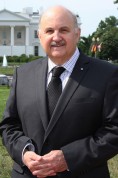
Stephen Bryen
last updated: February 3, 2012
Please note: The Militarist Monitor neither represents nor endorses any of the individuals or groups profiled on this site.
Affiliations
- Jewish Institute for National Security Affairs: Member, Advisory Board; Former Executive Director (1979-1981)
- Center for Security Policy: Former Adviser
- American Enterprise Institute: Former Adjunct Fellow
- Taiwan Institute for Political, Economic, and Strategic Studies: Fellow
- Committee for Peace and Security in the Gulf: Signatory (1998)
Government
- U.S.-China Economic & Security Review Commission: Commissioner, 2001-2005
- Defense Technology Security Administration: Founder, First Director (1995)
- Department of Defense: Deputy Undersecretary, 1981-1988
- Senate Foreign Relations Committee: Former Professional Staff Member and Near East Subcommittee Director
Business
- SDB Partners: Founder
- Finmeccanica, Inc.: Former President
- Telos Corp.: Member, Board of Directors (as of 1997)
- Loral Space Systems Government Security Committee: Member (as of 1997)
- G-MAC Industries (Mechanicsburg, PA): Member, Board of Directors (as of 1997)
- Beaconsfield Capital LLC: Member, Advisory Board (as of 1997)
- Aurora Defense, LLC: Managing Director (as of 1997)
Education
- Rutgers University: Degree, History and Political Science (1964)
- Tulane University: MA (1966); PhD, International Politics (1971)
Stephen D. Bryen is a longtime Washington insider well connected in both the defense industry and Washington power circles. Bryen is also closely connected to various high-profile neoconservatives like Richard Perle—under whom Bryen worked when Perle was President Ronald Reagan's assistant secretary of defense—and has supported the work of a number of hardline pro-Israel groups like the Center for Security Policy (CSP) and the Jewish Institute for National Security Affairs (JINSA).
Bryen is the founder of SDB Partners, a defense-industry consulting group that promises clients “powerful access to hard markets” in a variety of countries, including the United States. Previously, he was president of the defense contractor Finmeccanica, Inc., the U.S. branch of the leading Italian arms maker, which maintains close ties to many Republican Party elites.
Although not a highly visible public figure, Bryen occasionally authors opinion pieces with his wife Shoshana for conservative outlets. In a January 2012 op-ed for the American Thinker, for example, the Bryens argued that Iran’s navy was well equipped to wreak havoc on oil tankers in the Strait of Hormuz, suggesting that existing NATO naval technology was inadequate to the task of protecting ships in transit. The Bryens advocated increased NATO cooperation in advance of any potential clashes (perhaps also implying that newer military acquisitions should be in the offing), but concluded that the ultimate deterrent was full-scale war: “If, in the end, Iran does try to prevent oil tankers from transiting the Strait,” they wrote, “and if in the end the U.S. is unable to offer direct protection to ships that desire transit, there are other ways to force Iran to desist. It would likely be ugly, and it is not to be desired, but Iran and Iran-watchers would be foolish indeed to doubt America's retaliatory capability after an act of war.”[1]
JINSA
In the mid-1970s, Bryen and a group of other mainly neoconservative figures, including Michael Ledeen, helped establish JINSA as an important Washington-based think tank specializing in fostering close ties between the U.S. and Israeli militaries. Today, JINSA is a central component of a burgeoning group of U.S. think tanks that pursue a Likud Party line on Mideast peace and lobby to sustain a strategic relationship between the United States and Israel.[2]
According to some accounts, Bryen and his wife were instrumental in turning JINSA into an important gateway connecting the U.S. military, defense contractors, and Washington elites into a formidable element of the so-called Israel Lobby. Journalist Mark Milstein writes that under Bryen, JINSA became by 1979 "fully operational," shedding its earlier incarnation as a mere study group aimed at learning the lessons of the 1973 Yom Kippur War, which included ensuring the that United States would aid Israel in a conflict.[3]
When Bryen left JINSA in the early 1980s to take a post in the Reagan administration, his wife took over as head of the group. Milstein reports: "While JINSA's early years can be described as low-level but intensive networking efforts, the decade under Shoshana Bryen is described by many observers as the time when the mouse finally learned to roar. With Bryen at the helm, JINSA sent out the likes of former AIPAC [American Israel Public Affairs Committee] executive director Morris J. Amitay, now a lobbyist and director of the rightist pro-Israel Washington PAC, attracted well-known military commentators like Admiral Elmo Zumwalt, and produced influential papers … that many credit for keeping the joint U.S.-Israeli Arrow missile project afloat."[4]
Insider Connections and Controversies
At the Pentagon, meanwhile, Stephen Bryen quickly set about crafting a new direction for U.S. relations with Israel. "Bryen became a consultant for Richard N. Perle, the Reagan administration assistant secretary of defense-designate," Milstein reported. "After Perle was confirmed by the Senate, Bryen was named deputy assistant secretary of defense in charge of regulating the transfer of U.S. military technology to foreign countries. Critics at the time cited the placement of Bryen in one of the most sensitive positions at the Pentagon as evidence of the tilt in U.S. policy toward Israel under Reagan. 'They don't say no anymore to Israel at the Pentagon,' said a former high-ranking Defense Department official. 'Israel is the 51st state.' It was during the Reagan era that U.S. economic aid to Israel rose to $1.2 billion annually, and military aid to $1.8 billion annually. Bryen had a role in choosing not only what U.S. weaponry Israel would be allowed to purchase with those funds, but also what sensitive U.S. military technology would be made available to Israel for use in its own burgeoning arms industry."
Some observers have accused Bryen of using his insider connections in Washington to benefit Israel. In his book The Armageddon Network, Michael Saba, a former director of an Arab-American organization, alleged that in 1978 he saw Bryen, then a staffer on the Senate Foreign Relations Committee, offer "Pentagon documents on the bases" to officials of the Israeli government during a meeting in a Washington restaurant. Writes Saba: "After I reported this incident to the Justice Department, FBI and Justice Department investigators gathered sufficient evidence on Dr. Bryen's activities to recommend he be brought before an investigative grand jury for espionage. The case was quietly closed, however, by Philip Heymann, the assistant attorney general in charge of the Justice Department's Criminal Division, a close personal friend and associate of Dr. Bryen's attorney. Bryen was never formally charged or made to account for his actions under oath."[5]
More recently, Bryen’s former defense firm Finmeccanica was at the center of a corruption scandal surrounding former Rep. Curt Weldon (R-PA), who was voted out of office in the 2006 mid-term elections. Weldon's daughter Kim was offered a job at a Finmeccanica subsidiary shortly after the contractor won a $1.6-billion contract to build a fleet of Marine One helicopters. Some saw the deal, which came as a surprise to many observers, as part of a quid-pro-quo resulting from Italy's support for the U.S.-led invasion of Iraq.[6] In 2003, Shoshana Bryen donated money as a representative for Finmeccanica to Weldon's election campaign.[7]
Bryen has served in a number of government advisory roles and supported the work of a string of hardline advocacy groups. From 2001 to 2005, he served as a commissioner for the U.S.-China Economic & Security Review Commission (the U.S.-China Commission), which during the George W. Bush administration hosted a number of rightist figures, including Thomas Donnelly of the American Enterprise Institute (AEI). According to the conservative Heritage Foundation, in its 2006 report to Congress the commission concluded that "China's influence is growing as its wealth and power increase, and there remain many reasons to hope that China might in some future stand as a pillar of the international community, but its behavior is as yet far from meeting that standard."[8]
Bryen reportedly founded the Defense Technology Security Administration (DTSA), which according to a 2005 Pentagon directive, was established to "administer, consistent with U.S. policy, national security objectives, and Federal laws and regulations, the development and implementation of DoD technology security policies on international transfers of defense-related goods, services, and technologies to ensure that critical U.S. military technological advantages are preserved; transfers that could prove detrimental to U.S. security interests are controlled and limited; proliferation of weapons of mass destruction and their means of delivery is prevented; diversion of defense-related goods to terrorists is prevented; legitimate defense cooperation with foreign friends and allies is supported; and the health of the defense industrial base is assured."[9]
According to his biography on the JINSA website, Bryen's bona fides for establishing the DTSA were earned when he served under Perle in the Reagan Defense Department, during which time he purportedly "pioneered the field of technology security as deputy under secretary of defense from 1981-1988."
According to the biographical note he submitted along with his 1997 written testimony to the House National Security Procurement Subcommittee, Bryen had extensive Capital Hill experience throughout the 1970s, the same period during which he helped to establish JINSA. His bio note reads: "From 1971 until 1979 Dr. Bryen served as Foreign Policy Adviser to Sen. Clifford P. Case (R-NJ) who was then Ranking Republican Member of the Senate Foreign Relations Committee and a senior member of the Senate Appropriations Committee. After 1975 Dr. Bryen served as a Professional Staff Member of the Senate Foreign Relations Committee and as the Staff Director of the Near East Subcommittee. He was responsible for foreign assistance legislation, for the State Department Authorization, for the Case Act (PL 92-403), for the Arms Export Control Act, and for a host of legislative agreements. In connection with his work for the Committee, Dr. Bryen conducted study missions to Europe, Africa, Asia (including Vietnam and Cambodia), Rhodesia (now Zimbabwe), Cyprus, and the Middle East as well as to the Soviet Union."[10]
Aside from his work with JINSA, Bryen has also served as an adjunct scholar for AEI and been an adviser to the CSP, both leading organizations in the neoconservative firmament. He has also worked for a string of defense and technology firms, including Aurora Defense, L-3 Network Security, and Loral Space System's Government Security Committee.
Bryen is the author of various monographs—including the Revolution in Military Affairs, Revolution in Technology Security; Cyberterrorism: The Threat and the U.S. Response; and The Application of Cybernetic Analysis to the Study of International Politics—and is an occasional writer for outlets like the National Review and guest speaker at conferences organized by groups like JINSA and AEI.
Hawkish Advocacy
In a January 2002 article for National Review Online, Bryen pushed the erroneous thesis that Iraq had maintained a well-developed biological weapons program since the first Gulf War in 1991, making it the "leading threat" to "global survival." He argued: "Over the next few years the United States will be searching for ways to handle the anthrax threat, and threats from other biological weapons. But is that enough? Countries that build biological weapons whose effects can't be controlled or even predicted are engaged in global terrorism. That is one reason why the United States ended its offensive biological-warfare program years ago. Countries with a demonstrated capability and willingness to use chem-bio weapons, and who continue to develop nastier forms of biological-terror weapons, are a potential threat to global survival. Iraq, from all the evidence available including recent defectors, is the world's leading threat."[11]
Even prior to the 9/11 terrorist attacks, Bryen was part of a core group of foreign policy hardliners and neoconservatives who pushed for overthrowing Saddam Hussein. In February 1998, for example, he joined the likes of Richard Perle, Richard Allen, Frank Gaffney, Douglas Feith, Robert Kagan, Paul Wolfowitz, and David Wurmser in signing his name to an "open letter" to President Bill Clinton produced by the Committee for Peace and Security in the Gulf—a precursor letterhead group to the more infamous Project for the New American Century—which advocated overthrowing Saddam Hussein. The letter, part of a broad neoconservative campaign that championed a new post-Cold War U.S. foreign policy aimed at overturning rogue regimes and aggressively pushing democracy, argued that "containment" of Iraq was not viable because of its purported weapons of mass destruction programs. "Only a determined program to change the regime in Baghdad will bring the Iraqi crisis to a satisfactory conclusion," the letter said.[12]