
George Weigel
last updated: April 28, 2015
Please note: The Militarist Monitor neither represents nor endorses any of the individuals or groups profiled on this site.
Affiliations
- Ethics and Public Policy Center: Distinguished Senior Fellow, Senior Fellow (1996-2007); President (1989-1996)
- Project for the New American Century: Signatory, Founding Statement of Principles (1997)
- National Endowment for Democracy:Board Member
- Friends of Israel Initiative:Co-Founder
- Notre Dame Center for Ethics and Culture: Board of Advisors
- The Center for Bioethics and Human Dignity: Signatory, Open Letter to President George W. Bush on Human Cloning (2002)
- Institute on Religion and Democracy: Member Emeritus, Board of Directors
- Discovery Institute: Religion, Liberty, & Public Life Program, Adjunct Fellow
- James Madison Foundation: Founding President (1986-1989)
- Woodrow Wilson International Center for Scholars: Scholar-in-Residence (1984-1985)
- World Without War Council: Scholar-in-Residence (1977-1984)
- St. Thomas Seminary School of Theology: Former Assistant Professor of Theology; Former Assistant Dean of Studies; Former Acting Dean of Studies
- First Things: Member, Editorial Board
- Orbis: Member, Editorial Board
Education
- St. Mary’s Seminary and University: B.A.
- University of St. Michael’s College: M.A.
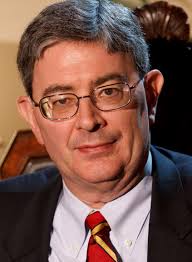
George Weigel is a theologian often described as a “neoconservative Catholic.”[1] He is a “distinguished senior fellow” at the Ethics and Public Policy Center (EPPC) and was a founding signatory to the neoconservative Project for the New American Century (PNAC). Weigel is considered to be a leading member of a small group of hawkish religious scholars, many of whom are conservative Catholics (including the American Enterprise Institute’s Michael Novak and the Institute on Religion and Public Life’s Richard John Neuhaus), who have worked to turn back the secular tradition in U.S. politics.[2]
In 2010, Weigel joined international figures like former U.S. Ambassador to the United Nations John Bolton and former Spanish Prime Minister José María Aznar in launching the “Friends of Israel Initiative,” a “pro-Israel” advocacy organization that seeks to form a “strategic alliance between Jews and non-Jews.”[3] Weigel is also a board member at the National Endowment for Democracy, along with Elliot Abrams and Zalmay Khalilzad.[4]
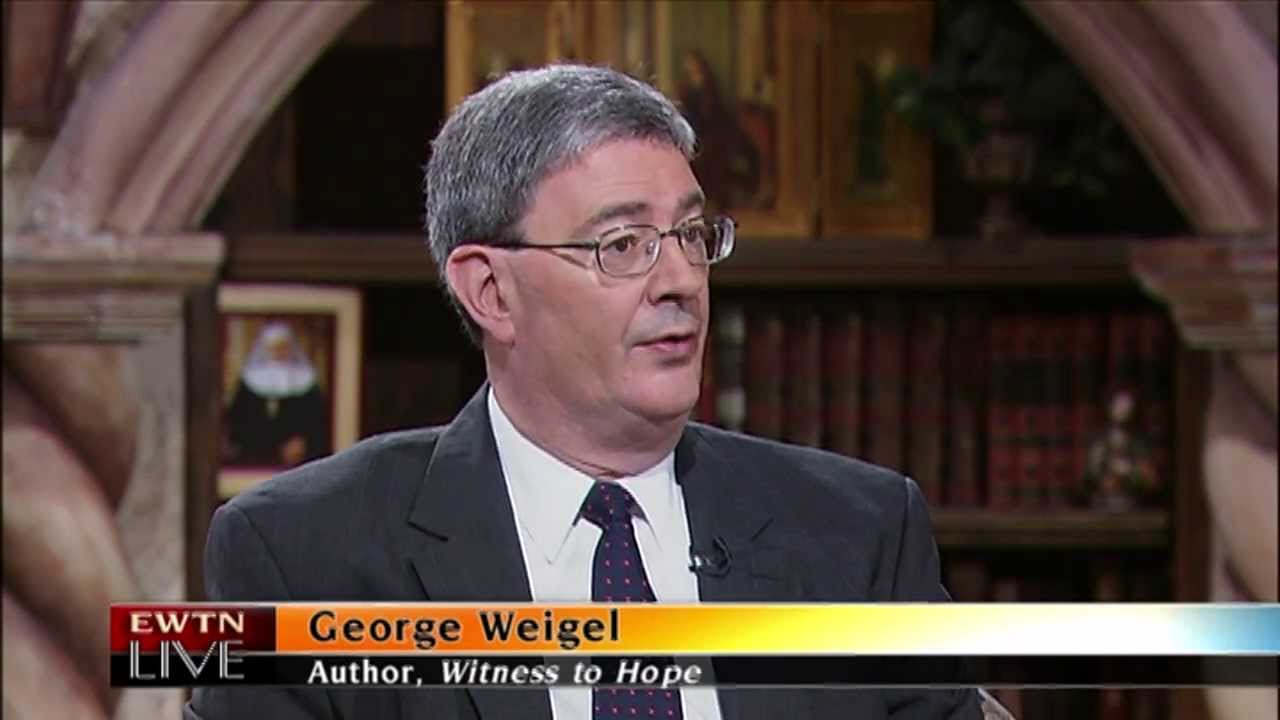
Weigel has criticized what he claims is the “prevalent Christian wishful thinking today” which “imagines there to be just solutions to the evils caused by murderous men like Slobodan Milosevic, Saddam Hussein, Bashar al-Assad, and the Iranian mullahs without the effective threat, or the effective use, of proportionate and discriminate armed force.”[5]
In a 2014 article for First Things, he argued that such “wishful thinking” is the result of “several bad ideas,” including: “The bad idea that radical pacifism is implicit in the Gospel and was normative in the early Church; the bad idea that moral authority to wage war today is held by the United Nations alone; the bad idea that contemporary international law adequately reflects the moral reasoning of the just war tradition; the bad idea that the prudential norms within the just war tradition (like ‘last resort’) trump other considerations.”[6]
Obama Era
Weigel has stridently criticized the Obama administration’s foreign policy, often using alarmist language. In December 2014 op-ed for Standpoint Magazine he wildly wrote: “The foreign policy of President Barack Obama and his two Secretaries of State, Hillary Clinton and John Kerry, is so close to being a comprehensive catastrophe as to suggest comparisons to the great power meltdown that erased the Dual Monarchy of Austria-Hungary from the chessboard of history a century ago.”[7]
He argued that the “United States itself is not going to come apart at the seams in the wake of the Obama administration. But very little of the world order of which the United States was the linchpin and guarantor will be left on January 21, 2017.”[8] He also accused President Obama of “kowtowing to the Iranian mullahs” in nuclear negotiations with Iran and “complementing appeasement by dismantling the U.S. military in all its component parts.”[9][10]
Weigel has argued that the idea of nuclear deterrence working in the Middle East is “an outcome on which no thoughtful analyst would wager” because, he says, the region is “beset” by “congenital political corruption and inflamed religious passions.”[11]
Weigel also lambasted Secretary of State John Kerry’s 2014 Israeli-Palestinian peace talks as hurting Israel, stating in December 2014: “John Kerry’s shuttle diplomacy in the Middle East has not only failed to produce a two-state solution between Israel and Palestine, it has empowered the most radical elements in the West Bank and Gaza while exposing Israel, the Middle East’s only mature democracy and a beacon of economic and technological development, to even more vile opprobrium from the world’s witless (and worse).”[12]
After the rise of the self-proclaimed “Islamic State” in Iraq and Syria in 2014, Weigel wrote that “Christian leaders” must state “publically that, when confronted by bloody-minded fanatics like those responsible for the reign of terror that has beset Syria and Iraq this summer, armed force, deployed prudently and purposefully by those with the will and the means to defend innocents, is morally justified.”[13]
In the aftermath of the January 2015 terrorist attack on the French satirical magazine Charlie Hebdo, Weigel contended that “Great Britain and France are both in grave danger of becoming new and extremely bloody fronts in the jihadist war against the West, not simply because Islamic State and al-Qaeda recruiting in the two countries has a kind of feedback loop built into it.” He added: “But the deeper problem is the abandonment of any morally informed cultural self-defense by the United Kingdom and France, which seems, to me at least, a direct result of their radical secularization—or, to put it another way, their thoroughgoing de-Christianization.”[14]
Since the 2014 Ukraine crisis, Weigel has taken a particularly hawkish tone on Russia. “Putin must be stopped now, by sequestering his regime as the first, necessary step toward regime change in Russia,” he wrote in a March 2015 op-ed for The National Review. He further stated: “Putin’s Leninist kleptocracy is such a lethal threat. Because he must keep going, he must be stopped: not only for the sake of Ukraine, the Baltic states, and the dying Russian nation, but for the sake of the minimum of world order required to keep the post–Cold War peace.”[15]
War on Terror
An outspoken proponent of the George W. Bush administration’s “war on terror,” including the campaign to push for war in Iraq, Weigel has endeavored to frame global crises in Islamophobic language. In a February 2008 book talk at the Foreign Policy Research Institute, Weigel outlined several lessons that he says need to be learned in the confrontation with “jihadism,” proclaiming: “Jihadism is the enemy in the multi-front war that has been declared upon us. There are many forms of Islam. Some of them, often called ‘fundamentalism’ or ‘Islamism,’ stress the need for a deep religious and moral reform within the House of Islam and for the reestablishment of Islamic political power. The specific form of Islamism which threatens the West is best described as jihadism.”[16]
Other “lessons” according to Weigel include the need to eliminate consideration of Islam as one of the “three religions of the Book” (the other two being Judaism and Christianity); the idea that “cultural self-confidence is indispensable to victory in the long-term struggle against jihadism”; and the recognition that “great human questions, including the great questions of public life, are ultimately theological.”[17]
Weigel has also claimed that Western civilization is facing an existential crisis, one that is made more acute by growing atheism. In Faith, Reason, and War against Jihadism, he writes: “It is, perhaps, ironic that, at precisely the moment when a religiously grounded, existential threat to the civilization of the West has manifested itself with real power, a new atheism, dripping with disdain for traditional religious conviction, has risen up in the form of broadsides by bestselling polemicists like Richard Dawkins, Daniel Dennett, Christopher Hitchens, and Sam Harris. Yet contrary to the claims of these new atheists and their call to the ‘maturity’ of unbelief, a West that has lost the ability to think in terms of ‘God’ and ‘Satan,’ and that has forgotten the drama contained in the idea of ‘redemption,’ is a West that will be at a loss to recognize what inspires and empowers those enemies of the West who showed their bloody hand on September 11, 2001. A West that does not take religious ideas seriously as a dynamic force in the world’s unfolding history is a West that will have disarmed itself, conceptually and imaginatively, in the midst of war.”[18]
In a USA Today opinion piece adapted from his book, Weigel argued that the war on terror was really a war “against jihadism: the religiously inspired ideology that teaches that all Muslims are morally obliged to use whatever means necessary to compel the world’s submission to Islam.”[19]
One reviewer said of Weigel’s Faith, Reason, and War Against Jihadism: “The main goal of Mr. Weigel’s book… is to harangue, condemn, and damn Americans because they do not see the world as do the neoconservatives, and because they find nothing consistent with America’s history, interests, character, or ideals in the type of country and foreign policy Mr. Weigel advocates. And there is no room for debate in Mr. Weigel’s new world order, which is to be dominated by something he calls the U.S.-led ‘freedom project,’ apparently to be patterned on current Iraq War. [p. 117] Americans who disagree with him … are not real Americans, they are rather members of the ‘Unhinged Left and the Unhinged Right’ [p. 137], men and women who do not now ‘deserve’ victory in the war against the Islamists [p. 109-10]”.[20]
Hawkish Record
Weigel has a track record of calling for a more aggressive U.S. foreign policy stretching back to well before 9/11 and the Iraq War. In a 1995 special issue of the Hoover Institution‘s Policy Review, Weigel argued that the United States “has not had a foreign policy since January 20, 1993. Before then, with the exception of the Gulf War, the foreign and defense policies of the [George H.W. Bush] administration were geared not to shaping the post-Cold War future, but to managing the Cold War’s endgame. The Republican president inaugurated on January 20, 1997, will thus have an immense responsibility: creating the first post-Cold War foreign policy worthy of the name.”[21]
According to Weigel, such a policy must include the aggressive expansion of NATO; the development of a policy of “preemptive military action [to] be used to counter weapons proliferation against rogue states or terrorist organizations”; developing and sharing with friends missile defense systems as an “essential technological complement to an assertive policy of nonproliferation and counterterrorism”; aiding the “democratic opposition” in countries across the globe, including in China and Cuba; and reforming the United Nations, which “has become a hotbed of internationalized libertinism, as demonstrated by the 1994 (anti-) population conference in Cairo and the 1995 Beijing conference on women.”[22]
In 1997, Weigel and host of prominent neoconservatives and hardline foreign policy wonks added their names to the founding statement of principles of PNAC, a group that helped champion a new post-Cold War agenda guided by “Reaganite” foreign policy and served as a key rallying point for supporters of an Iraq war in the wake of the 9/11 terrorist attacks.[23]
In the run up to the 2003 U.S.-led invasion of Iraq, Weigel endeavored to develop a Christian justification for the war and the “preemptive” use of military force. In opposition to the arguments of many leading Catholics, Weigel stated that Catholic “just-war” tradition “lives more vigorously … at the higher levels of the Pentagon than … in certain offices at the United States Conference of Catholic Bishops.” The National Catholic Reporter said in response: “It’s an interesting argument, but to employ a military euphemism, Weigel seems guilty of faulty targeting. The U.S. bishops have put out one well-reasoned, cautious statement expressing reservations about a possible attack in Iraq, but there has been no antiwar campaign from their headquarters in Washington. The real outcry in the Catholic world is coming from across the Atlantic Ocean, and more precisely from the subject of Weigel’s 1999 biography Witness to Hope—Pope John Paul II. If Weigel should be picking on anyone, it’s the pope”.[24]
Weigel’s views on the Iraq War and preemptive military force fall squarely within the neoconservative policy framework. In his 1997 book on the roots and trajectory of neoconservatism, former PNAC director Mark Gerson writes that “the term ‘neoconservative’ … has been applied broadly to a prominent group of largely Jewish intellectuals who, once considered to be on the left, are now on the right.” Gerson lists some 40 individuals as being at the core of the early movement, including Weigel; Irving Kristol (“the central figure of neoconservatism”); Gertrude Himmelfarb, the noted historian of Victorian England to whom Kristol is married; the husband-wife team of Norman Podhoretz (editor at large of Commentary magazine) and writer Midge Decter; and a ragtag assortment of well-known political figures, writers, and scholars, such as Michael Novak, William Bennett, the late Jeane Kirkpatrick, Joshua Muravchik, Walter Lacquer, Peter Berger, Elliott Abrams, Ben Wattenberg, Daniel Patrick Moynihan, the late Penn Kemble, Sidney Hook, Nathan Glazer, Saul Bellow, Daniel Bell, Leon Kass, Carl Gershman, and Martin Peretz.[25]
Commenting on his vision of neoconservatism and the relationships between its adherents, Weigel once remarked: “There is a kind of Henry V quality about all this. ‘We few, we happy few, we band of brothers.’ I mean, that really is true. [We are] people who have been together in a great moral cause.”[26]
In his 1989 book, American Interests, American Purpose: Moral Reasoning and U.S. Foreign Policy, Weigel argued that given that “evildoers” roam free, U.S. foreign policy should be guided not by naïve moral notions about how nations should behave, but by moral reasoning. In some cases, he adds, moral reasoning may require that the United States support authoritarian regimes to fend off the greater evils of moral decay and threats to the security of the United States, which is the champion of all that is good and right.[27]
During the Reagan administration, Weigel was associated with several institutions that gave him the opportunity to put into practice his political theology. He was president of the right-wing James Madison Foundation, which received funding from the U.S. Institute of Peace to monitor what it called “peace groups.”[28]
Weigel was also a principal at the Puebla Institute and an associate of the anticommunist World Without War Council, which promoted aggressive U.S. military action in Cold War hotspots like Central America. There he worked with Nina Shea, whose investigation of alleged Sandinista government religious persecution was carried out in coordination with the CIA and Contra figures. The Puebla Institute received U.S. government funding channeled through the National Endowment for Democracyto the front group PRODEMCA.[29]