
Devon Cross
last updated: November 21, 2014
Please note: The Militarist Monitor neither represents nor endorses any of the individuals or groups profiled on this site.
Affiliations
- Secure America Now: Member
- Foreign Policy Research Institute: Member, Board of Trustees
- Center for Security Policy: Former Member, Advisory Board
- Project for the New American Century: Former Director
- Lincoln Group: Former Advisor
- Policy Forum for International Security Affairs: Affiliate, Position Unknown
- Center for Strategic and Budgetary Assessments: Former Member, Board of Directors
- Donor’s Forum on International Affairs: Former President
- Donner Canadian Foundation: Former President
- Smith Richardson Foundation: Former Director, 1984-1983
- Gilder Foundation: Former Executive Director
- Washington Quarterly: Former Senior Associate Editor
Government
- U.S. Department of Defense: Member, Defense Policy Board Member (2001-2008)
Education
- Johns Hopkins School of Advanced International Studies: M.A.
- Bryn Mawr College: B.A.
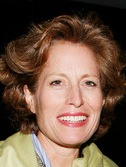
Devon Cross (aka Devon Gaffney Cross) is a neoconservative activist known for her “pro-Israel” advocacy and support for militarist U.S. policies in the Middle East. Cross, who served on the Richard Perle-chaired Defense Policy Board during the George W. Bush administration, frequently works with groups that aim to influence overseas debate and promote positive spin on U.S. foreign policy. These have included the controversial public relations firm Lincoln Group, the Case for Freedom, and the London-based Policy Forum for International Security Affairs, which received funding from the U.S. Department of Defense. Cross has also served on the board of the Center for Strategic and Budgetary Assessments. He sibling, Frank Gaffney, runs the Center for Security Policy, and her spouse, Jay Cross, is president of the New York Jets.[1]
Cross is also a member of the Board of Trustees of the Foreign Policy Research Institute (FPRI), a think-tank that often publishes works by neoconservatives such as James Woolsey, Eliot Cohen, and Max Boot.[2] Cross co-chairs FPRI’s “Manhattan Salons,” which it describes as “exclusive monthly salons with leading thinkers at the homes of friends in Manhattan.” Guests have included former George W. Bush official Michael Doran.[3]
In 2011, Cross re-emerged after an apparent hiatus from political activism as a member of the advisory board of a controversial pressure group called Secure America Now. Founded by pollsters John McLaughlin and Pat Caddell in an effort to “inject national security issues into the public dialogue,” the group’s advisers as of late 2014 included Cross, former Arkansas Governor Mike Huckabee, John Bolton, Lee Smith, among others.[4]
Secure America Now made headlines in July 2011 when it released a heavily criticized poll that claimed to show large numbers of Jewish Americans dropping their support for President Barack Obama over his handling of the U.S.-Israel relationship.[5] A writer for the Washington Post described the poll as “laughably bogus” because of its flawed sampling techniques and misleading questions.[6]
In September 2011, Secure America Now released another controversial poll, this one claiming to show that Americans view Iran as the top U.S. security threat. In a press release about the poll, Cross stated: “Though both the Bush and Obama administrations have been reticent to consider military options to address the threat posed by Iranian nukes, the American people are prepared to support such action should sanctions fail. Americans across the political spectrum are focused on security, even though these issues get far less attention from politicians than these polling numbers indicate they should.”[7]
Discussing the poll, Ben Smith of Politico wrote: “The group has been accused in the past of running leading questions, and elsewhere in the poll there do seem to be some of those. For instance: ‘Do you think that if the Palestinians are given their own state in the West Bank and Gaza they would live peacefully with Israel or continue their campaign of terror to destroy Israel?’”[8]
Secure American Now also garnered controversy during the 2012 presidential election for a pro-Mitt Romney advertisement it ran in Florida. The ad portrayed President Obama as trying to appease Iran juxtaposed while Israeli Prime Minister Benjamin Netanyahu appealed for a more aggressive U.S. foreign action.[9]
Remarked Scott McConnell of the American Conservative: “I can’t think of a previous instance where a foreign leader has intervened, or has been deployed (and both are happening) so blatantly in an American election.”[10]
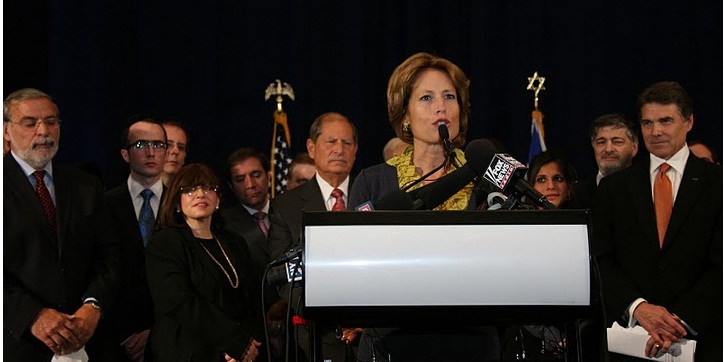
Cross has also appeared to support the presidential campaign of Texas Governor Rick Perry. She was part of a large contingent of Jewish community leaders in New York who participated in a September 2011 press conference during which Perry proclaimed, “As a Christian, I have a clear directive to support Israel.” Cross said at the press conference that she was “jumping for joy at the thought of a candidate who was going to speak so forcefully, and so articulately, what Americans feel—which is unswerving support for Israel.”[11]
Promoting the “War on Terror” Abroad
The Lincoln Group, a Washington, DC-based “strategic communication management service”[12] that Cross has advised, was awarded a Pentagon contract for work in Iraq in 2004, “after military officials concluded that the United States was failing to win over Muslim public opinion.”[13] In late 2005, the “multimillion-dollar covert campaign to plant paid propaganda in the Iraqi news media and pay friendly Iraqi journalists monthly stipends” was revealed. According to the New York Times, Lincoln Group’s role was “to translate the articles into Arabic and submit them to Iraqi newspapers or advertising agencies without revealing the Pentagon’s role.” Many were outraged that the United States would subsidize “journalism” practices anathema to the American tradition of an independent press, but American Enterprise Institute scholar Michael Rubin justified the planting of stories, saying, “Informational operations are a part of any military campaign. Especially in an atmosphere where terrorists and insurgents—replete with oil boom cash—do the same. We need an even playing field, but cannot fight with both hands tied behind our backs.”[14] (When commenting to the Times,Rubin failed to disclose that he himself had reviewed propaganda articles for Lincoln.)
Cross’s International Security Affairs Policy Forum has also sought to manipulate overseas opinion about U.S. policies. According to the group, it was formed in 2002 because “American foreign policy and its goals and motivations in undertaking the War on Terror were increasingly subject to caricature and worse in the European media, and to outright misrepresentation in the broader public debate.”
In mid-2007, Policy Forum received a small ($79,416), no-bid contract to undertake media outreach on behalf of the Pentagon; the check was made out to Cross.[15] The contract was “for technical support and consulting services for public liaison and media outreach services in support of the diplomacy mission including addressing and informing European and Middle Eastern audiences on the challenges facing U.S. National Security policies. The awardee will engage London based European and Arab media in candid discussions on a wide variety of national security issues of interest to senior Department of Defense (DoD) officials.”[16]
The contract was awarded by the Undersecretary of Defense for Policy Eric Edelman, who advised Vice President Dick Cheney in the run-up to the Iraq War. Cross’s exact position with the Policy Forum is not clear, and the organization’s website, which appears to have been moribund since 2009, provides no details about its principals.[17] Policy Forum is pro-war on terror, though it does not make explicit the sources of many of its right-leaning opinions. In the “Opinions & Analysis” section on its website, Policy Forum (which also refers to itself as “Policy Forum for International Affairs,” dropping the “security”) posts unattributed excerpts from opinion pieces written by writers at other organizations. For example, Policy Forum posted a piece it entitled “There’s no Arguing with Iran,” which excerpted (and did not give credit to) part of an article by Kathryn Jean Lopez called “Iranian Hostage Crisis,” written for the National Review Online. Other unattributed excerpts posted by Policy Forum appear to originate from sources such as NewsMax.com, the Wall Street Journal opinion page, and Dennis Prager at Townhall.com.
Cross served on the Pentagon’s Defense Policy Board, a government-appointed advisory panel that provides supposedly objective advice to the Defense Department. Cross’s term on the board lasted from August 2001 to January 2008. Others members of the board who coincided with Cross included Newt Gingrich, Eliot Cohen, Richard Allen, Martin Anderson, Henry Kissinger, Ruth Wedgwood, Christopher Williams, and Pete Wilson. Because the Policy Forum contract was awarded while Cross served on the Defense Policy Board, some observers questioned whether it could be considered a conflict of interest.[18]
A Neoconservative International?
Shortly before the Pentagon contracted Policy Forum to do media work, Cross participated[19] in the June 2007 Democracy and Security Conference in Prague, an event whose primary agenda seemed to be to promote the neoconservatives’ Mideast agenda among political groups overseas. Sponsored by the Prague Security Studies Institute, the Jerusalem-based Adelson Institute for Strategic Studies (funded by Sheldon Adelson), and Spain’s Foundation for Social Analysis and Studies, the conference’s featured speaker was President George W. Bush, who compared the “war on terror” to the Cold War. He purported, “The most powerful weapon in the struggle against extremism is not bullets or bombs—it is the universal appeal of freedom. Freedom is the design of our Maker, and the longing of every soul.”[20]
Conference participants included: Sheldon Adelson of the Sands Corporation and Freedom’s Watch; Peter Ackerman of Freedom House; former Spanish Prime Minister José Aznar; Anne Bayefsky of the Hudson Institute; Jeffrey Gedmin of Radio Free Europe; Reuel Marc Gerecht, Joshua Muravchik, Michael Rubin, Michael Novak, and Richard Perle of the American Enterprise Institute (AEI); Farid Ghadry of the U.S.-based Reform Party of Syria; former Czech President Vaclav Havel; Bruce Jackson of the Project on Transitional Democracies; Josef Joffe of Germany’s Die Zeit; Garry Kasparov, the famous chess player and member of the Russian opposition party United Civil Front; U.S. Sen. Joseph Lieberman (I-CT); Tod Lindberg of the Hoover Institution; Herb London of the Hudson Institute; Clifford May and Walid Phares of the Foundation for Defense of Democracies; Harold Rhode, a Pentagon employee close to many core neoconservatives like David Wurmser; and Natan Sharansky, the former Soviet dissident and chairman of the Adelson Institute for Strategic Studies.[21]
Cross attended the conference as a representative of an organization called Case for Freedom; the other Case for Freedom member at the conference was David Goder, who has written for One Jerusalem,[22] a staunchly Likudnik group chaired by Sharansky. Like Policy Forum, Case for Freedom maintains an extremely low profile, declining to post any useful information on its website, which, as of 2011, provided few details about the organization’s personnel or funding sources. According to a summary of its guiding principles and mission: “Those who cherish the values of classical liberalism and the cause of freedom must take this often times systematic assault on freedom seriously. We must express solidarity with these courageous freedom-fighters and help gain international recognition and support for their struggles. CaseForFreedom.org mobilizes support for freedom advocates everywhere, by providing them with an international platform to report their experiences and for people around the globe to learn about and support their efforts.”[23]
In an investigative report, Jim Lobe of the Inter Press Service reported on connections between Case for Freedom (CFF), Policy Forum, and One Jerusalem, which apparently share the same ISP address. Lobe reported, “Experts I’ve spoken to insist that all of these sites are almost certainly managed, hosted and owned by the same organization or individual which, we believe, must be onejerusalem. (It was the first to register the domain, back in 2000.) One Jerusalem was the only one of the three sites that listed an actual phone number on its registration, and, when we called it, the receptionist answered, ‘Allen Roth’s office,’ presumably the same Allen Roth who last year was listed as One Jerusalem’s president nine months ago. This would add to the impression that we first gained last June: that the CFF and Cross’ [Policy Forum] work very closely with and may well be fronts for One Jerusalem.”[24]
Cross has supported the work of a number of policy and advocacy organizations. She is a former director of the Project for the New American Century (PNAC) and participated in the PNAC study group that produced the 2000 publication Rebuilding America’s Defenses, which was meant to serve as a blueprint of security priorities for the incoming administration.[25] Cross has also served as an adviser to her brother Frank’s hawkish policy outfit the Center for Security Policy, and she is a former board member, along with former CIA director James Woolsey, of the Center for Strategic and Budgetary Assessments.[26]
Philanthropy
Cross has served as an officer at a number of right-wing philanthropies, including the Smith Richardson Foundation.[27] Cross has also headed the Donors Forum on International Affairs; the Donors Forum’s 2005 Form 990 tax form listed Cross as the only employee. It provided and received no grants that year, and it listed “public policy promotion” as its reason for tax-exempt status.[28] The forum was funded by the John Olin Foundation and may have ceased functioning after Olin closed up shop in 2005.[29]
In an article on philanthropy’s role in shaping policy co-written by Devon Gaffney Cross and Frank Gaffney, the brother-sister team criticized various liberal-minded foundations such as Rockefeller and MacArthur for their “ironic vision of international orderliness,” which they said “must be contrasted with the world as it actually is.” The article, which appeared in a journal published by the rightwing Philanthropy Roundtable, said: “And then there is private philanthropy, among the least recognized forces in the shaping of United States security policy. Specifically, the leading funders in international security programs at U.S. think-tanks, academic institutions, and grassroots groups are generously underwriting an ambitious and highly politicized agenda. Today, as in the past, arms control and other international legal endeavors are the organizing principle behind much of what the Rockefeller Brothers’ Fund calls the ‘One World Program.’ The operative premise has been described by syndicated columnist Charles Krauthammer as ‘a world imagined [where] laws, treaties and binding international agreements can domesticate the international arena.’”[30]