
Gary Becker (1930-2014)
last updated: May 5, 2014
Please note: The Militarist Monitor neither represents nor endorses any of the individuals or groups profiled on this site.
Affiliations
- Hoover Institution: Senior Fellow
- University of Chicago: Lecturer in Law, University of Chicago Law School; Ford Foundation Visiting Professor of Economics, 1968-1969; Assistant Professor, 1954-1957; Recipient of Professional Achievement Award
- Cato Institute: Member of Project Board, Project on Social Security Choice
- American Economic Association: Distinguished Fellow, 1988; President, 1987; Recipient of John Bates Clark Medal
- Manhattan Institute: Former Member, Board of Trustees
- Mont Pelérin Society: President, 1990-1992
- Dole Presidential Campaign: Economic Policy Adviser, 1996
- American Enterprise Institute: Council of Academic Advisers, 1989
- Columbia University: Part-time Professor, 1957-1968
- National Bureau of Economic Research: Researcher, 1957-1968
Government
- Defense Policy Board: Former Member
Education
- Princeton University: B.A., 1951
- University of Chicago: M.A., 1953; Ph.D., 1955
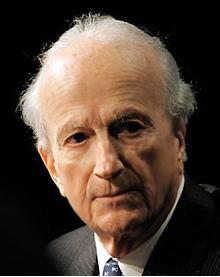
Gary Becker was a conservative writer and economist based at the University of Chicago. He was a longtime senior fellow at Stanford University's Hoover Institution, a past academic adviser to the American Enterprise Institute, and a trustee of the Manhattan Institute.[1] He passed away in May 2014.[2]
Though primarily focused on domestic policy, Becker emerged during the George W. Bush years as a supporter of the administration's hawkish foreign policy agenda. Despite having little experience in foreign or military policy, he was tapped to serve on the Defense Policy Board in the Donald Rumsfeld Pentagon and wrote a number of articles supporting the Iraq War and the "war on terror."
In a December 2004 entry on a blog he coauthored with the conservative judge Richard Posner, Becker argued that deterrence was not an adequate tool against terrorism. Claiming that "it is becoming increasingly possible for terrorist organizations and governments to unleash biological, chemical, or nuclear weapons that will cause massive destruction," he argued, "the only really effective approach is to stop them before they engage in their attacks. This is accomplished by tracking them down and imprisoning or killing them based on evidence that they intend to engage in suicidal attacks. Those planning such acts can also be punished on the basis of intent. The same argument applies to dictators who are willing to use weapons of mass destruction to attack their enemies when they do not care if many of their populations are killed and maimed by retaliation from other countries."[3]
Following the war in Iraq, however, Becker apparently changed his mind about the value of overseas military intervention. "I originally supported the 2nd Iraqi invasion as necessary to bring down a cruel and dangerous dictator," he wrote in 2013 as neoconservatives were pressuring the Obama administration to intervene in Syria's civil war. But "one should have appreciated that the longer-term outcomes of such a disorganized and destructive activity as war are disturbingly uncertain.My conclusion is that except under extreme circumstances, it is not worth intervening in another country’s squabbles, even when the government is undemocratic and cruel. The extreme circumstances would include that American interests are very seriously threatened by the outcome, or that killing of non-fighters is on such a large scale that humanitarian reasons justify intervention to put an end to these killings. Neither of these criteria applies to the Syrian civil war."[4]
An acolyte of the conservative economist Milton Friedman, Becker held standard neoliberal views on taxation, regulation, and government spending. Describing his core economic views during a 1996 PBS interview, Becker said: "I think the main issue is government spending, and I would be willing to take a deficit if we can reduce government spending. … I much prefer people to spend their own money their way than have the government spend the money for them the way they think it should be spent."[5]
But Becker was best known for applying economic theory to a host of traditionally sociological concerns, including crime, racial discrimination, and marriage and divorce, among other issues. In defiance of many cultural conservatives, Becker made economic arguments against marijuana prohibition,[6] prison sentences for nonviolent offenders,[7] and the Cuban embargo.[8] He also wrote in favor of a "revenue-neutral" tax on carbon emissions (which he called "a major pollutant")[9] and a legal market for transplant organs.[10] "Professor Becker’s inquiries cast fresh light on social phenomena previously regarded as having little or no economic dimension," noted his New York Times obituary.[11]
Becker received the 1992 Nobel Prize for his multidisciplinary work in economics. According to the Nobel press release: "Gary Becker's research consists primarily of having extended the domain of economic theory to aspects of human behavior which had previously been dealt with—if at all—by other social science disciplines such as sociology, demography, and criminology. In so doing, he has stimulated economists to tackle new problems. … Becker's applications of his basic model to different types of human behavior can be accounted for by distinguishing among four research areas: (i) investments in human capital; (ii) behavior of the family (or household), including distribution of work and allocation of time in the family; (iii) crime and punishment; and (iv) discrimination on the markets for labor and goods."[12]
Becker and numerous other well-known economists were criticized in French economist Thomas Piketty’s acclaimed 2014 book on capitalism, Capital in the Twenty-First Century. Piketty argued that Becker and like-minded neoliberals had relied on presumption rather than data when building their theories. "One of Piketty’s favorite piñatas is Nobel laureate Gary Becker," noted Slate's David Auerbach in about a review of Piketty's book. "Piketty goes after Becker’s unjustifiably optimistic theory of 'human capital,' in which increased education and talent in people supposedly makes up for unequal distribution of nonhuman capital, yielding a capitalist utopia meritocracy. Becker’s problem, as Piketty hints, is that the theory is simply not based on evidence; it’s just hot air," Auerbach explained. "Mathematical models like Becker’s, Piketty remarks, 'are frequently no more than an excuse for occupying the terrain and masking the vacuity of the content.'"[13]